Systematic Review Examining the Association Between Angiotensin Converting Enzyme Inhibitor or Angiotensin Receptor Blocker Prescription and Abdominal Aortic Aneurysm Growth and Events
Systematic review and meta-analysisMixed results
Does angiotensin converting enzyme inhibitor or angiotensin receptor blocker prescription affect abdominal aortic aneurysm growth and events?
Who
58022
Patients with abdominal aortic aneurysms
Compared
Angiotensin converting enzyme inhibitor prescription: standard mean difference 0.01 mm/year
Angiotensin receptor blocker prescription
Main outcome
Abdominal aortic aneurysm growth, rupture, repair, and related events
Result: OR 0.87 (95% CI 0.81 - 0.93) for rupture
Bottom line: Angiotensin converting enzyme inhibitor prescription was associated with reduced abdominal aortic aneurysm rupture and related events with very low certainty.
Limitation: All of the findings had a very low certainty of evidence based on the GRADE analysis.
Eur J Vasc Endovasc Surg · 2024-03-25Download image
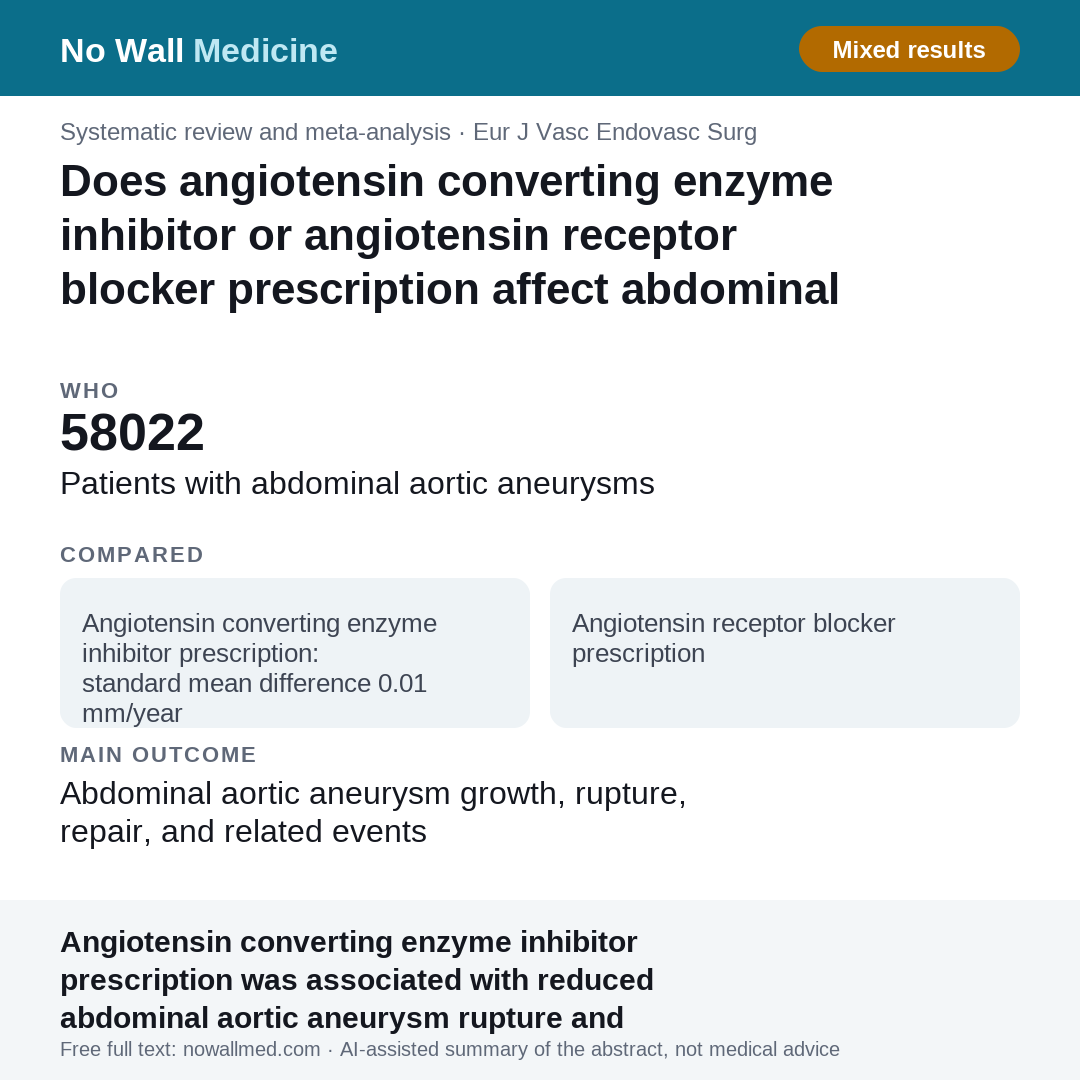
Clinical question: Does angiotensin converting enzyme inhibitor or angiotensin receptor blocker prescription affect abdominal aortic aneurysm growth and events?
Abstract
Objective
Whether angiotensin II blockade is an effective medical treatment for abdominal aortic aneurysms (AAAs) has not been established. This systematic review and meta-analysis aimed to determine the association between angiotensin converting enzyme inhibitor (ACEi) or angiotensin receptor blocker (ARB) prescription and AAA growth and events. Data sources
MEDLINE, Embase, Scopus, Web of Science, and the Cochrane Library databases were searched from their inception to 4 January 2024, with no language restrictions. Review methods
The five databases were searched for randomised controlled trials (RCTs) and observational studies reporting the association between ACEi or ARB prescription and AAA growth, repair, or rupture. The primary outcome was AAA growth, with secondary outcomes of AAA rupture, AAA repair, and AAA related events (rupture and repair combined). Risk of bias was assessed using the Risk of Bias 2 tool for RCTs and with a modified Newcastle-Ottawa scale for observational studies. Certainty of evidence was assessed using the Grading of Recommendations, Assessment, Development, and Evaluation (GRADE). Random effects models were used for meta-analyses. Results
Eleven studies (two RCTs, eight observational studies, and one meta-analysis of individual patient data from seven populations) involving 58 022 patients were included. ACEi prescription was not associated with a statistically significant reduction in AAA growth (standard mean difference 0.01 mm/year, 95% confidence interval [CI] -0.26 - 0.28; p = .93; I2 = 98%) or AAA repair (odds ratio [OR] 0.73, 95% CI 0.50 - 1.09; p = .65; I2 = 61%), but was associated with a statistically significantly lower risk of AAA rupture (OR 0.87, 95% CI 0.81 - 0.93; p < .001; I2 = 26%) and AAA related events (OR 0.82, 95% CI 0.72 - 0.95; p = .006; I2 = 80%). ARB prescription was not associated with significantly reduced AAA growth or a lower risk of AAA related events. The two RCTs had a low risk of bias, with one observational study having low, seven moderate, and one high risk of bias. All of the findings had a very low certainty of evidence based on the GRADE analysis. Conclusion
There was no association between ACEi or ARB prescription and AAA growth, but ACEi prescription was associated with a reduced risk of AAA rupture and AAA related events with very low certainty of evidence.
Subject terms
Cite this article
Tian K, Thanigaimani S, Gibson K, Golledge J. Systematic Review Examining the Association Between Angiotensin Converting Enzyme Inhibitor or Angiotensin Receptor Blocker Prescription and Abdominal Aortic Aneurysm Growth and Events. Eur J Vasc Endovasc Surg. 2024. doi:10.1016/j.ejvs.2024.03.034
Spotted a mistake? Suggest a correction
Top studies every Monday
The week’s key trials and guidelines in your specialties, plus any topics you follow. By email, free.
Get the weekly digest