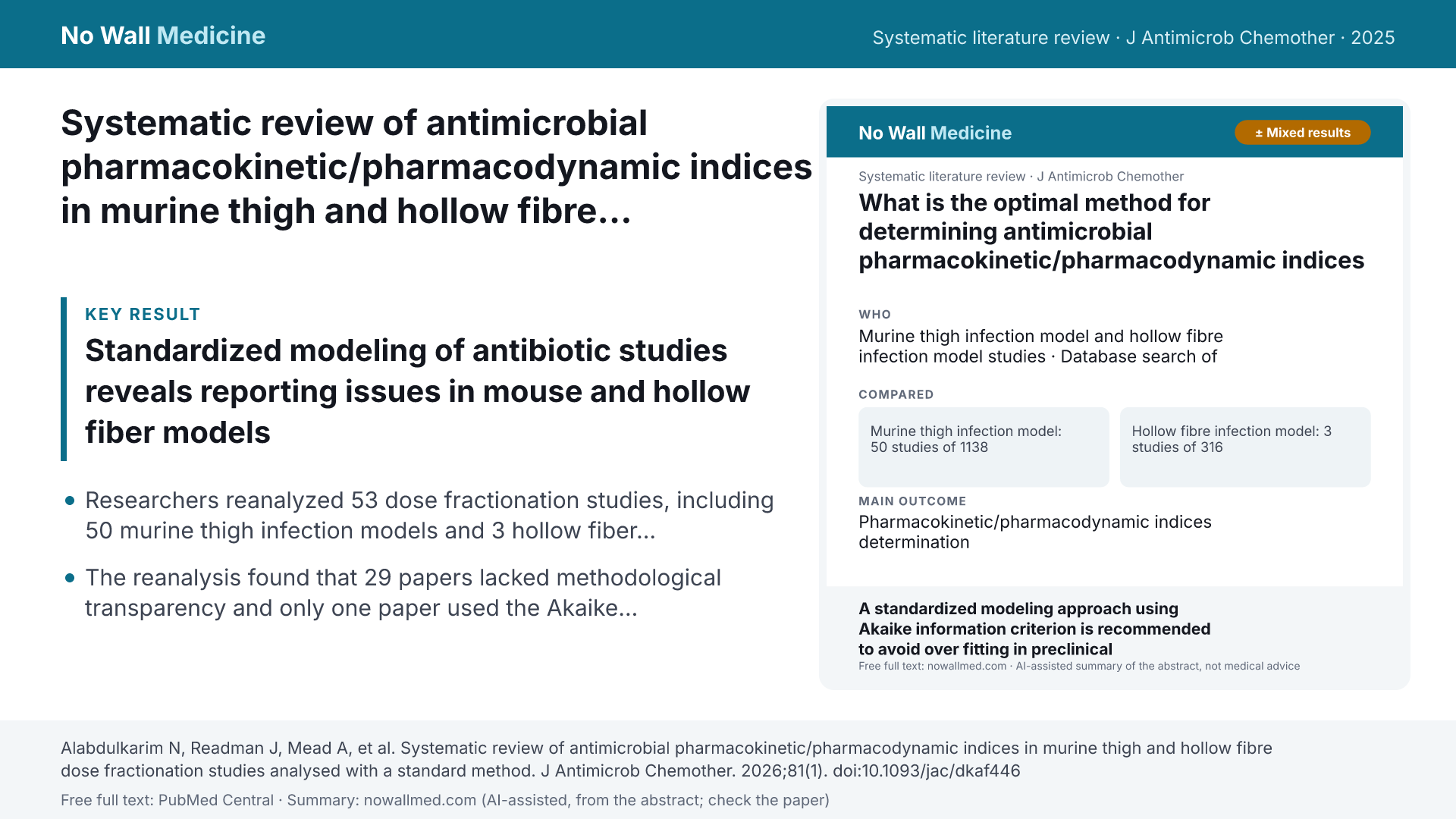
Standardized modeling of antibiotic studies reveals reporting issues in mouse and hollow fiber models
Systematic review of antimicrobial pharmacokinetic/pharmacodynamic indices in murine thigh and hollow fibre dose fractionation studies analysed with a standard method
Systematic literature reviewMixed results
What is the optimal method for determining antimicrobial pharmacokinetic/pharmacodynamic indices in preclinical models?
Who
Murine thigh infection model and hollow fibre infection model studies · Database search of PubMed, MEDLINE, BIOSIS, SCOPUS and EMBASE
Compared
Murine thigh infection model: 50 studies of 1138
Hollow fibre infection model: 3 studies of 316
Main outcome
Pharmacokinetic/pharmacodynamic indices determination
Bottom line: A standardized modeling approach using Akaike information criterion is recommended to avoid over fitting in preclinical studies.
Limitation: Too few hollow fibre infection model studies were found to allow comparison with murine thigh infection models.
J Antimicrob Chemother · 2025-12-17 · Save PNG

Clinical question: What is the optimal method for determining antimicrobial pharmacokinetic/pharmacodynamic indices in preclinical models?
Why it matters: Researchers lack a standardized method for determining the pharmacokinetic/pharmacodynamic indices used to translate animal antibiotic studies to human dosages.
Key points
- Researchers reanalyzed 53 dose fractionation studies, including 50 murine thigh infection models and 3 hollow fiber infection models, using a standardized mathematical approach.
- The reanalysis found that 29 papers lacked methodological transparency and only one paper used the Akaike information criterion for model selection.
- Remodeling the data showed disagreement regarding the optimal pharmacokinetic/pharmacodynamic indices in six of the analyzed studies.
Headline and key points written with AI from the paper’s abstract, with every number checked against it. Read the paper before relying on them.
Was this summary helpful?
Subject terms
Headline, design, result, key points, caveat and citation as plain text.
Cite this article
Alabdulkarim N, Readman J, Mead A, et al. Systematic review of antimicrobial pharmacokinetic/pharmacodynamic indices in murine thigh and hollow fibre dose fractionation studies analysed with a standard method. J Antimicrob Chemother. 2026;81(1). doi:10.1093/jac/dkaf446
Spotted a mistake? Suggest a correction