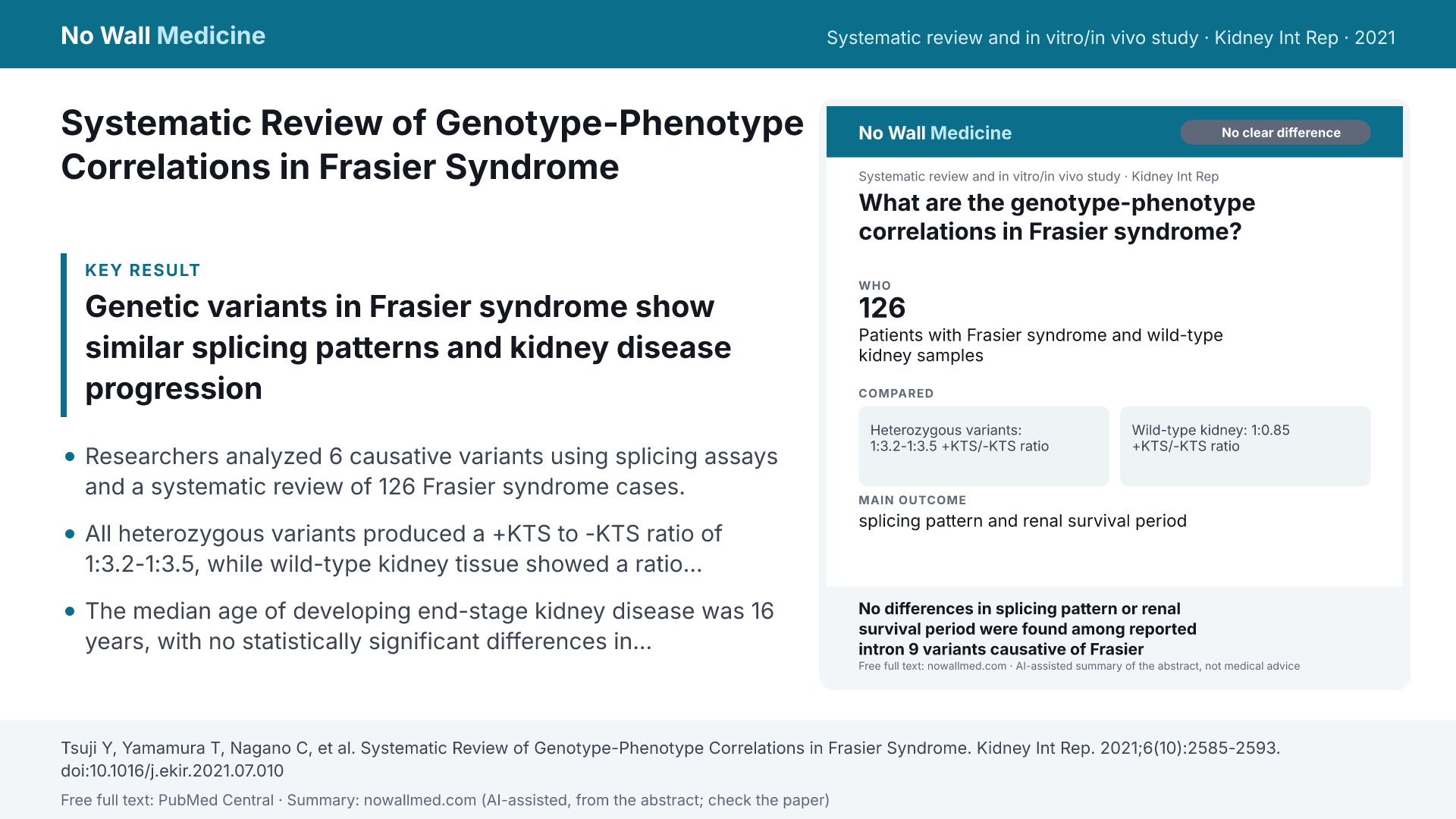
Genetic variants in Frasier syndrome show similar splicing patterns and kidney disease progression
Systematic Review of Genotype-Phenotype Correlations in Frasier Syndrome
Systematic review and in vitro/in vivo studyNo clear difference
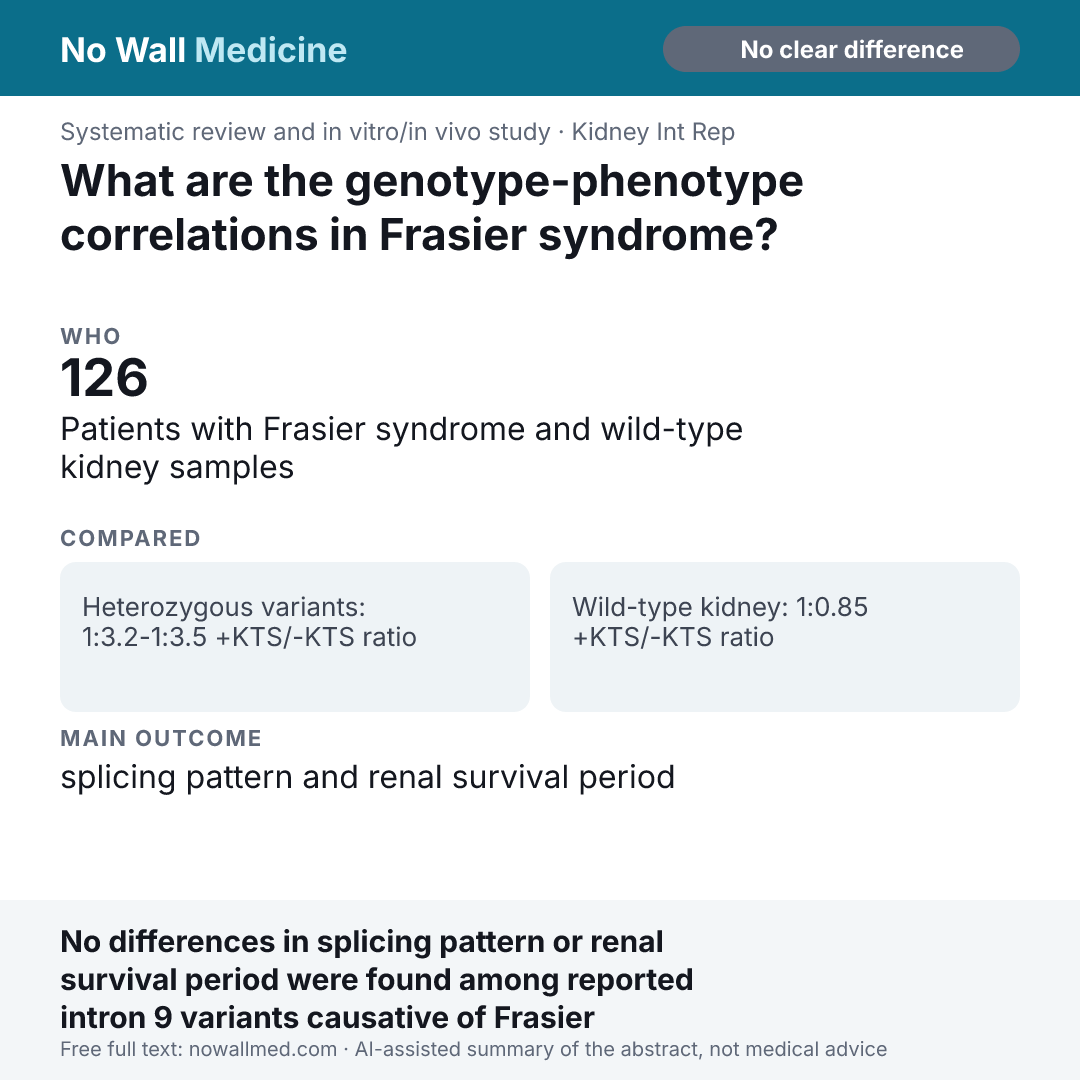
What are the genotype-phenotype correlations in Frasier syndrome?
Who
126
Patients with Frasier syndrome and wild-type kidney samples
Compared
Heterozygous variants: 1:3.2-1:3.5 +KTS/-KTS ratio
Wild-type kidney: 1:0.85 +KTS/-KTS ratio
Main outcome
splicing pattern and renal survival period
Bottom line: No differences in splicing pattern or renal survival period were found among reported intron 9 variants causative of Frasier syndrome.
Kidney Int Rep · 2021-07-16 · Save PNG
Clinical question: What are the genotype-phenotype correlations in Frasier syndrome?
Key points
- Researchers analyzed 6 causative variants using splicing assays and a systematic review of 126 Frasier syndrome cases.
- All heterozygous variants produced a +KTS to -KTS ratio of 1:3.2-1:3.5, while wild-type kidney tissue showed a ratio of 1:0.85.
- The median age of developing end-stage kidney disease was 16 years, with no statistically significant differences in renal survival based on genotype or sex chromosome karyotype.
Headline and key points written with AI from the paper’s abstract, with every number checked against it. Read the paper before relying on them.
Was this summary helpful?
Headline, design, result, key points, caveat and citation as plain text.
Cite this article
Tsuji Y, Yamamura T, Nagano C, et al. Systematic Review of Genotype-Phenotype Correlations in Frasier Syndrome. Kidney Int Rep. 2021;6(10):2585-2593. doi:10.1016/j.ekir.2021.07.010
Spotted a mistake? Suggest a correction