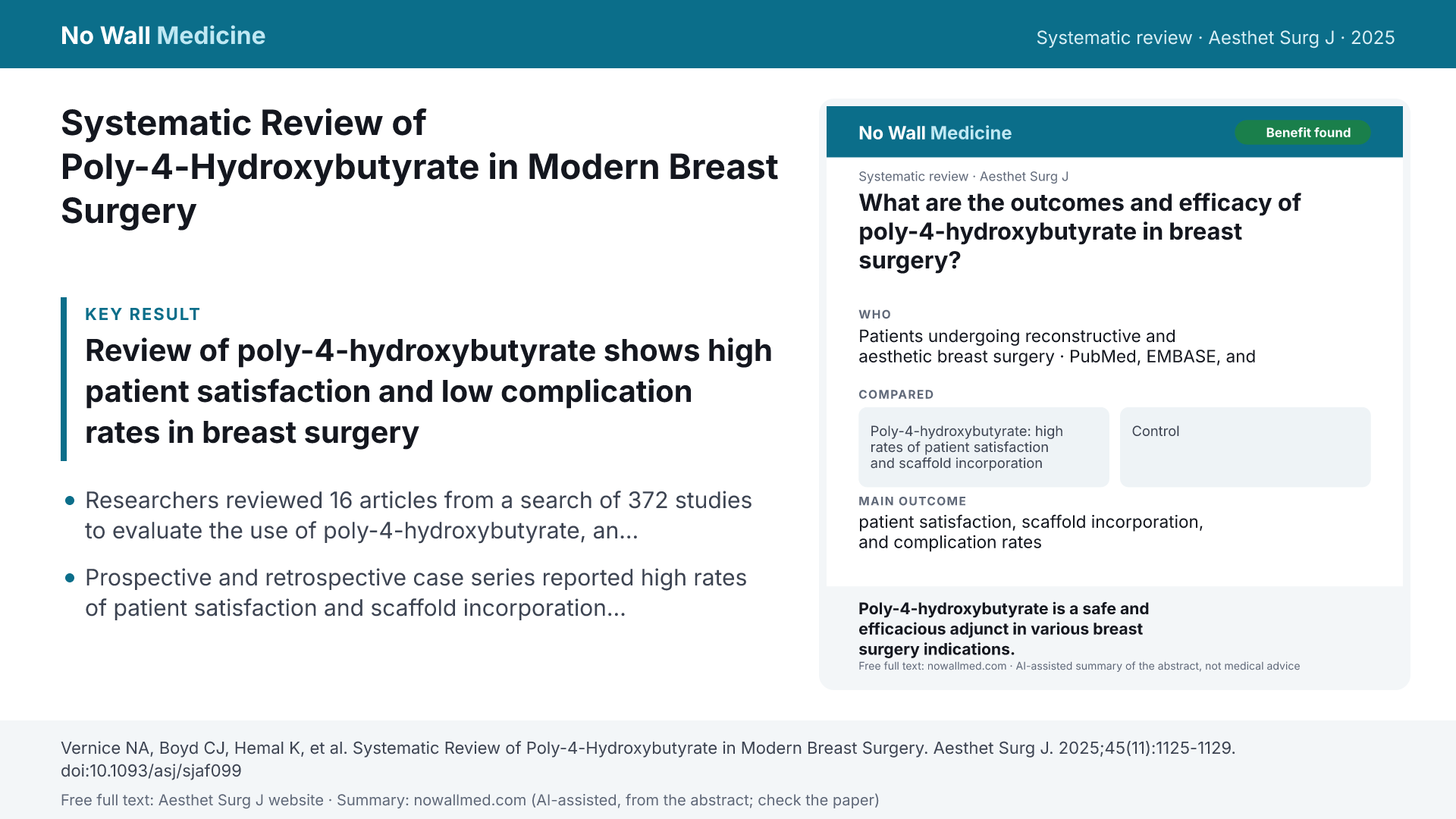
Review of poly-4-hydroxybutyrate shows high patient satisfaction and low complication rates in breast surgery
Systematic Review of Poly-4-Hydroxybutyrate in Modern Breast Surgery
Systematic reviewBenefit found
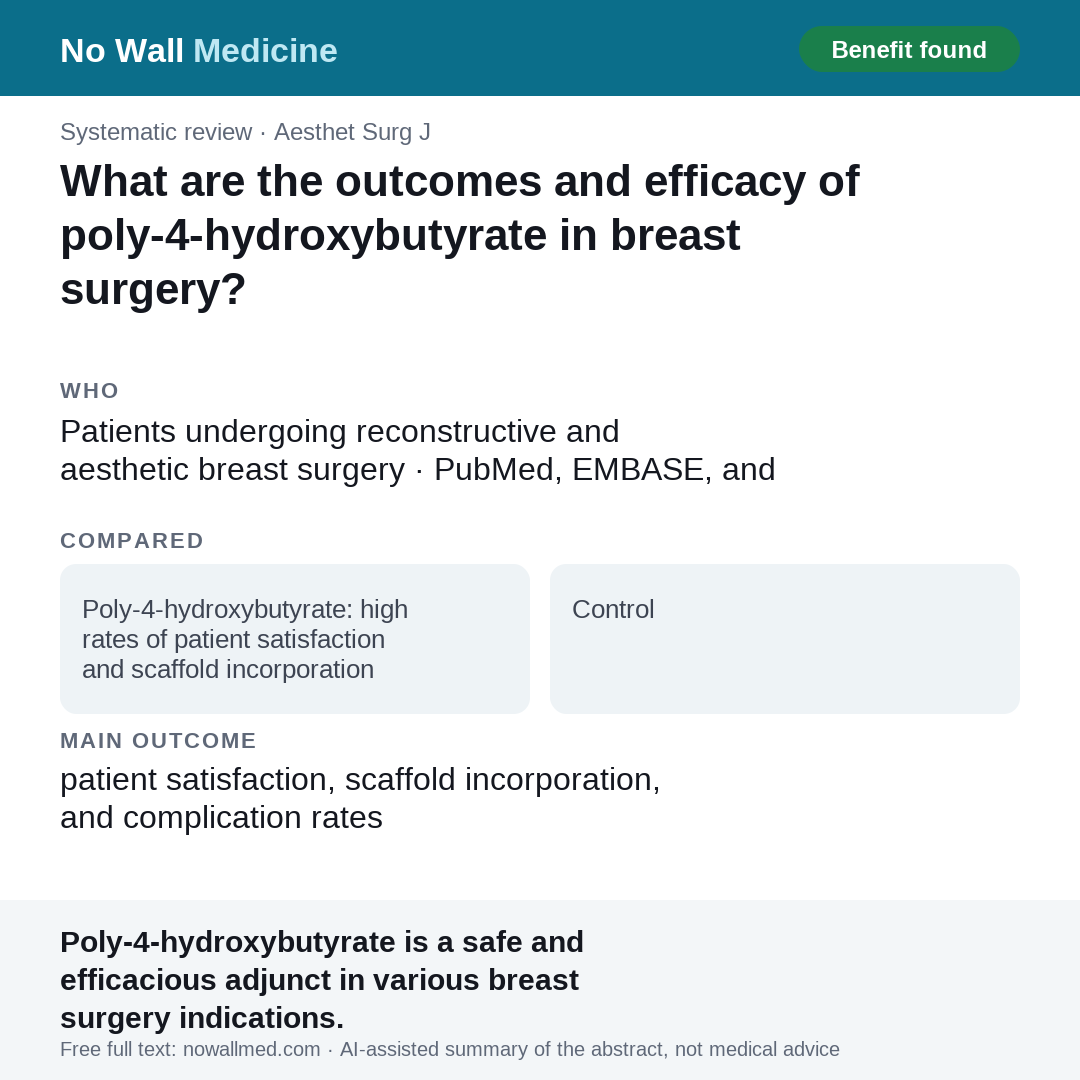
What are the outcomes and efficacy of poly-4-hydroxybutyrate in breast surgery?
Who
Patients undergoing reconstructive and aesthetic breast surgery · PubMed, EMBASE, and Cochrane databases
Compared
Poly-4-hydroxybutyrate: high rates of patient satisfaction and scaffold incorporation
Control
Main outcome
patient satisfaction, scaffold incorporation, and complication rates
Bottom line: Poly-4-hydroxybutyrate is a safe and efficacious adjunct in various breast surgery indications.
Aesthet Surg J · 2025-07-01Download image
Clinical question: What are the outcomes and efficacy of poly-4-hydroxybutyrate in breast surgery?
Why it matters: The use of poly-4-hydroxybutyrate is increasing in breast surgery, but a synthesis of available data on its outcomes and efficacy was needed.
Key points
- Researchers reviewed 16 articles from a search of 372 studies to evaluate the use of poly-4-hydroxybutyrate, an absorbable polymer, in breast reconstruction and aesthetic surgery.
- Prospective and retrospective case series reported high rates of patient satisfaction and scaffold incorporation alongside low rates of complications like implant malposition or recurrent ptosis.
- One retrospective cohort study was associated with significantly higher rates of capsular contracture, which is the hardening of the tissue around an implant, when using a poly-4-hydroxybutyrate sling.
Limitation the authors note: Large-scale, randomized trials between poly-4-hydroxybutyrate and other types of soft tissue support are needed.
Headline and key points written with AI from the paper’s abstract, with every number checked against it. Read the paper before relying on them.
Was this summary helpful?
Subject terms
Cite this article
Vernice NA, Boyd CJ, Hemal K, et al. Systematic Review of Poly-4-Hydroxybutyrate in Modern Breast Surgery. Aesthet Surg J. 2025. doi:10.1093/asj/sjaf099
Spotted a mistake? Suggest a correction