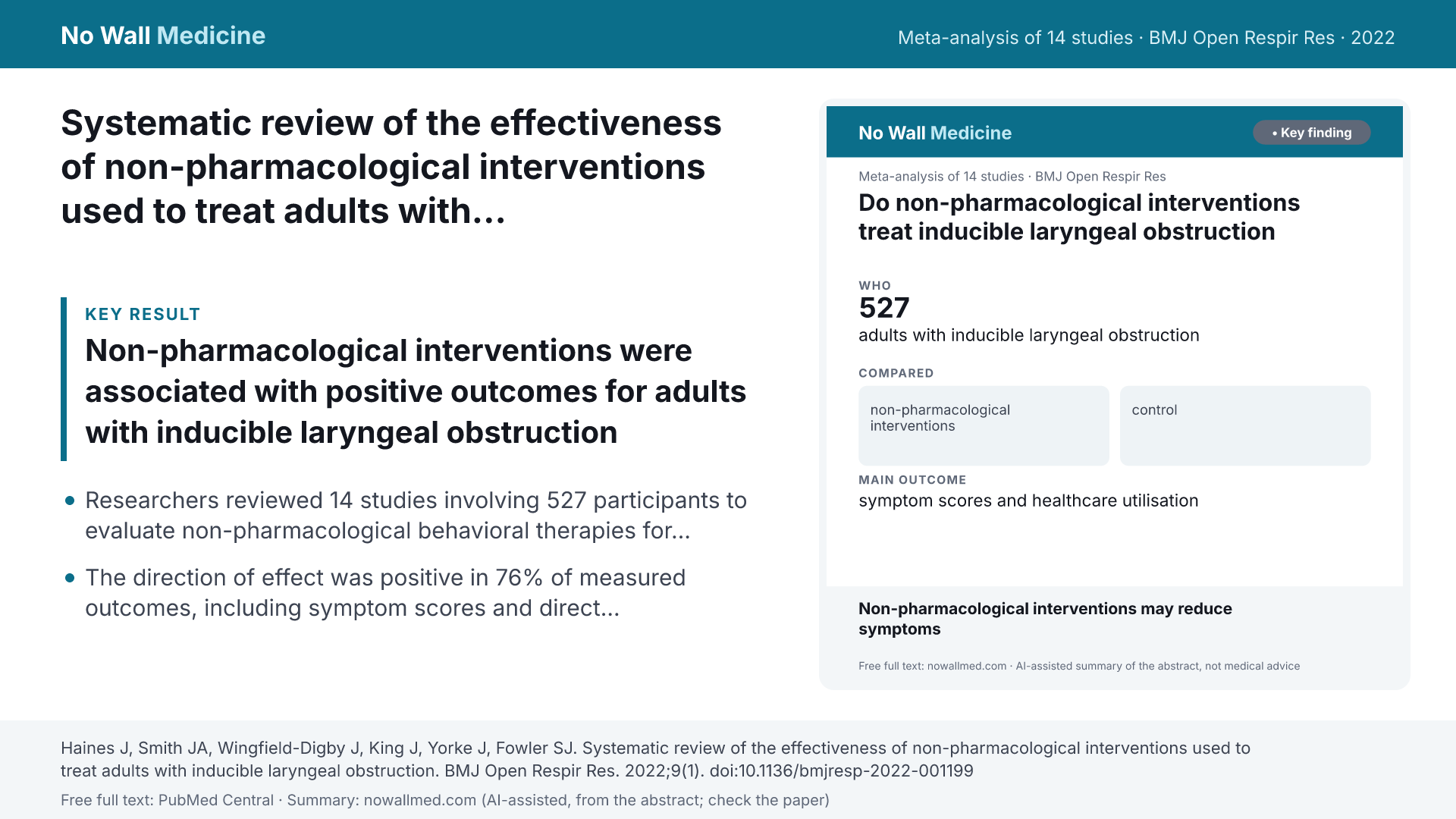
Non-pharmacological interventions were associated with positive outcomes for adults with inducible laryngeal obstruction
Systematic review of the effectiveness of non-pharmacological interventions used to treat adults with inducible laryngeal obstruction
Meta-analysis of 14 studiesKey finding
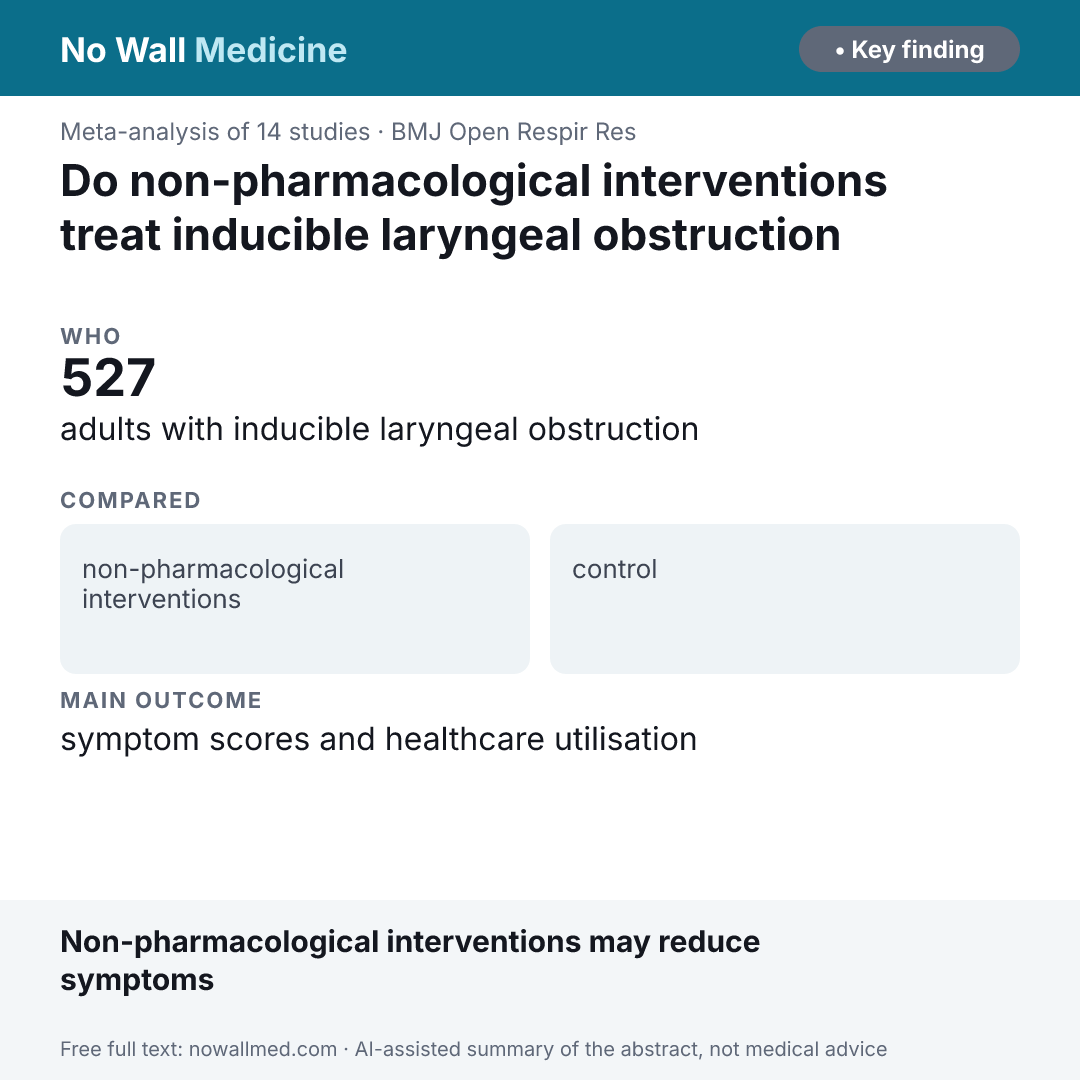
Do non-pharmacological interventions treat inducible laryngeal obstruction
Who
527
adults with inducible laryngeal obstruction
Compared
non-pharmacological interventions
control
Main outcome
symptom scores and healthcare utilisation
Bottom line: Non-pharmacological interventions may reduce symptoms
Limitation: low-level evidence and high risk of bias
BMJ Open Respir Res · 2022-06-15 · Save PNG
Why it matters: The effectiveness of non-pharmacological behavioral therapy for treating adults with inducible laryngeal obstruction is largely unknown.
Key points
- Researchers reviewed 14 studies involving 527 participants to evaluate non-pharmacological behavioral therapies for inducible laryngeal obstruction, which is transient closure of the voice box during breathing.
- The direction of effect was positive in 76% of measured outcomes, including symptom scores and direct laryngeal imaging, and healthcare utilization was associated with an overall reduction of 59.5%.
- All included studies were low-level evidence, such as observational studies and case reports, and none contained control groups for comparison.
Limitation the authors note: All included studies were low-level evidence with a high risk of bias and lacked control arms for comparison.
Headline and key points written with AI from the paper’s abstract, with every number checked against it. Read the paper before relying on them.
Was this summary helpful?
Abstract
Introduction
Inducible laryngeal obstruction (ILO) describes transient laryngeal closure during respiration and can cause significant morbidity. Non-pharmacological behavioural therapy is the commonly cited treatment but efficacy is largely unknown. Aim
To synthesise the current evidence base on the effectiveness of non-pharmacological interventions used to treat adults with ILO. Methods
Electronic databases (Medline/Embase/CINAHL/PsycINFO/AMED/CENTRAL) were systematically searched, informed by a population, intervention, comparison, outcome framework. Two reviewers independently screened a representative sample, with lead-author completion due to excellent inter-rater reliability. Data was extracted using a predefined piloted form. Methodological quality was appraised (blindly by two reviewers) using the Joanna Briggs Institute Critical Appraisal Tools. A narrative synthesis was performed due to heterogeneity of studies (PROSPERO registration number: CRD42020213187). Results
Initial searching identified 3359 records. Full-text screening occurred in 92 records and 14 studies, comprising 527 participants, were deemed eligible. All studies were low-level evidence (observational by design, with four case reports), with a high risk of bias; none contained control arms for comparison. Intervention description was inconsistently and poorly described but direction of effect was positive in 76% of outcomes measured. The majority of studies showed a reduction in symptom scores and improved direct laryngeal imaging post intervention; there was an overall reduction, 59.5%, in healthcare utilisation. Discussion
The literature is in an embryonic state and lacks robust data to truly inform on the effectiveness of non-pharmacological interventions used to treat adults with ILO. However, positive signals in the synthesis performed support non-pharmacological treatment approaches and further development is warranted.
Abstract reproduced under the article’s CC BY NC licence.
Subject terms
Headline, design, result, key points, caveat and citation as plain text.
Cite this article
Haines J, Smith JA, Wingfield-Digby J, King J, Yorke J, Fowler SJ. Systematic review of the effectiveness of non-pharmacological interventions used to treat adults with inducible laryngeal obstruction. BMJ Open Respir Res. 2022;9(1). doi:10.1136/bmjresp-2022-001199
Spotted a mistake? Suggest a correction