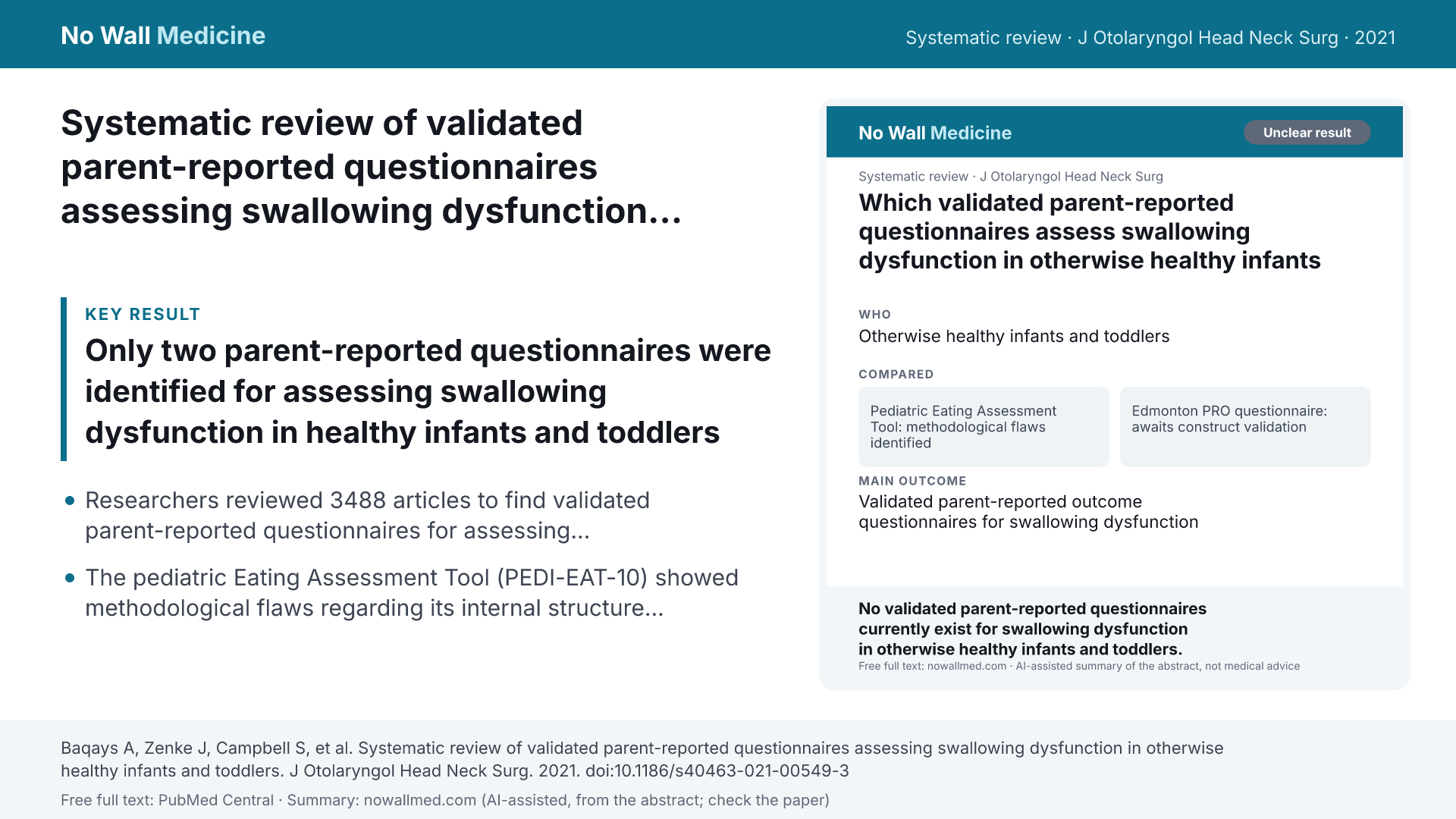
Only two parent-reported questionnaires were identified for assessing swallowing dysfunction in healthy infants and toddlers
Systematic review of validated parent-reported questionnaires assessing swallowing dysfunction in otherwise healthy infants and toddlers
Systematic reviewUnclear result
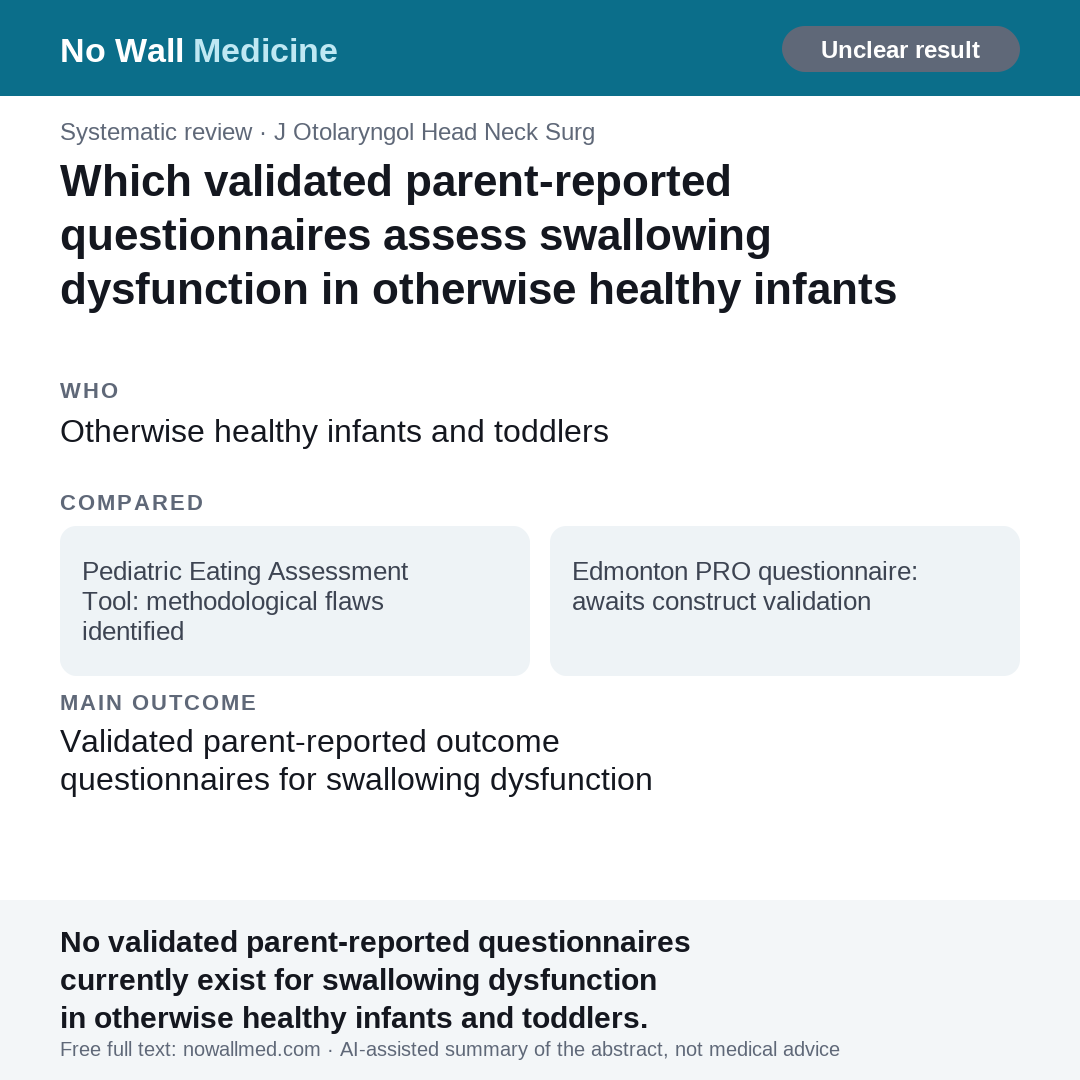
Which validated parent-reported questionnaires assess swallowing dysfunction in otherwise healthy infants and toddlers?
Who
Otherwise healthy infants and toddlers
Compared
Pediatric Eating Assessment Tool: methodological flaws identified
Edmonton PRO questionnaire: awaits construct validation
Main outcome
Validated parent-reported outcome questionnaires for swallowing dysfunction
Bottom line: No validated parent-reported questionnaires currently exist for swallowing dysfunction in otherwise healthy infants and toddlers.
Limitation: The identified Edmonton questionnaire has not yet been validated in the population of interest.
J Otolaryngol Head Neck Surg · 2021-12-04Download image
Clinical question: Which validated parent-reported questionnaires assess swallowing dysfunction in otherwise healthy infants and toddlers?
Why it matters: Standard diagnostic tests for swallowing dysfunction in healthy infants and toddlers are often invasive or difficult to find.
Key points
- Researchers reviewed 3488 articles to find validated parent-reported questionnaires for assessing oropharyngeal swallowing dysfunction, which is difficulty moving food or liquid from the mouth to the esophagus, in healthy infants and toddlers.
- The pediatric Eating Assessment Tool (PEDI-EAT-10) showed methodological flaws regarding its internal structure and developmental process, despite being tested on children with cerebral palsy.
- The Edmonton PRO questionnaire for Swallowing Dysfunction in OHITs met certain criteria but has not yet been validated or had its psychometric properties assessed in the target population.
Headline and key points written with AI from the paper’s abstract, with every number checked against it. Read the paper before relying on them.
Was this summary helpful?
Subject terms
Cite this article
Baqays A, Zenke J, Campbell S, et al. Systematic review of validated parent-reported questionnaires assessing swallowing dysfunction in otherwise healthy infants and toddlers. J Otolaryngol Head Neck Surg. 2021. doi:10.1186/s40463-021-00549-3
Spotted a mistake? Suggest a correction