No single non-computed tomography technology matches current standards for differentiating stroke types
Systematic Review on Noncomputed Tomography-Based Technologies for Prehospital Stroke Diagnosis
Systematic reviewUnclear result
What are the current noncomputed tomography-based technologies for prehospital stroke diagnosis?
Who
Patients requiring prehospital stroke diagnosis
Compared
Individual technologies
Combined modalities
Main outcome
Prehospital stroke diagnosis and differentiation of stroke types
Bottom line: No single noncomputed tomography technology can currently differentiate between ischemic and hemorrhagic stroke effectively.
Limitation: No single technology provides capabilities similar to computed tomography for stroke differentiation.
J Am Heart Assoc · 2026-08-20Download image
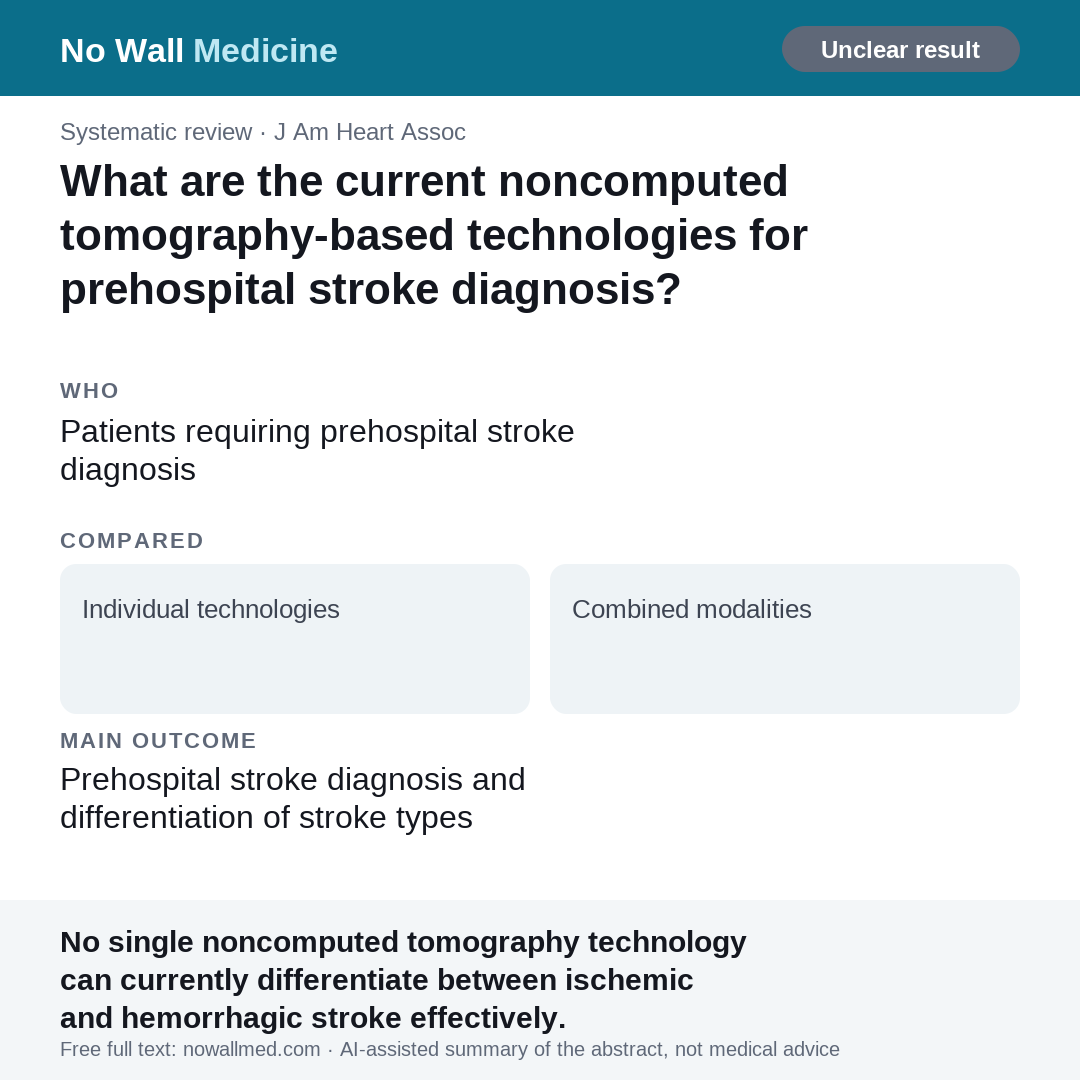
Clinical question: What are the current noncomputed tomography-based technologies for prehospital stroke diagnosis?
Why it matters: Mobile stroke units are expensive and difficult to deploy, creating a need for alternative prehospital tools to enable early treatment and targeted transport.
Key points
- Researchers reviewed 105 publications evaluating various technologies like ultrasound, magnetic resonance imaging, and artificial intelligence for diagnosing stroke before reaching a hospital.
- The review found that no single technology provides the same ability as computed tomography to detect and distinguish between ischemic and hemorrhagic strokes.
- Electroencephalography, which measures electrical activity in the brain, showed the most promise for identifying large vessel occlusion.
Headline and key points written with AI from the paper’s abstract, with every number checked against it. Read the paper before relying on them.
Topics
Spotted a mistake? Suggest a correction
More in Cardiology
Clonal hematopoiesis mutations linked to higher atrial fibrillation risk in cancer populations
Association of Clonal Hematopoiesis Mutations With Incident Atrial Fibrillation: A Systematic Review and Meta-Analysis
Deep learning model detects aortic stenosis from finger-cuff pressure waveforms accurately
Aortic Valve Stenosis Screening Using Deep Learning on Noninvasive Arterial Pressure Waveforms
Spontaneous coronary artery dissection affects younger women more often than expected
Spontaneous coronary artery dissection: implications for women's health, clinical care, and future research
Early lipid-lowering strategies may reduce atherosclerotic cardiovascular disease risk
Lipid-Lowering Strategies in the Era of Early Atherosclerosis Detection: 2026 ACC Scientific Statement: A Report of the American College of Cardiology