Certain gut bacteria were associated with colorectal cancer in a review of metagenomic studies
Systematic Review: The Relationship Between the Faecal Microbiome and Colorectal Neoplasia in Shotgun Metagenomic Studies
Systematic review of shotgun metagenomic studiesMixed results
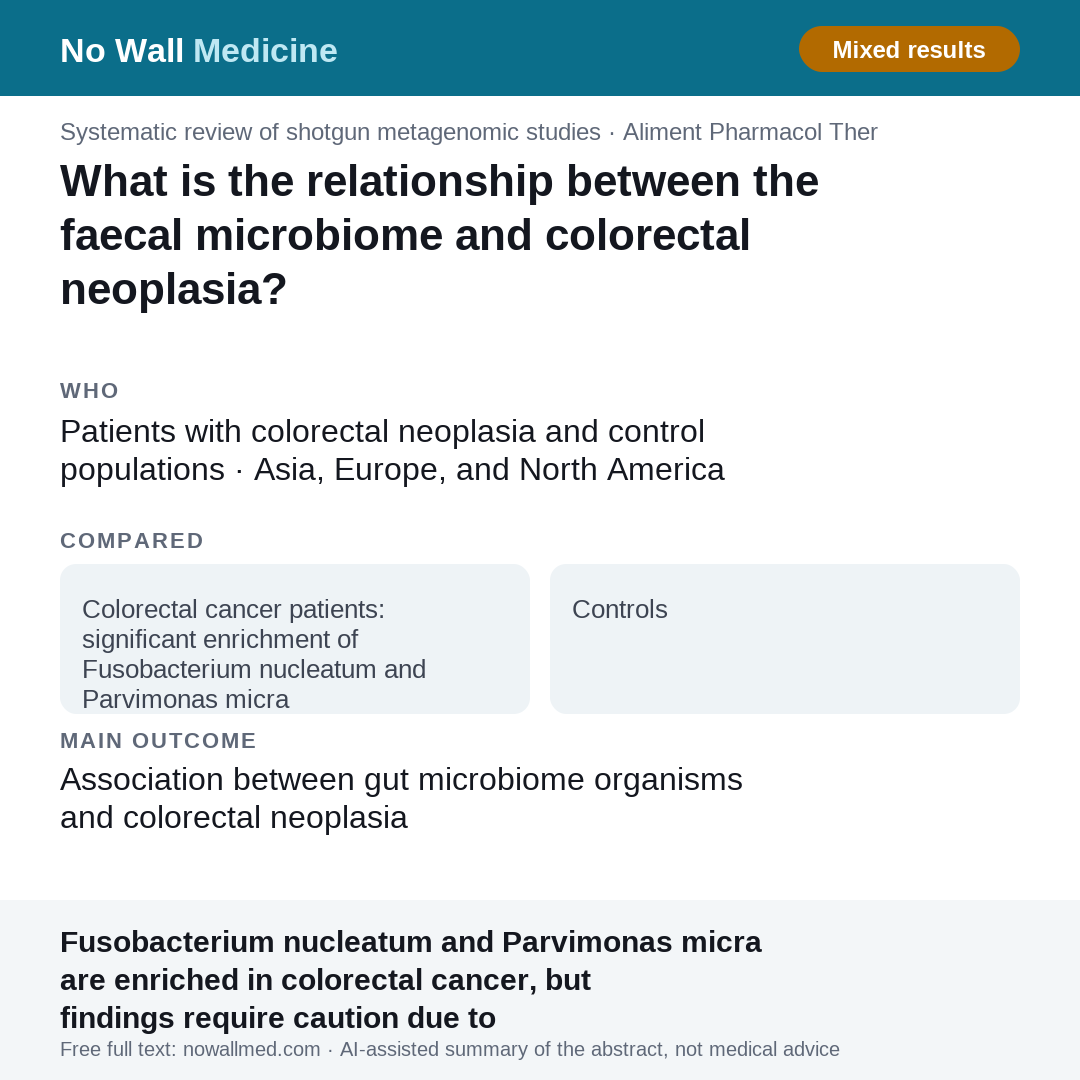
What is the relationship between the faecal microbiome and colorectal neoplasia?
Who
Patients with colorectal neoplasia and control populations · Asia, Europe, and North America
Compared
Colorectal cancer patients: significant enrichment of Fusobacterium nucleatum and Parvimonas micra
Controls
Main outcome
Association between gut microbiome organisms and colorectal neoplasia
Bottom line: Fusobacterium nucleatum and Parvimonas micra are enriched in colorectal cancer, but findings require caution due to heterogeneity.
Limitation: Poor quality appraisal regarding selection of cases and controls and varied control definitions.
Aliment Pharmacol Ther · 2025-08-12Download image
Clinical question: What is the relationship between the faecal microbiome and colorectal neoplasia?
Why it matters: Findings regarding the link between specific gut organisms and colorectal neoplasia have shown limited reproducibility across different populations.
Key points
- Researchers reviewed 26 studies involving 22 study populations, ranging from 14 to 971 individuals, to examine the gut microbiome and colorectal neoplasia.
- The enrichment of Fusobacterium nucleatum and Parvimonas micra was associated with colorectal cancer in 10 and nine studies, respectively.
- Data reproducibility was lower in studies comparing individuals with colorectal polyps to controls due to varying definitions of polyp cases.
Limitation the authors note: The authors state that 21 out of 26 studies scored poorly on quality appraisal regarding the selection of cases and controls.
Headline and key points written with AI from the paper’s abstract, with every number checked against it. Read the paper before relying on them.
Topics
Cite this article
Manning S, Hackney E, Dunneram Y, Hull MA, Mitra S, Stewart CJ. Systematic Review: The Relationship Between the Faecal Microbiome and Colorectal Neoplasia in Shotgun Metagenomic Studies. Aliment Pharmacol Ther. 2025. doi:10.1111/apt.70252
Spotted a mistake? Suggest a correction
Top studies every Monday
The week’s key trials and guidelines in your specialties, by email. Free.
Get the weekly digest