Systematic Review: Ultrasound Goes Echo-Decarbonising Inflammatory Bowel Disease Care Through Intestinal Ultrasound
Systematic reviewBenefit found
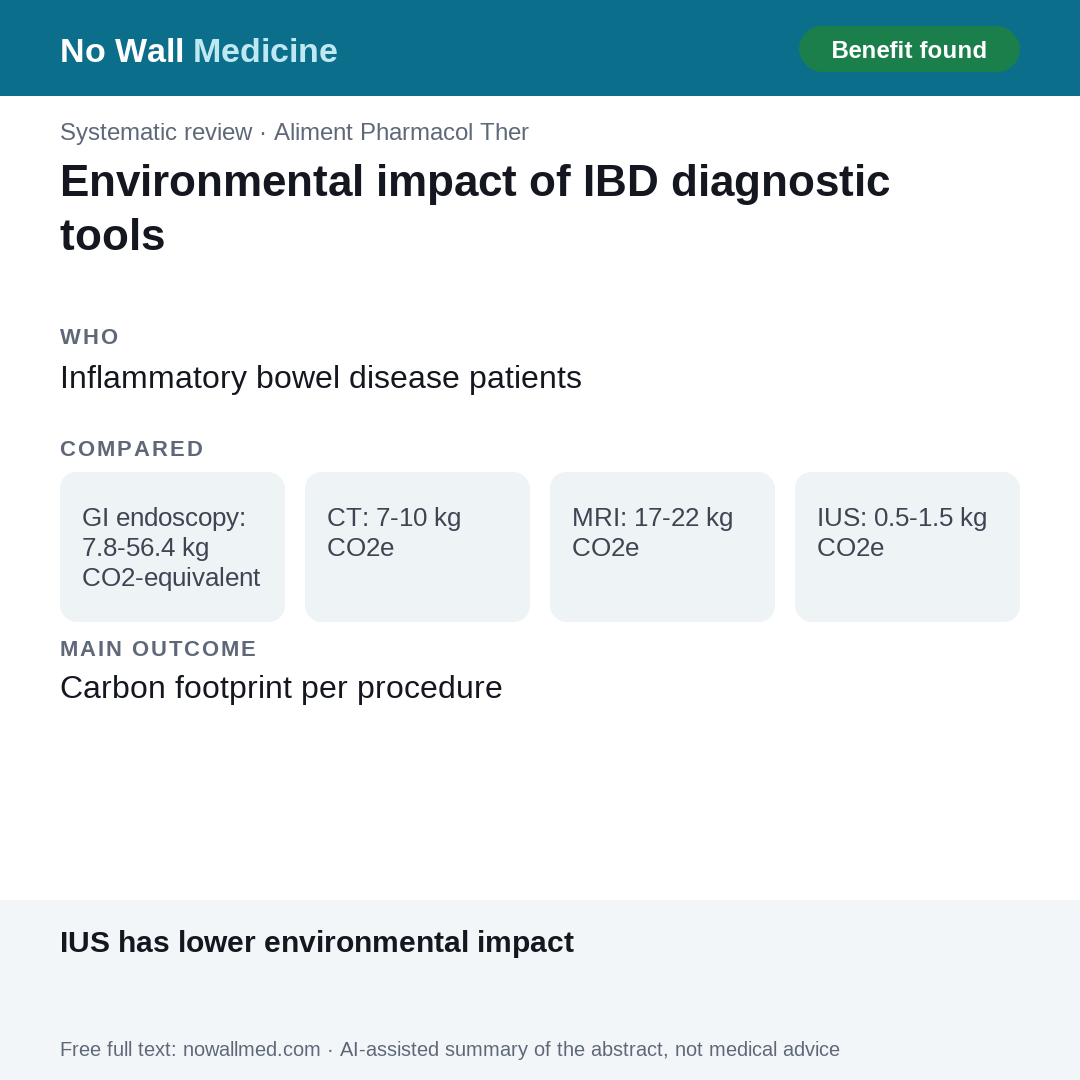
Environmental impact of IBD diagnostic tools
Who
Inflammatory bowel disease patients
Compared
GI endoscopy: 7.8-56.4 kg CO2-equivalent
CT: 7-10 kg CO2e
MRI: 17-22 kg CO2e
IUS: 0.5-1.5 kg CO2e
Main outcome
Carbon footprint per procedure
Bottom line: IUS has lower environmental impact
Aliment Pharmacol Ther · 2025-09-23Download image
Abstract
Background
Inflammatory bowel disease (IBD) is a chronic, resource-intensive condition requiring repeated diagnostic assessments. Healthcare contributes ~5% of global greenhouse gas emissions, and key diagnostic tools in IBD-gastrointestinal (GI) endoscopy, computed tomography (CT) and magnetic resonance imaging (MRI)-are associated with substantial environmental impacts. The environmental burden of these diagnostic pathways, however, remains underappreciated. Aim
To systematically assess the carbon footprint and environmental impact of diagnostic imaging modalities commonly used in IBD, with particular focus on intestinal ultrasound (IUS) as a sustainable, low-carbon alternative. Methods
A systematic review was conducted according to PRISMA 2020 guidelines. PubMed, Scopus and Embase were searched from inception to May 2025 for studies reporting the environmental impact of diagnostic modalities relevant to IBD care (GI endoscopy, CT, MRI and IUS). Studies providing quantitative or qualitative data on carbon footprint, energy consumption, waste generation or sustainability metrics were included. Data were synthesised narratively. Results
Thirty-one studies were included. GI endoscopy generates approximately 7.8-56.4 kg CO2-equivalent per procedure, largely driven by transportation, energy use and disposables. CT carries a carbon footprint of 7-10 kg CO2e per procedure in direct life cycle assessments, while broader institutional and modelling estimates extend this to ~20 kg CO2e depending on throughput, protocol and energy sources. MRI is substantially more energy-intensive, ranging from 17-22 kg CO2e per scan in most studies, and up to 200-300 kg CO2e for high-field (3T) systems when full life cycle impacts are included. In contrast, IUS produces only 0.5-1.5 kg CO2e per scan, with minimal energy demand and negligible waste. IUS enables point-of-care assessments, reducing patient travel and associated emissions. Conclusion
GI endoscopy, CT and MRI are indispensable in IBD care but carry considerable environmental costs. The broader adoption of IUS offers a clinically effective, low-carbon alternative that can contribute to more sustainable IBD management, aligning with planetary health goals. Trial registration
PROSPERO International Prospective Register of Systematic Reviews: CRD420251088016.
Topics
Cite this article
Massironi S, Zilli A, Furfaro F, Allocca M, Peyrin-Biroulet L, Jairath V. Systematic Review: Ultrasound Goes Echo-Decarbonising Inflammatory Bowel Disease Care Through Intestinal Ultrasound. Aliment Pharmacol Ther. 2025. doi:10.1111/apt.70385
Spotted a mistake? Suggest a correction
Top studies every Monday
The week’s key trials and guidelines in your specialties, plus any topics you follow. By email, free.
Get the weekly digest