Electrogustometer shows moderate to weak association with other taste tests and lacks diagnostic consistency
Systematic review: Validity, reliability, and diagnostic accuracy of the electrogustometer
Systematic reviewUnclear result
What are the validity, reliability, and diagnostic accuracy of the electrogustometer?
Who
Adults undergoing electrogustometry
Compared
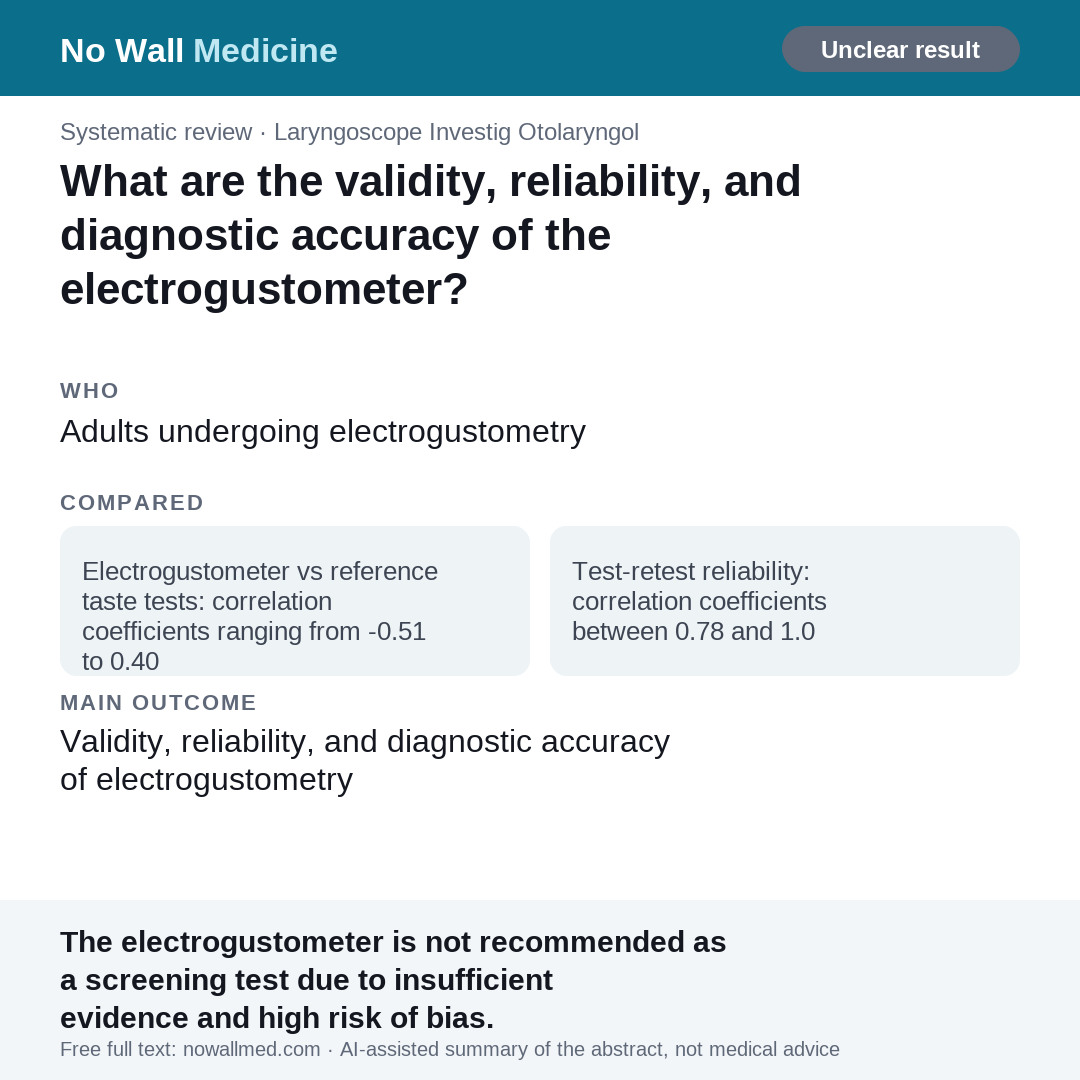
Electrogustometer vs reference taste tests: correlation coefficients ranging from -0.51 to 0.40
Test-retest reliability: correlation coefficients between 0.78 and 1.0
Main outcome
Validity, reliability, and diagnostic accuracy of electrogustometry
Bottom line: The electrogustometer is not recommended as a screening test due to insufficient evidence and high risk of bias.
Limitation: Included studies carry a high risk of bias and lack required standards for firm conclusions.
Laryngoscope Investig Otolaryngol · 2023-07-12Download image
Clinical question: What are the validity, reliability, and diagnostic accuracy of the electrogustometer?
Why it matters: It is unknown if the electrogustometer is a valid, reliable, or accurate tool for assessing taste sensation in adults compared to other methods.
Key points
- Researchers reviewed 18 studies involving adults to evaluate the validity, reliability, and diagnostic accuracy of the electrogustometer, an electrical device used to measure taste sensation.
- The association between the electrogustometer and various reference taste tests was moderate or weak, with correlation coefficients ranging from -0.51 to 0.40.
- While test-retest reliability was good with correlation coefficients between 0.78 and 1.0, diagnostic accuracy metrics varied widely across the included studies.
Limitation the authors note: The included studies carry a high risk of bias and lack the required standards regarding study design to draw firm conclusions.
Headline and key points written with AI from the paper’s abstract, with every number checked against it. Read the paper before relying on them.
Was this summary helpful?
Cite this article
Blijleven EE, Fuchten D, Dullaart MJ, Stokroos RJ, Thomeer HGXM, Wegner I. Systematic review: Validity, reliability, and diagnostic accuracy of the electrogustometer. Laryngoscope Investig Otolaryngol. 2023. doi:10.1002/lio2.1108
Spotted a mistake? Suggest a correction
Top studies every Monday
The week’s key trials and guidelines in your specialties, plus any topics you follow. By email, free.
Get the weekly digest