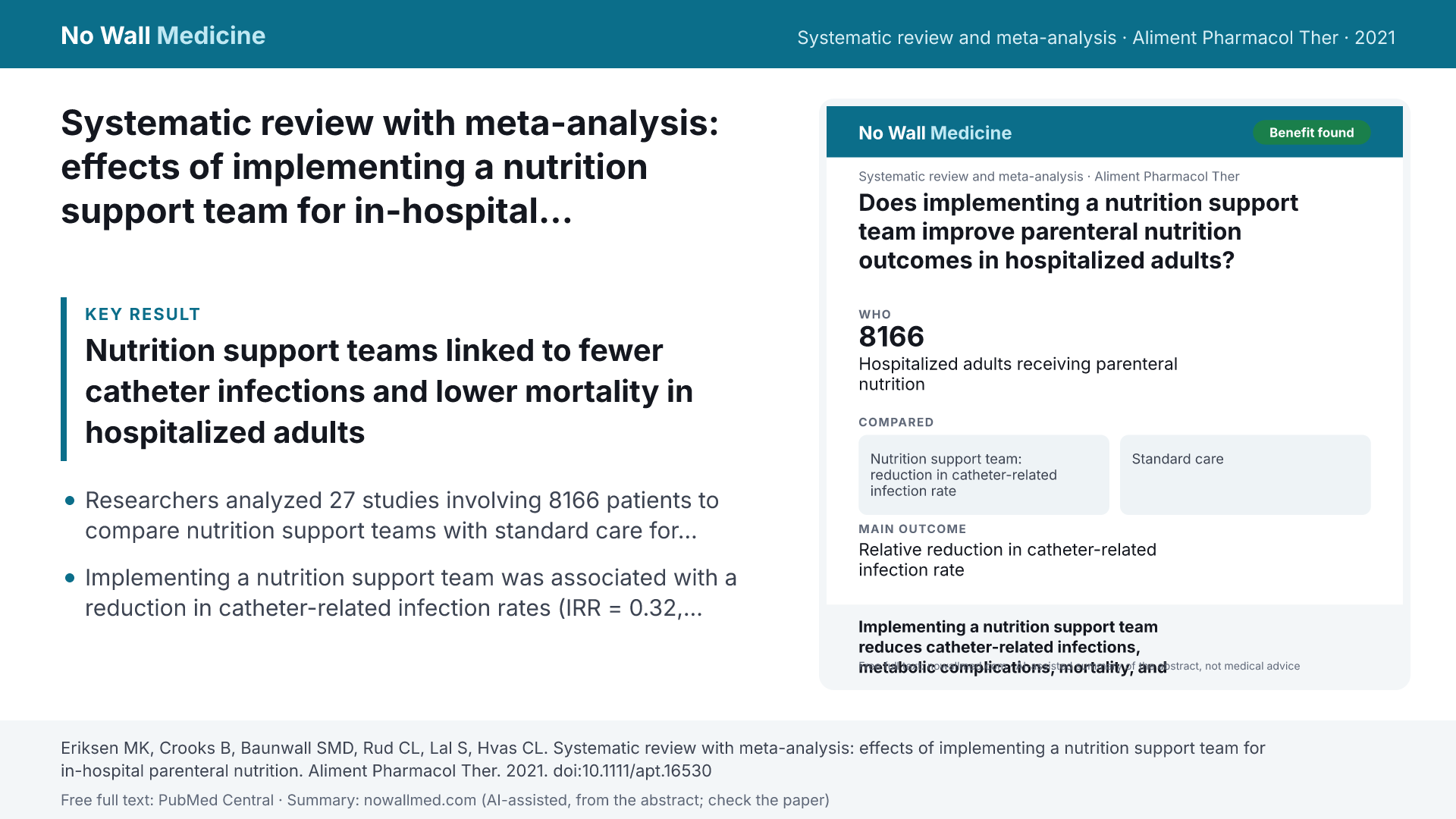
Nutrition support teams linked to fewer catheter infections and lower mortality in hospitalized adults
Systematic review with meta-analysis: effects of implementing a nutrition support team for in-hospital parenteral nutrition
Systematic review and meta-analysisBenefit found
Does implementing a nutrition support team improve parenteral nutrition outcomes in hospitalized adults?
Who
8166
Hospitalized adults receiving parenteral nutrition
Compared
Nutrition support team: reduction in catheter-related infection rate
Standard care
Main outcome
Relative reduction in catheter-related infection rate
Result: incidence rate ratio 0.32 (95% CI 0.19 to 0.53)
Bottom line: Implementing a nutrition support team reduces catheter-related infections, metabolic complications, mortality, and inappropriate parenteral nutrition use.
Aliment Pharmacol Ther · 2021-07-18Download image
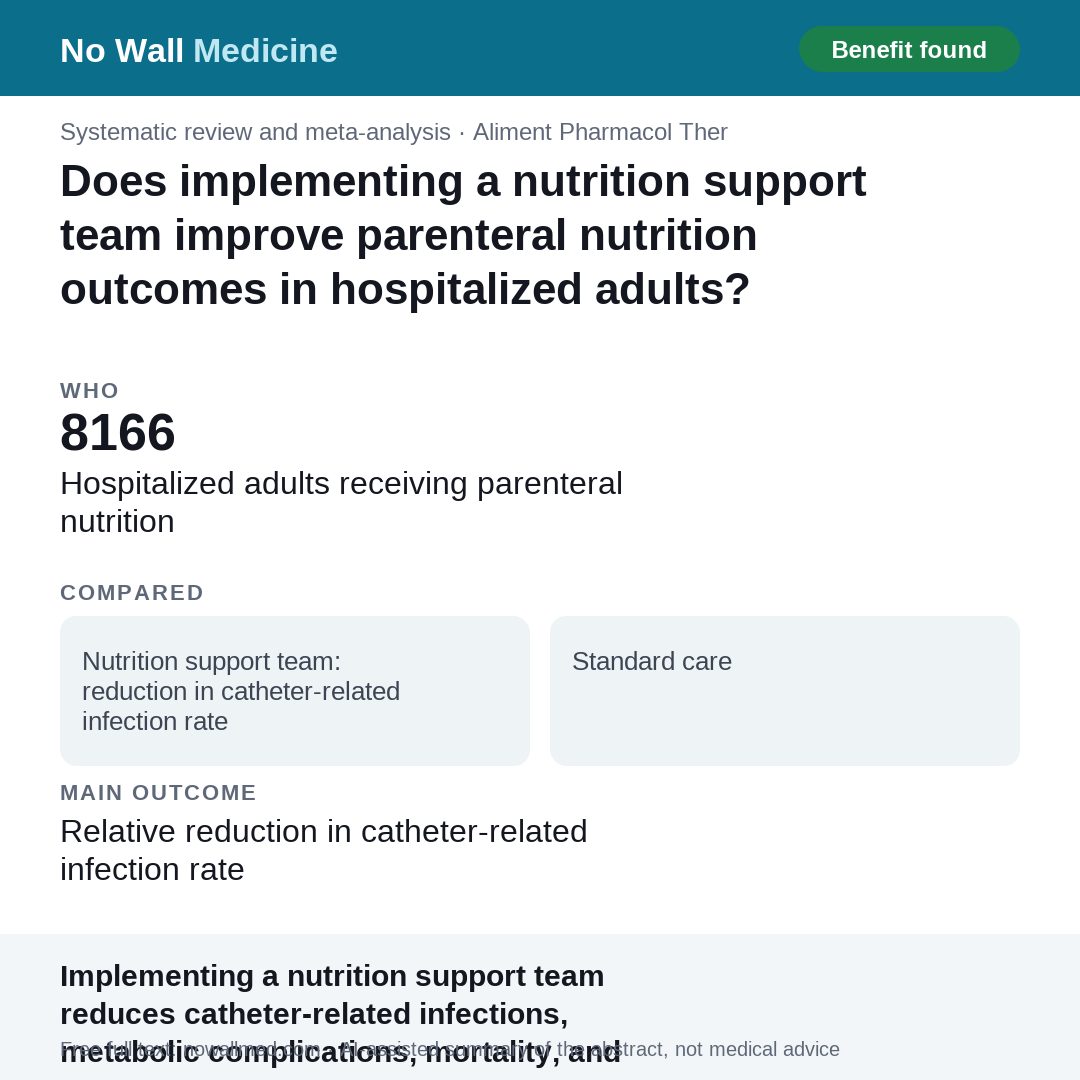
Clinical question: Does implementing a nutrition support team improve parenteral nutrition outcomes in hospitalized adults?
Why it matters: It was unknown if implementing nutrition support teams provided conclusive benefits for catheter-related infection rates or other clinical outcomes in hospitalized adults.
Key points
- Researchers analyzed 27 studies involving 8166 patients to compare nutrition support teams with standard care for patients receiving parenteral nutrition, which is intravenous feeding.
- Implementing a nutrition support team was associated with a reduction in catheter-related infection rates (IRR = 0.32, 95% CI: 0.19-0.53) and 30-day mortality (IRD = -6%, 95% CI: -11% to -1%).
- The teams were also associated with fewer episodes of hypophosphataemia (low blood phosphate), which occurred -12% less frequently (IRD = -12%, 95% CI: -24% to -1%).
Limitation the authors note: The quality of evidence for these findings was rated as very low to moderate.
Headline and key points written with AI from the paper’s abstract, with every number checked against it. Read the paper before relying on them.
Was this summary helpful?
Subject terms
Cite this article
Eriksen MK, Crooks B, Baunwall SMD, Rud CL, Lal S, Hvas CL. Systematic review with meta-analysis: effects of implementing a nutrition support team for in-hospital parenteral nutrition. Aliment Pharmacol Ther. 2021. doi:10.1111/apt.16530
Spotted a mistake? Suggest a correction
Top studies every Monday
The week’s key trials and guidelines in your specialties, plus any topics you follow. By email, free.
Get the weekly digest