Systematic screening with non-invasive devices increases atrial fibrillation diagnosis but does not change clinical outcomes
Systematic screening for atrial fibrillation with non-invasive devices: a systematic review and meta-analysis
Systematic review and meta-analysisMixed results
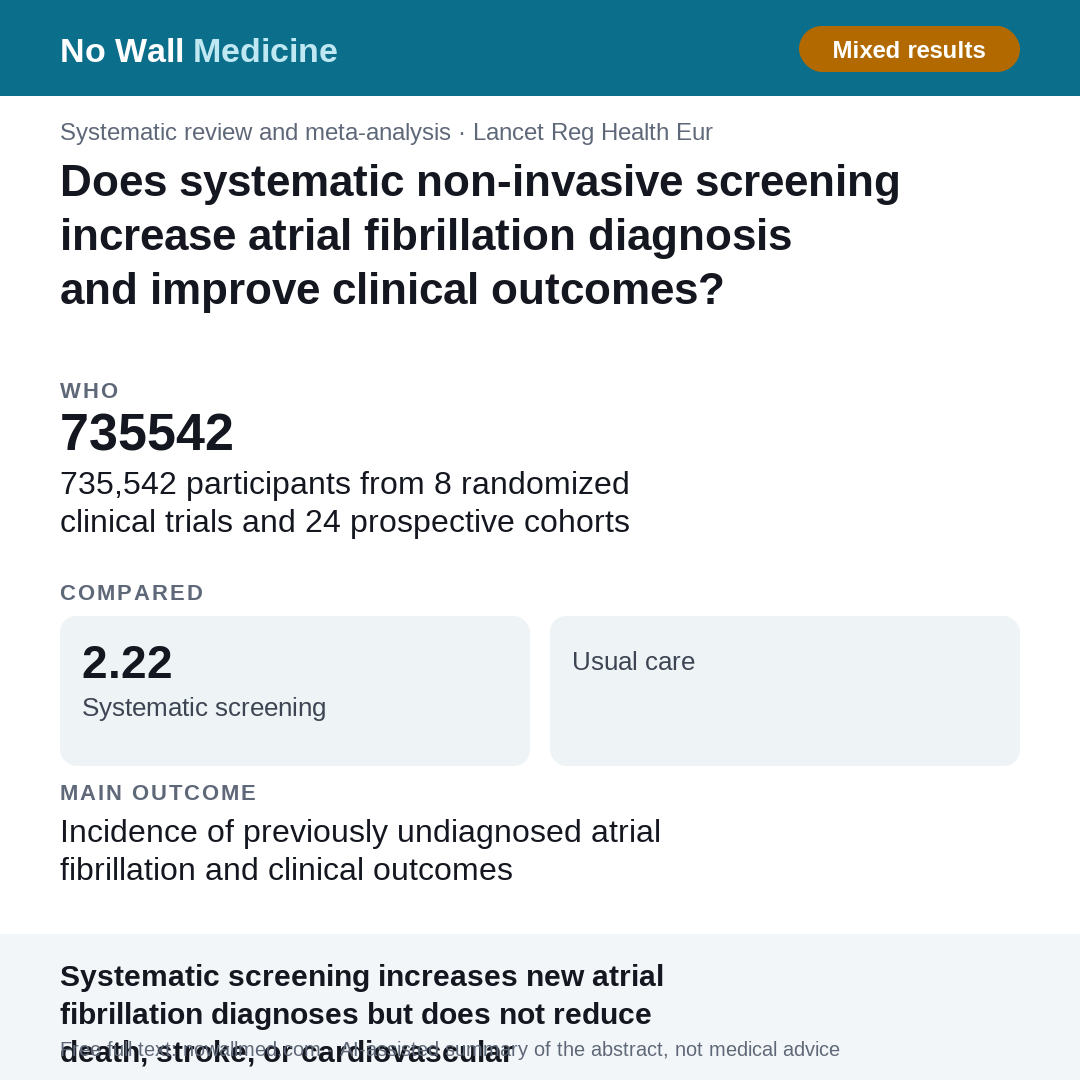
Does systematic non-invasive screening increase atrial fibrillation diagnosis and improve clinical outcomes?
Who
735542
735,542 participants from 8 randomized clinical trials and 24 prospective cohorts
Compared
2.22Systematic screening (95% CI 1.41-3.50)
Usual care
Main outcome
Incidence of previously undiagnosed atrial fibrillation and clinical outcomes
Result: relative risk 2.22 (95% CI 1.41-3.50)
Bottom line: Systematic screening increases new atrial fibrillation diagnoses but does not reduce death, stroke, or cardiovascular hospitalisation.
Funded by: British Heart Foundation and National Institute for Health and Care Research
Lancet Reg Health Eur · 2025-04-11Download image
Clinical question: Does systematic non-invasive screening increase atrial fibrillation diagnosis and improve clinical outcomes?
Why it matters: It is unclear if using non-invasive devices to systematically screen for atrial fibrillation improves the detection of the condition or reduces adverse clinical events.
Key points
- Researchers analyzed 32 studies involving 735,542 participants to evaluate how systematic screening for atrial fibrillation, an irregular heart rhythm, affects diagnosis and clinical events.
- Systematic screening was associated with a 2.75% diagnosis rate in prospective cohorts and a 2.22 relative risk of new diagnoses in randomized clinical trials.
- Screening was not linked to changes in death, cardiovascular hospitalisation, stroke, or bleeding according to pooled data from randomized clinical trials.
Headline and key points written with AI from the paper’s abstract, with every number checked against it. Read the paper before relying on them.
Was this summary helpful?
Cite this article
Wahab A, Nadarajah R, Larvin H, Farooq M, Raveendra K, Haris M. Systematic screening for atrial fibrillation with non-invasive devices: a systematic review and meta-analysis. Lancet Reg Health Eur. 2025. doi:10.1016/j.lanepe.2025.101298
Spotted a mistake? Suggest a correction
Top studies every Monday
The week’s key trials and guidelines in your specialties, plus any topics you follow. By email, free.
Get the weekly digest