Inflammatory markers were linked to itch intensity and treatment response in chronic kidney disease patients
Systemic Inflammatory Markers Correlate with Chronic Kidney Disease-Associated Pruritus and Response to Treatment
Retrospective analysis of 2 randomized phase 3 trialsBenefit found
Do systemic inflammatory markers correlate with pruritus intensity and difelikefalin treatment response?
Who
851
Patients with moderate-to-severe chronic kidney disease-associated pruritus
Compared
Difelikefalin responders: 10 markers significantly decreased from baseline
Difelikefalin nonresponders: 10 markers did not significantly decrease
Placebo-treated responders and nonresponders: Levels did not differ
Main outcome
Worst Itching Intensity Numerical Rating Scale score
Bottom line: Pruritus intensity correlates with inflammation, and difelikefalin responders show significant decreases in specific inflammatory markers.
J Invest Dermatol · 2025-05-21Download image
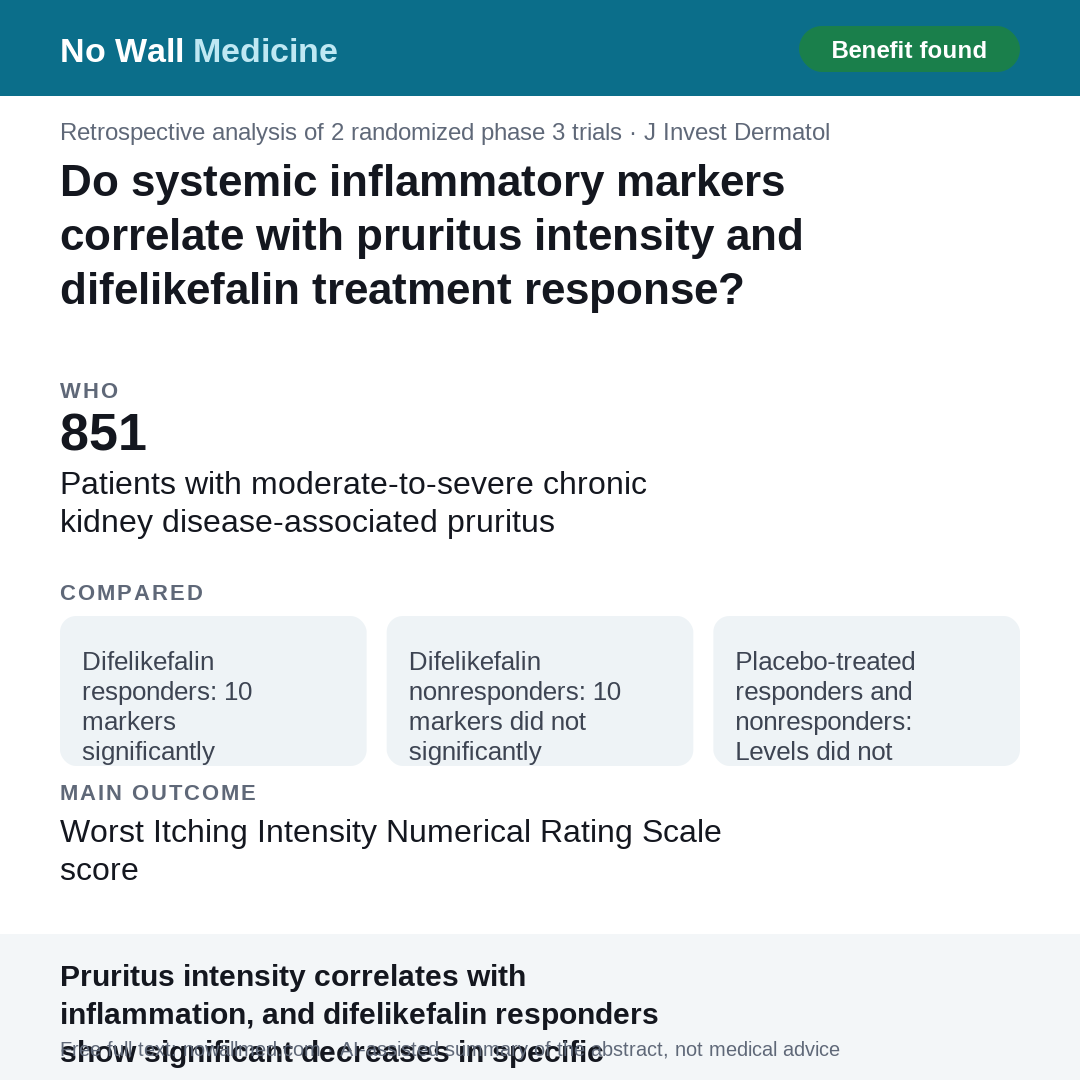
Clinical question: Do systemic inflammatory markers correlate with pruritus intensity and difelikefalin treatment response?
Why it matters: The biological causes of itching in patients with chronic kidney disease are not well understood.
Key points
- Researchers analyzed 851 patients from two randomized phase 3 trials who had moderate-to-severe itching related to chronic kidney disease.
- Baseline itch intensity was linked to a group of markers including CCL2, CCL17, CCL22, CCL27, CXCL10, CXCL11, IFNγ, IL-2, IL-31, and NGF.
- In patients responding to difelikefalin, levels of 10 markers including CCL2, CCL22, CXCL2, CXCL10, IFNγ, IL-2RA, IL-31, NGF, TNFα, and TSLP were significantly decreased from baseline.
Headline and key points written with AI from the paper’s abstract, with every number checked against it. Read the paper before relying on them.
Topics
Cite this article
Spencer RH, Kilfeather SA, Lee E, Munera C, Wen W, Shirazian S. Systemic Inflammatory Markers Correlate with Chronic Kidney Disease-Associated Pruritus and Response to Treatment. J Invest Dermatol. 2025. doi:10.1016/j.jid.2025.04.035
Spotted a mistake? Suggest a correction