Systemic therapy plus HAIC versus systemic therapy for hepatocellular carcinoma: a systematic review and meta-analysis
Systematic review and meta-analysisBenefit found
Does hepatic arterial infusion chemotherapy plus systemic therapy improve outcomes in hepatocellular carcinoma?
Who
3070
Patients with hepatocellular carcinoma
Compared
Systemic therapy plus hepatic arterial infusion chemotherapy
Systemic therapy
Main outcome
Overall survival, progression-free survival, objective response rate, and disease control rate
Result: hazard ratio 0.52 (95% CI 0.48-0.58)
Bottom line: Integrating hepatic arterial infusion chemotherapy with systemic therapy improves survival for hepatocellular carcinoma patients with manageable toxicity.
Limitation: Further evidence is necessary to standardize integration with first-line systemic therapy.
Int J Surg · 2025-05-01Download image
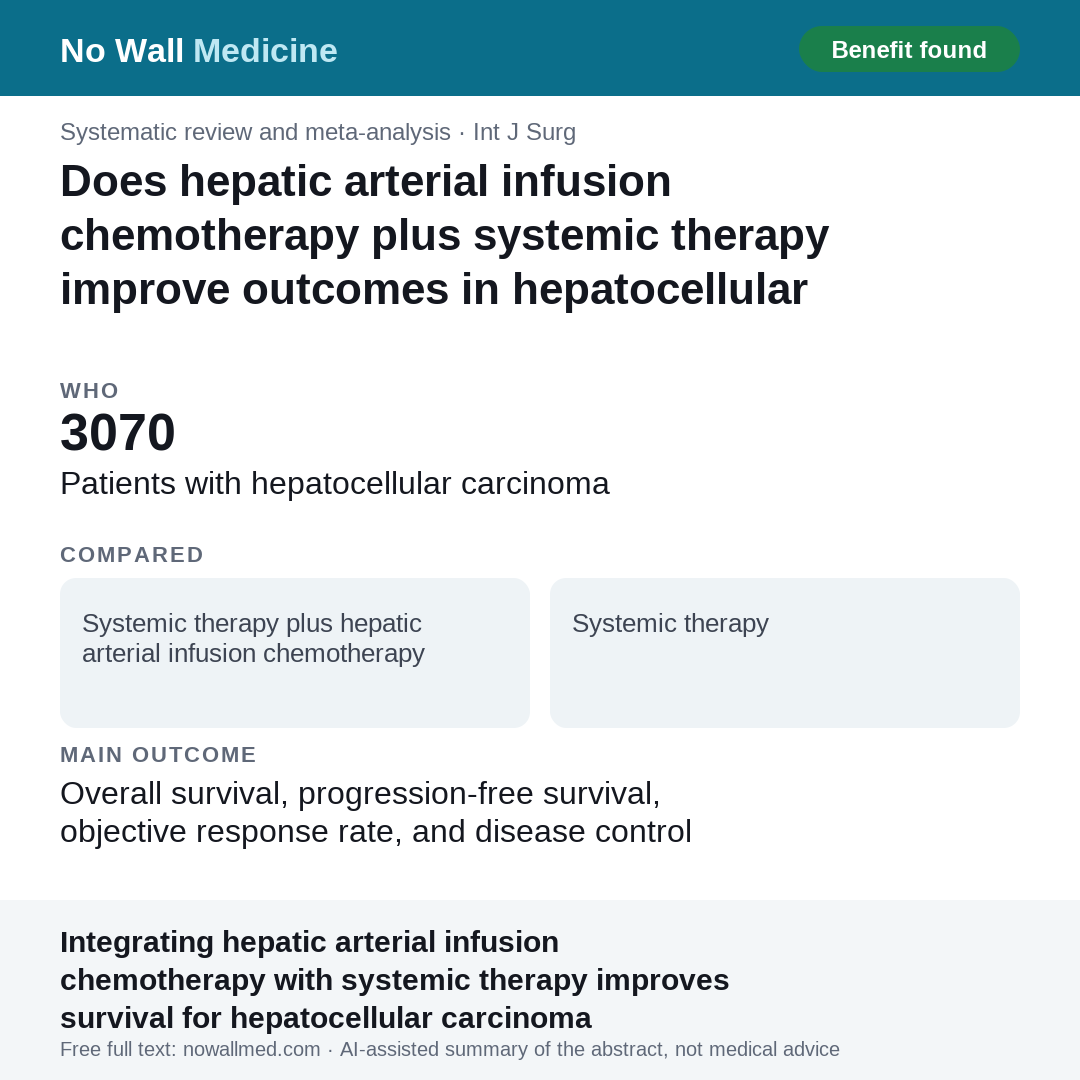
Clinical question: Does hepatic arterial infusion chemotherapy plus systemic therapy improve outcomes in hepatocellular carcinoma?
Abstract
Background
Hepatic arterial infusion chemotherapy (HAIC) exhibits synergistic anticancer effects with systemic therapy in treating hepatocellular carcinoma (HCC). The approach combining systemic therapy and HAIC is likely to establish a new survival benchmark for advanced HCC. However, related evidence is still lacking. Method
PubMed, Embase, Cochrane Library, and Web of Science were searched from January 1990 to July 2024. The extracted data were pooled using fixed- or random-effects models and expressed as hazard ratios (HRs) or risk ratios (RRs) with corresponding 95% confidence intervals (CIs). Meta-regression, subgroup analysis, prognostic factor analysis, correlation analysis, as well as trial sequential analysis were further conducted. Result
Seventeen trials involving 3070 participants were included. Patients receiving HAIC combined systemic therapy displayed superior overall survival (OS) (HR, 0.52; 95% CI, 0.48-0.58), progression-free survival (PFS) (HR, 0.54; 95% CI, 0.46-0.63), objective response rate (ORR) (RR, 2.20; 95% CI, 1.77-2.72) and disease control rate (RR, 1.21; 95% CI, 1.14-1.29) over systemic therapy. Combining HAIC resulted in higher incidences of grade ≥3 manageable adverse events. Subgroup analyses showed that HAIC could bring significant survival improvement for almost all specific populations; however, patients without portal vein tumor thrombosis might not benefit from it (HR, 0.74; 95% CI, 0.53-1.03). Prognostic factor analyses found extra HAIC was a protective factor for both OS (HR, 0.42; 95% CI, 0.34-0.51) and PFS (HR, 0.44; 95% CI, 0.36-0.53). Correlation analyses demonstrated a robust association between ORR and OS when applying systemic therapy with HAIC ( P -value = 0.031). In addition, trial sequential analyses visually showed the present data were compelling to draw reliable conclusions. Conclusion
With manageable toxicity, integrating HAIC with systemic therapy could bring favorable survival benefits for HCC patients. Further evidence is necessary to standardize the integration of HAIC with first-line systemic therapy.
Topics
Cite this article
Lu D, Li H, Sun P, Tian J, Jiao K, Cao Q. Systemic therapy plus HAIC versus systemic therapy for hepatocellular carcinoma: a systematic review and meta-analysis. Int J Surg. 2025. doi:10.1097/JS9.0000000000002326
Spotted a mistake? Suggest a correction
Top studies every Monday
The week’s key trials and guidelines in your specialties, plus any topics you follow. By email, free.
Get the weekly digest