Adding tafasitamab and lenalidomide to R-CHOP improved progression-free survival in high-risk lymphoma patients
Tafasitamab plus lenalidomide and R-CHOP versus R-CHOP for first-line treatment of patients with high-risk diffuse large B-cell lymphoma (frontMIND): a global, phase 3, randomised, double-blind, placebo-controlled trial
Randomised, double-blind, placebo-controlled trialBenefit found
Does adding tafasitamab and lenalidomide to R-CHOP improve progression-free survival in high-risk lymphoma?
Who
899
Patients aged 18-80 with high-risk diffuse large B-cell lymphoma or high-grade B-cell lymphoma · 298 centres in North America, South America, Europe, and Asia-Pacific
Compared
71.1%tafasitamab, lenalidomide, and R-CHOP (66.3-75.4%)
62.9%R-CHOP (57.9-67.5%)
Main outcome
investigator-assessed progression-free survival
Result: hazard ratio 0.75 (95% CI 0.59 to 0.96)
Bottom line: Adding tafasitamab and lenalidomide to R-CHOP improved progression-free survival but increased grade 3 or higher adverse events.
Limitation: Overall survival data are immature; follow-up is ongoing.
Funded by: Incyte Corporation
Lancet · 2026-05-30Download image
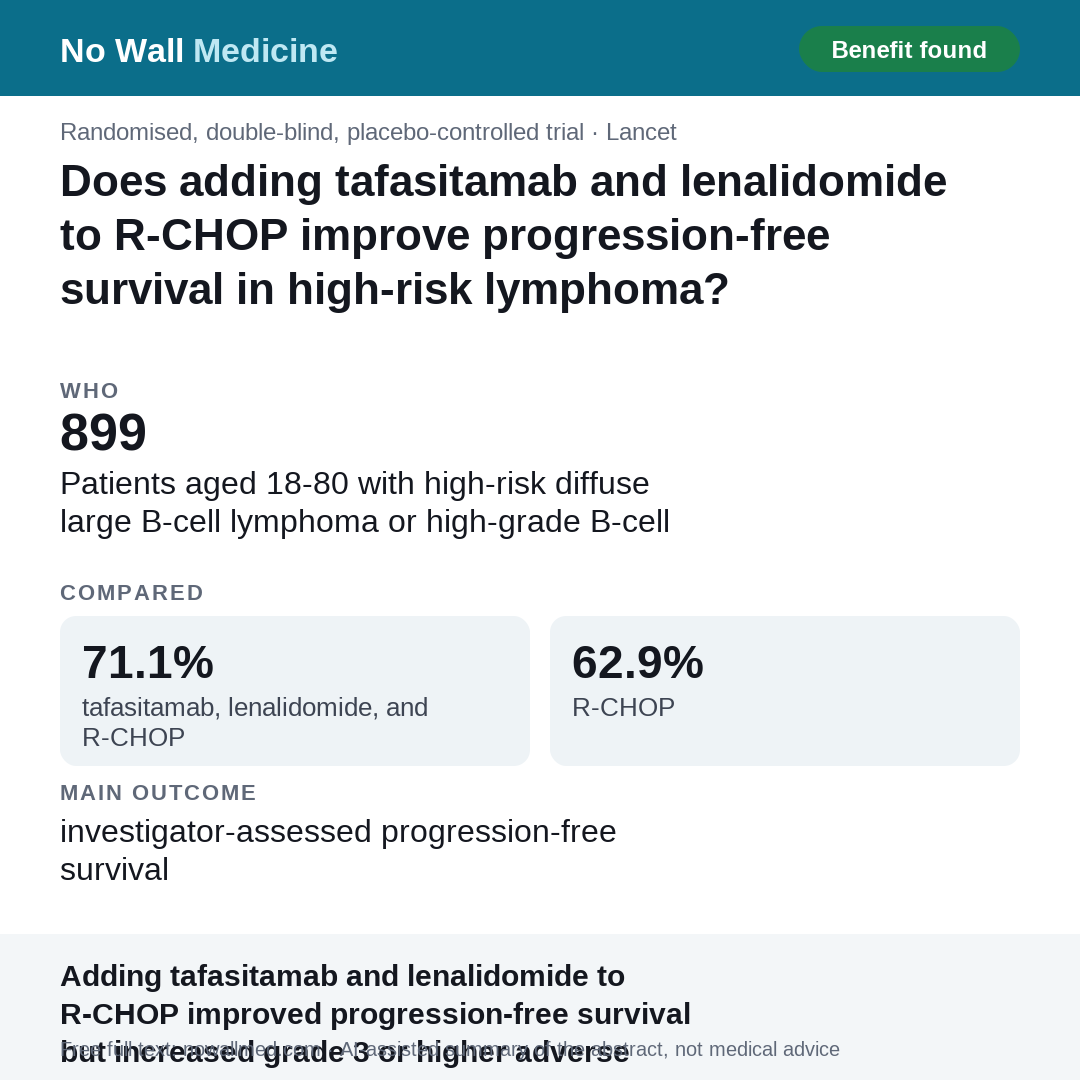
Clinical question: Does adding tafasitamab and lenalidomide to R-CHOP improve progression-free survival in high-risk lymphoma?
Why it matters: Approximately 40% of patients with high-risk diffuse large B-cell lymphoma are not cured with standard first-line R-CHOP treatment.
Key points
- The study randomized 899 patients with high-risk diffuse large B-cell lymphoma or high-grade B-cell lymphoma to receive either standard R-CHOP or R-CHOP plus tafasitamab and lenalidomide.
- The addition of tafasitamab and lenalidomide improved progression-free survival with a 2-year rate of 71.1% compared to 62.9% for the standard R-CHOP group.
- The tafa-len-R-CHOP group had a higher rate of grade 3 or higher treatment-emergent adverse events at 87% compared to 76% in the R-CHOP group.
Headline and key points written with AI from the paper’s abstract, with every number checked against it. Read the paper before relying on them.
Abstract
Background
Approximately 40% of patients with high-risk diffuse large B-cell lymphoma (DLBCL) are not cured with first-line R-CHOP (rituximab, cyclophosphamide, doxorubicin, vincristine, and prednisone or prednisolone). We aimed to investigate the addition of tafasitamab (an Fc-enhanced anti-CD19 monoclonal antibody) and lenalidomide to R-CHOP (tafa-len-R-CHOP) in patients with high-risk aggressive B-cell lymphomas. Methods
frontMIND is a phase 3, randomised, double-blind, placebo-controlled study conducted at 298 centres in North America, South America, Europe, and the Asia-Pacific region. Patients aged 18-80 years with previously untreated, high-intermediate-risk or high-risk DLBCL or high-grade B-cell lymphoma (HGBL) were randomly allocated (1:1), stratified by International Prognostic Index (IPI) or age-adjusted IPI and geographical region, to receive six 21-day cycles of standard R-CHOP (rituximab 375 mg/m2 intravenous on day 1, cyclophosphamide 750 mg/m2 intravenous on day 1, doxorubicin 50 mg/m2 intravenous on day 1, vincristine 1·4 mg/m2 [maximum 2 mg] intravenous on day 1, and prednisone or prednisolone 100 mg/day orally on days 1-5); patients in the tafa-len-R-CHOP group additionally received tafasitamab (12 mg/kg intravenous on days 1, 8, and 15) plus lenalidomide (25 mg/day orally on days 1-10), while those in the R-CHOP group received matching placebos. The primary endpoint was investigator-assessed progression-free survival (defined as time from randomisation to disease progression or death from any cause), analysed in the intention-to-treat population; safety was included as a secondary endpoint among all patients who received at least one dose of study treatment. The trial is registered with ClinicalTrials.gov (NCT04824092) and EUDRA-CT (2020-002990-84) and is active but no longer enrolling. Findings
Between May 11, 2021, and March 2, 2023, 1229 patients were screened, among whom 899 were randomly allocated: 448 (50%) to the tafa-len-R-CHOP group and 451 (50%) to the R-CHOP group. At the time of primary analysis (median follow-up 35·2 months [95% CI 35·0-35·4]), progression-free survival was improved in the tafa-len-R-CHOP group versus the R-CHOP group (hazard ratio [HR] 0·75 [95% CI 0·59-0·96]; p=0·0194), with 2-year progression-free survival rates of 71·1% (66·3-75·4) with tafa-len-R-CHOP versus 62·9% (57·9-67·5) with R-CHOP. Interim HR for overall survival was 0·85 (0·63-1·14). The overall rate of grade 3 or higher treatment-emergent adverse events was higher with tafa-len-R-CHOP (384 [87%] of 443) than with R-CHOP (340 [76%] of 447). Additionally, a higher rate of fatal treatment-emergent adverse events was observed with tafa-len-R-CHOP (26 [6%]) than with R-CHOP (17 [4%]). However, the number of overall deaths in the study was lower with tafa-len-R-CHOP than with R-CHOP (82 [19%] vs 97 [22%]). Based on disposition data, rates of premature discontinuation of all study drugs were similar in the tafa-len-R-CHOP group (71 [16%] of 443) and R-CHOP group (66 [15%] of 447). Interpretation
Progression-free survival was significantly improved with tafa-len-R-CHOP versus R-CHOP; however, the safety profile indicated increases in adverse events, including treatment-emergent adverse events leading to death, with the addition of tafasitamab and lenalidomide. Overall survival data are immature; follow-up is ongoing. Further analyses, including of circulating tumor DNA, will help to assess whether deeper molecular responses are contributing to the progression-free survival benefit observed with tafa-len-R-CHOP. Tafa-len-R-CHOP might represent a potential new first-line treatment for patients with high-risk DLBCL or HGBL. Funding
Incyte Corporation.
Abstract reproduced under the article’s CC BY licence.
Topics
Cite this article
Lenz G, Trněný M, Burke JM, Nowakowski GS, Fox CP, Chiappella A. Tafasitamab plus lenalidomide and R-CHOP versus R-CHOP for first-line treatment of patients with high-risk diffuse large B-cell lymphoma (frontMIND): a global, phase 3, randomised, double-blind, placebo-controlled trial. Lancet. 2026. doi:10.1016/S0140-6736(26)00866-4
Spotted a mistake? Suggest a correction