Tai chi was non-inferior to cognitive behavioural therapy for insomnia at 15 months
Tai chi or cognitive behavioural therapy for treating insomnia in middle aged and older adults: randomised non-inferiority trial
Randomised, assessor masked, non-inferiority trialBenefit found
Is tai chi non-inferior to cognitive behavioural therapy for chronic insomnia?
Who
200
Chinese participants aged 50 years or older with chronic insomnia · A single research site in Hong Kong
Compared
Tai chi: reduction of 9.51 (8.47 to 10.54) at month 15
Cognitive behavioural therapy for insomnia: reduction of 10.18 (8.97 to 11.40) at month 15
Main outcome
change in perceived insomnia severity measured by Insomnia Severity Index
Result: between group difference of 0.68 (-∞ to 2.00) at month 15
Bottom line: Tai chi was inferior to cognitive behavioural therapy at month 3 but non-inferior at 15 month follow-up.
BMJ · 2025-11-26Download image
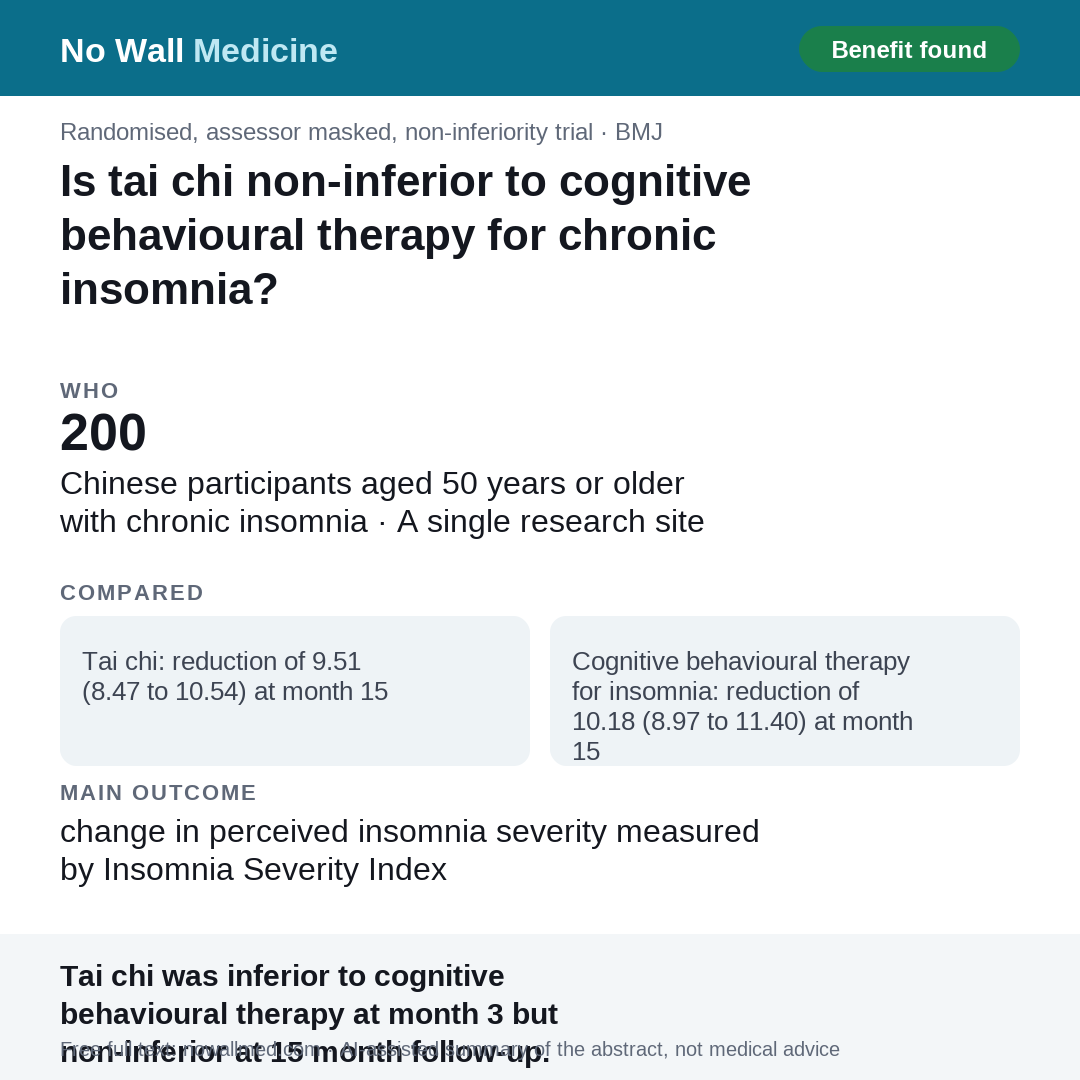
Clinical question: Is tai chi non-inferior to cognitive behavioural therapy for chronic insomnia?
Why it matters: It is unclear if tai chi is a suitable alternative to cognitive behavioural therapy for managing chronic insomnia in middle aged and older adults.
Key points
- Researchers studied 200 Chinese participants aged 50 years or older with chronic insomnia, comparing tai chi to cognitive behavioural therapy, a psychological treatment for sleep.
- At 3 months, tai chi was inferior to cognitive behavioural therapy, but at 15 months, tai chi was non-inferior with a between group difference of 0.68.
- No adverse events occurred during the intervention period for the participants in the study.
Headline and key points written with AI from the paper’s abstract, with every number checked against it. Read the paper before relying on them.
Abstract
Objective
To assess whether tai chi is non-inferior to cognitive behavioural therapy for insomnia (CBT-I), the first line treatment, for managing chronic insomnia in middle aged and older adults. Design
Randomised, assessor masked, non-inferiority trial. Setting
A single research site in Hong Kong with participants recruited from the local community between 18 May 2020 and 14 July 2022. Participants
Chinese participants aged ≥50 years with chronic insomnia diagnosed according to the Diagnostic and Statistical Manual of Mental Disorders, fifth edition. Interventions
Tai chi and CBT-I interventions were delivered in group format over three months, consisting of one hour sessions twice a week for a total of 24 sessions. Main outcome measures
The primary outcome was the change in perceived insomnia severity measured by the Insomnia Severity Index after the intervention (month 3) and at 12 month follow-up (month 15). To assess whether tai chi is non-inferior to CBT-I, a threshold of four points was used as the margin of non-inferiority. Results
200 participants were randomised (1:1) to receive tai chi (n=100) or CBT-I (n=100). The per protocol principle was adopted. At month 3, the tai chi group showed a reduction of 6.67 (95% confidence interval 5.61 to 7.73) in Insomnia Severity Index scores, while the CBT-I group had a reduction of 11.19 (10.06 to 12.32), resulting in a between group difference of 4.52 (-∞ to 5.81). Tai chi was deemed inferior to CBT-I at month 3 because the upper confidence limit exceeded the non-inferiority margin. At month 15, the reductions for tai chi and CBT-I were 9.51 (8.47 to 10.54) and 10.18 (8.97 to 11.40), respectively, with a between group difference of 0.68 (-∞ to 2.00). At this point, tai chi was considered non-inferior to CBT-I because the upper confidence limit fell within the non-inferiority margin. Results from the intention-to-treat analysis were consistent with the per protocol findings. No adverse events occurred during the intervention period. Conclusion
Tai chi was inferior to CBT-I at month 3 but non-inferior at month 15. This finding supports the use of tai chi as an alternative approach for the long term management of chronic insomnia in middle aged and older adults. Trial registration
ClinicalTrials.gov NCT04384822.
Abstract reproduced under the article’s CC BY NC licence.
Topics
Cite this article
Siu PM, Yu DJ, Yu AP, Recchia F, Li SX, Chan RN. Tai chi or cognitive behavioural therapy for treating insomnia in middle aged and older adults: randomised non-inferiority trial. BMJ. 2025. doi:10.1136/bmj-2025-084320
Spotted a mistake? Suggest a correction