Tailored implementation of national recommendations on falls prevention amongst older adults in municipalities in Norway-FALLPREVENT-a hybrid type 3 cluster-randomised trial
Hybrid type 3 cluster randomised trialBenefit found
Does a tailored implementation strategy improve adherence to falls prevention recommendations?
Who
487
487 health care professionals in twenty-five Norwegian municipalities · Norway
Compared
Intervention: mean difference of 1.8 points (95% CI 0.2-3.5) at T2
Control
Main outcome
self-reported adherence to the falls prevention recommendations
Result: mean difference of 1.8 points (95% CI 0.2-3.5)
Bottom line: A tailored strategy improved health care professional reported adherence to and experience of implementing falls prevention recommendations.
Limitation: Limited effectiveness on clinical outcomes might be due to limited fidelity or time needed to embed implementation.
Age Ageing · 2025-10-30Download image
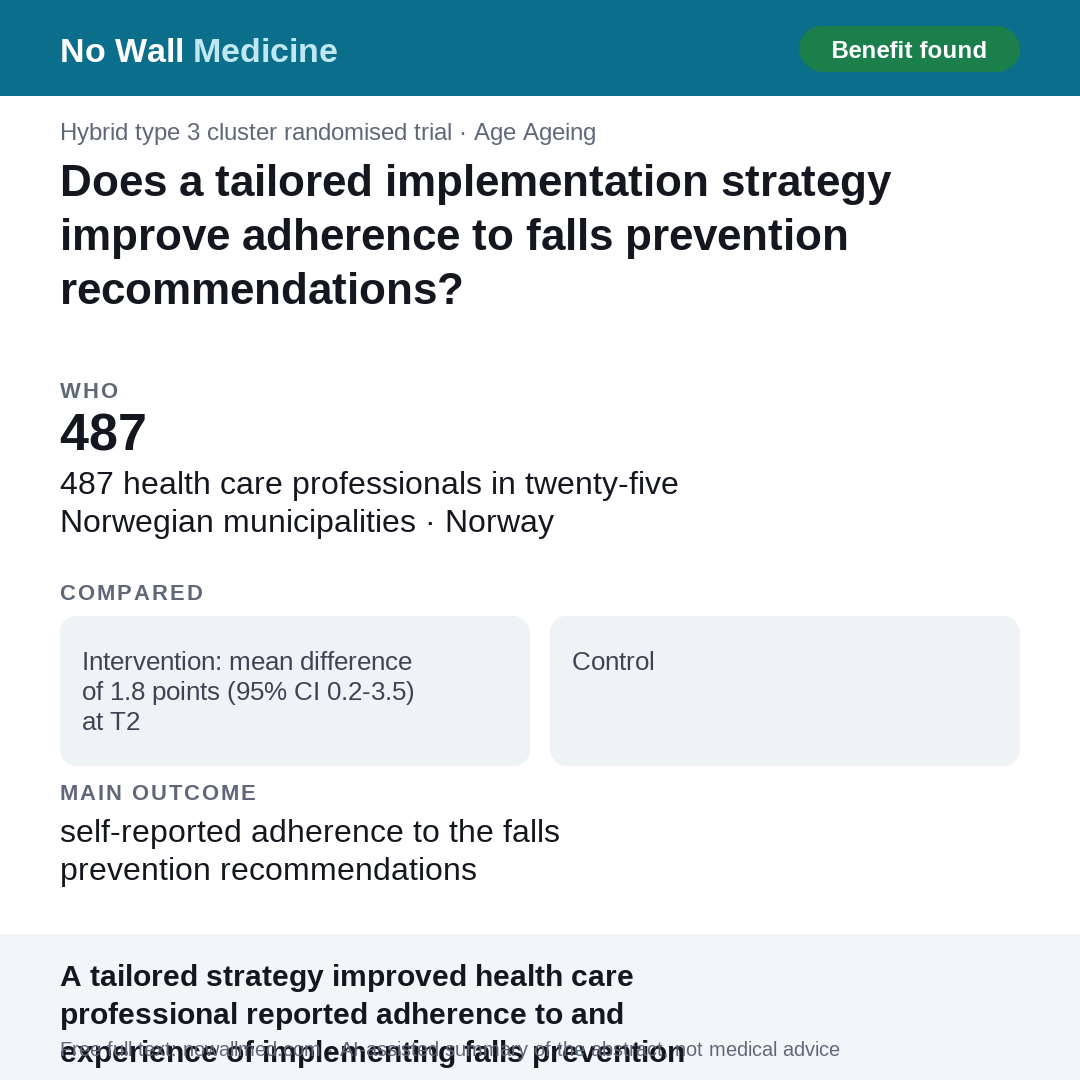
Clinical question: Does a tailored implementation strategy improve adherence to falls prevention recommendations?
Abstract
Background
Implementation of evidence-based falls prevention recommendations within community health care settings is variable and suboptimal. Objective
Evaluate the effectiveness of a tailored implementation strategy on adherence to falls prevention recommendations in Norwegian municipalities. Design
Hybrid type 3 cluster randomised trial. Participants
Twenty-five city districts/municipalities, with 13 intervention and 12 control clusters and 487 health care professionals (HCPs). Intervention
Clinical intervention: national recommendations for falls prevention for older adults. Tailored implementation strategy: leadership commitment, competence enhancement, resource teams and implementation support. Outcomes
Primary: self-reported adherence to the recommendations (questionnaire). Secondary: feasibility of the recommendations (Feasibility of Intervention Measure), experience of the implementation process (Normalisation Measure Development Questionnaire), fidelity to recommendations and strategy, and fall-related injuries. Assessments were conducted at baseline (T0), post-intervention at 9 months (T1) and at follow-up 15 months after baseline (T2). Results
HCPs adherence showed mean difference of 1.3 points (95% CI -0.2-2.9, P = .099) at T1 and 1.8 points (95% CI 0.2-3.5, P = .025) at T2, in favour of intervention versus control, along with higher scores on implementation experience at T2 (mean difference of 2.2 points; P = .033). No difference was found for feasibility or fall-related injuries. Fidelity to the recommendations was higher in the intervention clusters, for seminar attendance and implementation support. Conclusion
A tailored strategy improved HCP reported adherence to and experience of implementing falls prevention recommendations. The limited effectiveness on clinical outcomes might be due to limited fidelity by HCPs in delivery of the falls prevention interventions or time needed to fully embed workforce wide implementation.
Subject terms
Cite this article
Bjerk M, Pripp AH, Skyrud KD, Foy R, Helbostad JL, Skelton DA. Tailored implementation of national recommendations on falls prevention amongst older adults in municipalities in Norway-FALLPREVENT-a hybrid type 3 cluster-randomised trial. Age Ageing. 2025. doi:10.1093/ageing/afaf312
Spotted a mistake? Suggest a correction
Top studies every Monday
The week’s key trials and guidelines in your specialties, plus any topics you follow. By email, free.
Get the weekly digest