Combination of oncolytic virus and checkpoint inhibitor shows higher response rates in advanced melanoma
Talimogene laherparepvec in combination with ipilimumab versus ipilimumab alone for advanced melanoma: 5-year final analysis of a multicenter, randomized, open-label, phase II trial
Randomized, open-label, phase II trialBenefit found
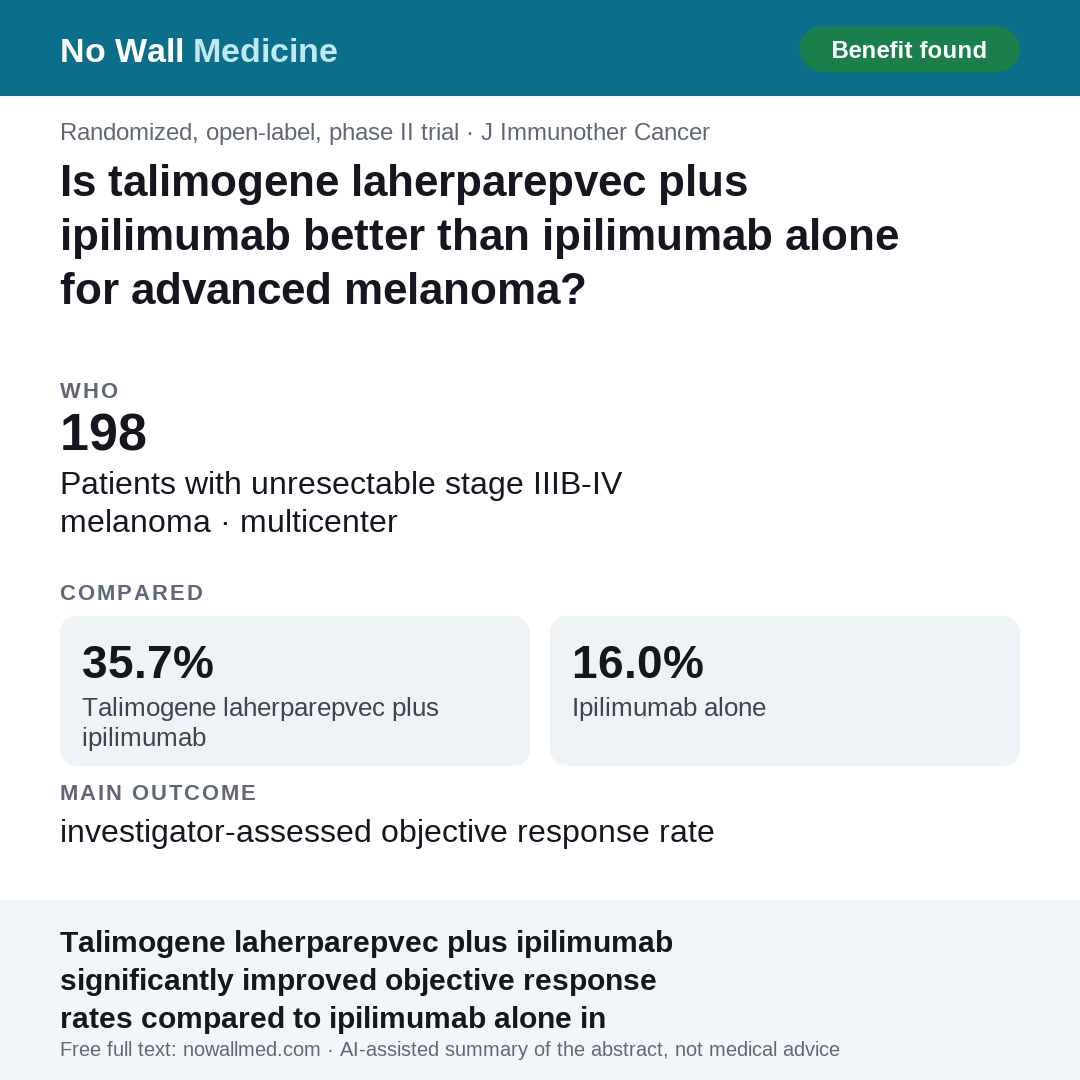
Is talimogene laherparepvec plus ipilimumab better than ipilimumab alone for advanced melanoma?
Who
198
Patients with unresectable stage IIIB-IV melanoma · multicenter
Compared
35.7%Talimogene laherparepvec plus ipilimumab
16.0%Ipilimumab alone
Main outcome
investigator-assessed objective response rate
Result: odds ratio 2.9 (95% CI 1.5 to 5.7)
Bottom line: Talimogene laherparepvec plus ipilimumab significantly improved objective response rates compared to ipilimumab alone in advanced melanoma.
J Immunother Cancer · 2023-05-05Download image
Clinical question: Is talimogene laherparepvec plus ipilimumab better than ipilimumab alone for advanced melanoma?
Why it matters: The long-term efficacy and safety of combining an oncolytic virus, a virus that infects and kills cancer cells, with a checkpoint inhibitor are unknown.
Key points
- Researchers studied 198 patients with unresectable stage IIIB-IV melanoma randomized to receive either talimogene laherparepvec plus ipilimumab or ipilimumab alone.
- The combination therapy resulted in a 35.7% objective response rate compared to 16.0% for ipilimumab alone, and a durable response rate of 33.7% versus 13.0%.
- The estimated 5-year overall survival was 54.7% for the combination group and 48.4% for the ipilimumab group, while median progression-free survival was not significantly different.
Headline and key points written with AI from the paper’s abstract, with every number checked against it. Read the paper before relying on them.
Was this summary helpful?
Abstract
Talimogene laherparepvec (T-VEC) plus ipilimumab has demonstrated greater antitumor activity versus ipilimumab alone, without additional toxicity, in patients with advanced melanoma. Here, we report the 5-year outcomes from a randomized phase II study. These data provide the longest efficacy and safety follow-up for patients with melanoma treated with a combination of an oncolytic virus and a checkpoint inhibitor.Eligible patients with unresectable stage IIIB‒IV melanoma were randomized 1:1 to receive T-VEC plus ipilimumab or ipilimumab alone. T-VEC was administered intralesionally at 106 plaque-forming units (PFU)/mL in week 1, followed by 108 PFU/mL in week 4 and every 2 weeks thereafter. Ipilimumab (3 mg/kg every 3 weeks; ≤4 doses) was administered intravenously starting at week 1 in the ipilimumab arm and week 6 in the combination arm. The primary end point was investigator-assessed objective response rate (ORR) per immune-related response criteria; key secondary end points included durable response rate (DRR), duration of response (DOR), progression-free survival (PFS), overall survival (OS), and safety.Overall, 198 patients were randomized to receive the combination (n=98) or ipilimumab (n=100). The combination improved the ORR versus ipilimumab (35.7% vs 16.0%; OR 2.9; 95% CI 1.5 to 5.7; p=0.003). DRR was 33.7% and 13.0% (unadjusted OR 3.4; 95% CI 1.7 to 7.0; descriptive p=0.001), respectively. Among the objective responders, the median DOR was 69.2 months (95% CI 38.5 to not estimable) with the combination and was not reached with ipilimumab. Median PFS was 13.5 months with the combination and 6.4 months with ipilimumab (HR 0.78; 95% CI 0.55 to 1.09; descriptive p=0.14). Estimated 5-year OS was 54.7% (95% CI 43.9 to 64.2) in the combination arm and 48.4% (95% CI 37.9 to 58.1) in the ipilimumab arm. Forty-seven (48.0%) and 65 (65.0%) patients in the combination and ipilimumab arms, respectively, received subsequent therapies. No new safety signals were reported.At the 5-year follow-up, the improved response rates observed with T-VEC plus ipilimumab were durable. This is the first randomized controlled study of the combination of an oncolytic virus and a checkpoint inhibitor that meets its primary end point.Trial registration number: NCT01740297.
Abstract reproduced under the article’s CC BY NC licence.
Subject terms
Cite this article
Chesney JA, Puzanov I, Collichio FA, Singh P, Milhem MM, Glaspy J. Talimogene laherparepvec in combination with ipilimumab versus ipilimumab alone for advanced melanoma: 5-year final analysis of a multicenter, randomized, open-label, phase II trial. J Immunother Cancer. 2023. doi:10.1136/jitc-2022-006270
Spotted a mistake? Suggest a correction
Top studies every Monday
The week’s key trials and guidelines in your specialties, plus any topics you follow. By email, free.
Get the weekly digest