Lower oxygen saturation target did not decrease severe retinopathy or death rate
Target ranges of oxygen saturation in extremely preterm infants
Why it matters: In extremely preterm infants, a lower oxygen-saturation target reduced eye disease but increased deaths.
Context written by the No Wall Medicine team.
Randomized trialMixed results
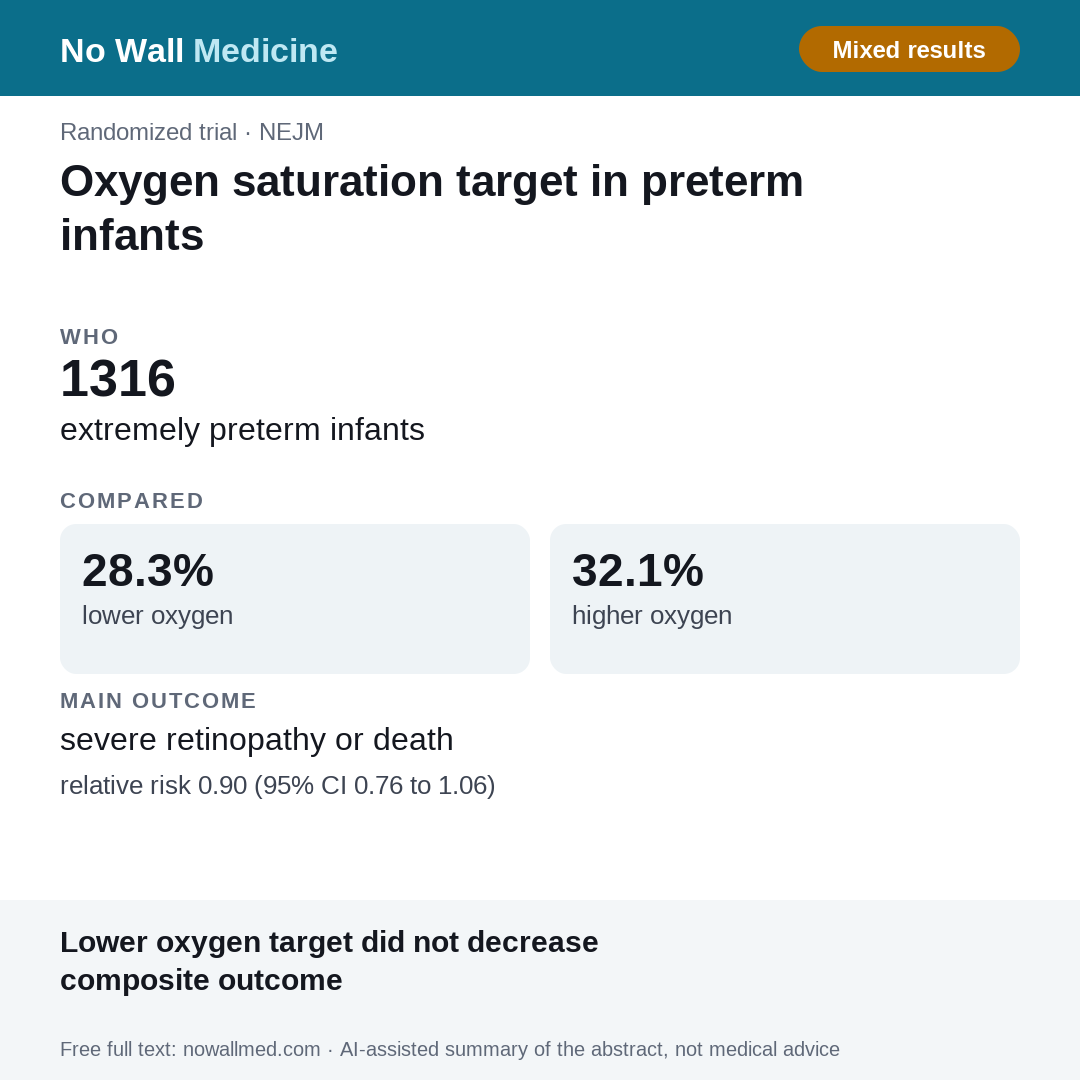
Oxygen saturation target in preterm infants
Who
1316
extremely preterm infants
Compared
28.3%lower oxygen
32.1%higher oxygen
Main outcome
severe retinopathy or death
Result: relative risk 0.90 (95% CI 0.76 to 1.06)
Bottom line: Lower oxygen target did not decrease composite outcome
NEJM · 2010-05-16Download image
Trial at a glance
Bottom line: Lower oxygen saturation target did not decrease severe retinopathy or death, but increased mortality and decreased severe retinopathy among survivors
Clinical question
Oxygen saturation target in preterm infants
Design
Randomized trial with 2-by-2 factorial design. Multiple sites, 24 weeks 0 days to 27 weeks 6 days of gestation
Who was studied
1316 extremely preterm infants
Key inclusion criteria
- born between 24 weeks 0 days and 27 weeks 6 days of gestation
- full resuscitation decided
Key exclusion criteria
- major congenital anomalies
- born in other hospitals
Interventions
- lower-oxygen-saturation: target oxygen saturation 85 to 89%
- higher-oxygen-saturation: target oxygen saturation 91 to 95%
Primary outcome
severe retinopathy or death before discharge. 28.3% and 32.1%, respectively; relative risk with lower oxygen saturation, 0.90; 95% confidence interval [CI], 0.76 to 1.06; P = 0.21
Secondary outcomes
- death before discharge: 19.9% and 16.2%, respectively; relative risk, 1.27; 95% CI, 1.01 to 1.60; P = 0.04
- severe retinopathy among survivors: 8.6% and 17.9%, respectively; relative risk, 0.52; 95% CI, 0.37 to 0.73; P<0.001
Harms
increased mortality in lower-oxygen-saturation group
Limitations reported by the authors
- not powered to detect interaction between oxygen saturation and ventilation intervention
- no adjustment for multiple comparisons in secondary outcomes
Funding
Eunice Kennedy Shriver National Institute of Child Health and Human Development and National Heart, Lung, and Blood Institute
Written with AI from the full paper; every number was checked against it. Read the paper before relying on it.
Key points
- 1316 extremely preterm infants were studied with two oxygen saturation targets compared.
- 28.3% and 32.1% had severe retinopathy or death in lower and higher oxygen groups respectively.
- Lower oxygen saturation increased death before discharge, but decreased severe retinopathy among survivors.
Headline and key points written with AI from the paper’s abstract, with every number checked against it. Read the paper before relying on them.
Topics
Spotted a mistake? Suggest a correction