Registry data replication of eight randomized clinical trials showed concordance for multiple sclerosis treatments
Target trial emulation to replicate randomised clinical trials using registry data in multiple sclerosis
Multicentre, retrospective, observational studyBenefit found
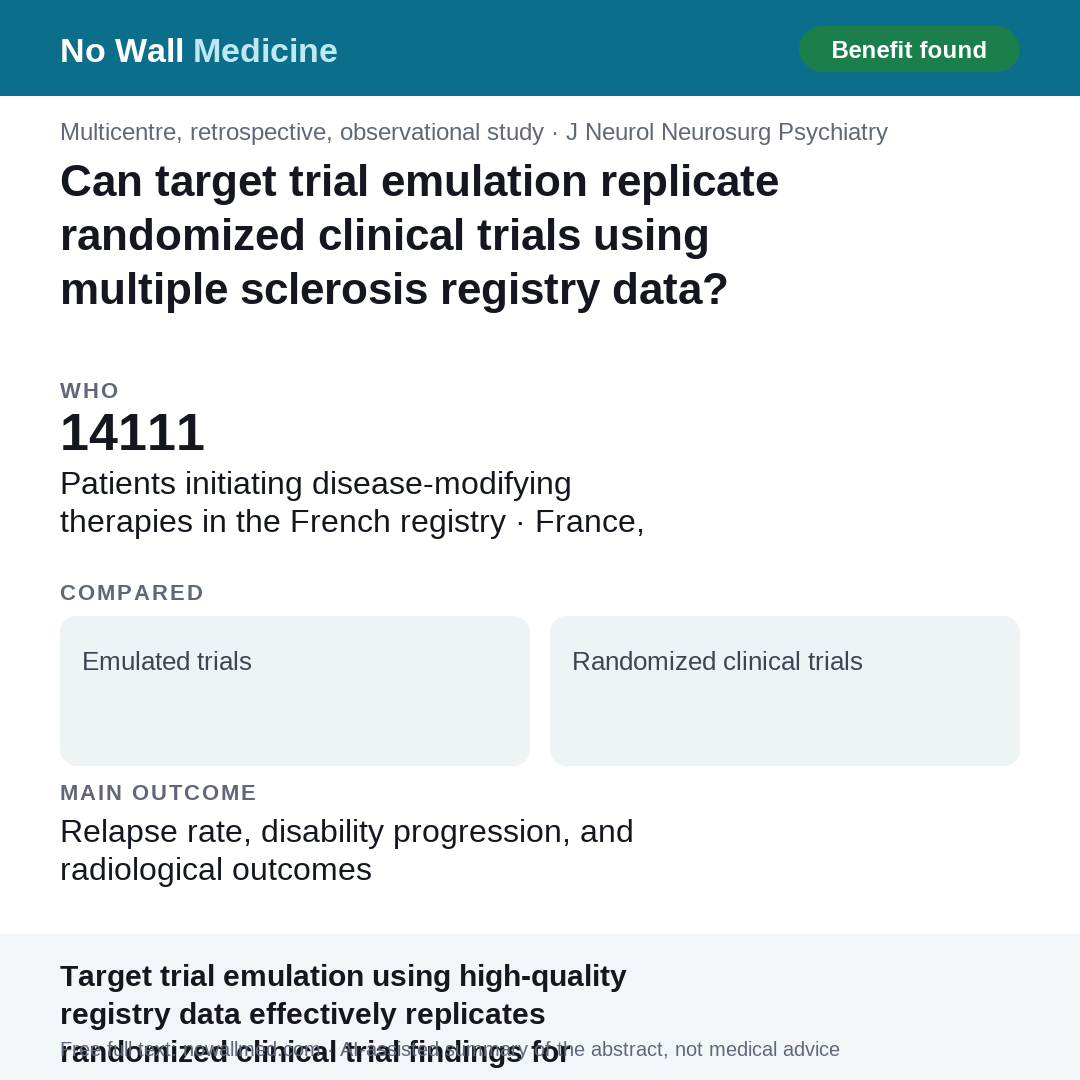
Can target trial emulation replicate randomized clinical trials using multiple sclerosis registry data?
Who
14111
Patients initiating disease-modifying therapies in the French registry · France, Observatoire Français de la Sclérose en Plaques database
Compared
Emulated trials
Randomized clinical trials
Main outcome
Relapse rate, disability progression, and radiological outcomes
Bottom line: Target trial emulation using high-quality registry data effectively replicates randomized clinical trial findings for multiple sclerosis treatments.
Limitation: Radiological outcomes were more challenging to replicate than clinical outcomes.
J Neurol Neurosurg Psychiatry · 2026-01-13Download image
Clinical question: Can target trial emulation replicate randomized clinical trials using multiple sclerosis registry data?
Why it matters: The validity of using target trial emulation to draw causal inferences from observational registry data needs to be evaluated by replicating existing randomized clinical trials.
Key points
- Researchers used data from 14,111 patients in the French Multiple Sclerosis Observatory database to emulate eight randomized clinical trials evaluating disease-modifying therapies.
- The emulated trials matched original randomized clinical trial results for relapse rates in seven of eight trials and for disability progression in all six trials assessed.
- Replicating brain MRI results was more difficult, with concordance achieved in three of five trials for new T2-lesions and one of four trials for new gadolinium-enhanced T1-lesions.
Headline and key points written with AI from the paper’s abstract, with every number checked against it. Read the paper before relying on them.
Abstract
Unlabelled
BackgroundTarget trial emulation (TTE) offers a formal framework for causal inference using observational data, but its validity must be evaluated in each research domain by replicating randomised clinical trials (RCTs). We aimed to replicate eight RCTs evaluating the efficacy of disease-modifying therapies (DMTs) in multiple sclerosis (MS) using French registry data. Methods
This multicentre, retrospective, observational study was conducted using data extracted in December 2023 from the Observatoire Français de la Sclérose en Plaques (OFSEP) database. For each emulated trial, patients were included when they initiated one of the DMT evaluated in the corresponding RCT and met its inclusion criteria. Clinical outcomes were the annualised relapse rate and 3-month confirmed Expanded Disability Status Scale progression. Radiological outcomes were new/enlarged T2-lesions and new gadolinium-enhanced T1-lesions on a brain MRI. A targeted maximum likelihood estimator was used to estimate the treatment effect adjusted for confounding factors between groups and corrected for censoring and missing outcome assessment. Results
14 111 patients were included in eight emulated trials: ASSESS (fingolimod vs glatiramer acetate), BEYOND (interferon beta vs glatiramer acetate), CONFIRM (dimethyl fumarate (DMF) vs glatiramer acetate), OPERA (ocrelizumab vs interferon beta), REGARD (interferon beta vs glatiramer acetate), RIFUND-MS (rituximab vs DMF), TENERE (teriflunomide vs interferon beta) and TRANSFORMS (fingolimod vs interferon beta). Treatment effects estimated in emulated trials were concordant with RCT findings in seven of eight trials for relapse rate, and in all six trials assessing disability progression. Radiological outcomes were more challenging to replicate; concordance was achieved in three of five trials for new T2-lesions, and one of four trials for new gadolinium-enhanced T1-lesions. Conclusion
The combined use of a TTE methodology and high-quality registry data is a valid tool to evaluate treatment effectiveness in MS.
Abstract reproduced under the article’s CC BY NC licence.
Topics
Cite this article
Gavoille A, Nourredine M, Rollot F, Casey R, Mathey G, Kerbrat A. Target trial emulation to replicate randomised clinical trials using registry data in multiple sclerosis. J Neurol Neurosurg Psychiatry. 2026. doi:10.1136/jnnp-2025-336762
Spotted a mistake? Suggest a correction