Ankle proprioceptive training improves balance, walking speed, and mobility in chronic stroke survivors
Targeted ankle proprioceptive training improves balance, gait, and functional mobility in chronic stroke survivors: a multicenter randomized controlled trial with longitudinal follow-up
Multicenter randomized controlled trialBenefit found
Does ankle proprioceptive training improve balance, gait, and mobility in chronic stroke survivors?
Who
132
Moderate-to-severe and non-ambulatory chronic stroke survivors
Compared
Proprioceptive ankle training: inversion Δ = 0.21
Standard rehabilitation
Main outcome
Weight-bearing ankle proprioception
Bottom line: Targeted proprioceptive exercises causally enhance functional recovery in post stroke populations and complement routine clinical practice.
J Neuroeng Rehabil · 2026-05-29Download image
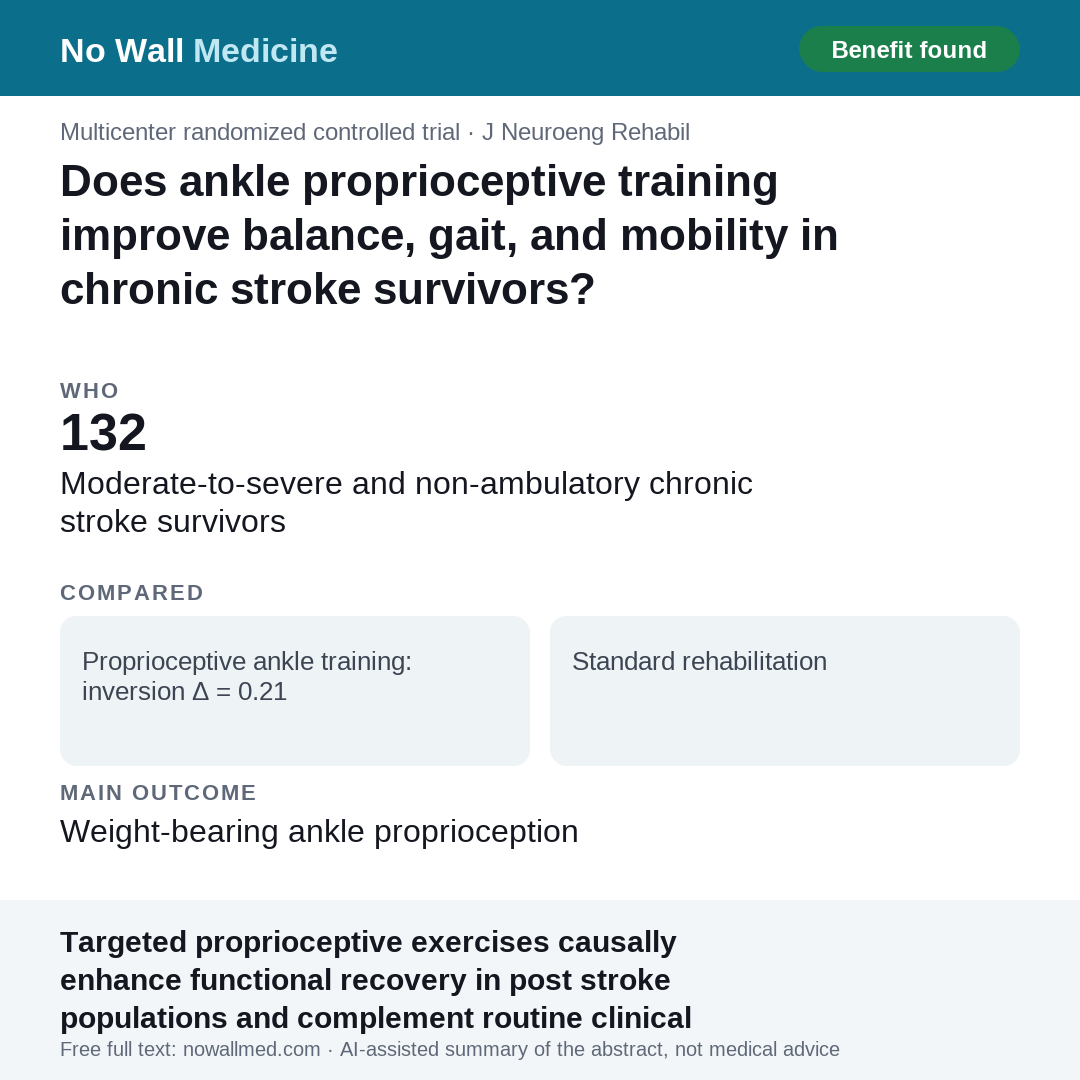
Clinical question: Does ankle proprioceptive training improve balance, gait, and mobility in chronic stroke survivors?
Why it matters: It was not previously proven if ankle proprioceptive impairment causes balance and gait problems or if training can improve these issues in severe stroke cases.
Key points
- Researchers studied 132 chronic stroke survivors, comparing 68 people receiving ankle proprioceptive training to 64 receiving standard rehabilitation.
- The training group showed improvements in ankle position sense, balance scores increased by 12.4 points, and walking speed increased by 0.32 m/s.
- These improvements in balance, walking, and mobility were sustained at a 6-month follow-up assessment.
Headline and key points written with AI from the paper’s abstract, with every number checked against it. Read the paper before relying on them.
Topics
Spotted a mistake? Suggest a correction