Targeted next-generation sequencing shows high accuracy for diagnosing drug-resistant tuberculosis
Targeted next-generation sequencing to diagnose drug-resistant tuberculosis: a systematic review and meta-analysis
Systematic review and meta-analysisBenefit found
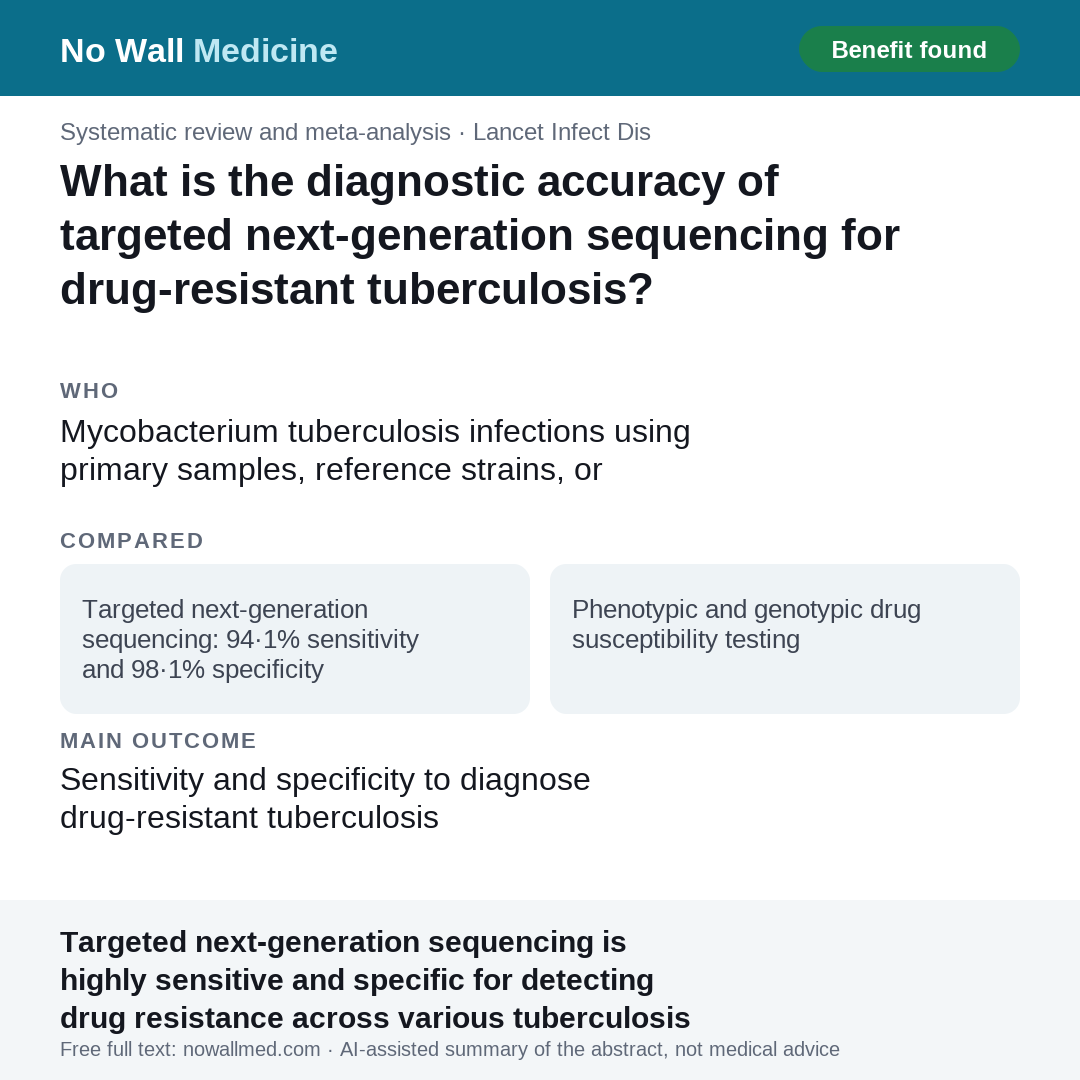
What is the diagnostic accuracy of targeted next-generation sequencing for drug-resistant tuberculosis?
Who
Mycobacterium tuberculosis infections using primary samples, reference strains, or cultured isolates · USA, western Europe, India, and China
Compared
Targeted next-generation sequencing: 94·1% sensitivity and 98·1% specificity
Phenotypic and genotypic drug susceptibility testing
Main outcome
Sensitivity and specificity to diagnose drug-resistant tuberculosis
Result: sensitivity 94·1% (95% credible interval [CrI] 90·9-96·3) and specificity 98·1% (97·0-98·9)
Bottom line: Targeted next-generation sequencing is highly sensitive and specific for detecting drug resistance across various tuberculosis drugs.
Limitation: There is a paucity of data on performance for some currently recommended drugs.
Funded by: National Institutes of Allergy and Infectious Diseases and Swiss National Science Foundation
Lancet Infect Dis · 2024-05-22Download image
Clinical question: What is the diagnostic accuracy of targeted next-generation sequencing for drug-resistant tuberculosis?
Why it matters: The diagnostic accuracy of targeted next-generation sequencing for detecting drug-resistant tuberculosis has not been comprehensively reviewed.
Key points
- Researchers analyzed 24 test accuracy studies involving 23 different tuberculosis drugs to evaluate targeted next-generation sequencing, which is a method for rapidly detecting genetic mutations.
- The combined sensitivity for all drugs was 94.1% and the specificity was 98.1%.
- Sensitivity for individual drugs ranged from 76.5% for capreomycin to 99.1% for rifampicin, while specificity ranged from 93.1% for ethambutol to 99.4% for amikacin.
Limitation the authors note: There is a paucity of data on performance for some currently recommended drugs.
Headline and key points written with AI from the paper’s abstract, with every number checked against it. Read the paper before relying on them.
Was this summary helpful?
Abstract
Background
Targeted next-generation sequencing (NGS) can rapidly and simultaneously detect mutations associated with resistance to tuberculosis drugs across multiple gene targets. The use of targeted NGS to diagnose drug-resistant tuberculosis, as described in publicly available data, has not been comprehensively reviewed. We aimed to identify targeted NGS assays that diagnose drug-resistant tuberculosis, determine how widely this technology has been used, and assess the diagnostic accuracy of these assays. Methods
In this systematic review and meta-analysis, we searched MEDLINE, Embase, Cochrane Library, Web of Science Core Collection, Global Index Medicus, Google Scholar, ClinicalTrials.gov, and the WHO International Clinical Trials Registry Platform for published and unpublished reports on targeted NGS for drug-resistant tuberculosis from Jan 1, 2005, to Oct 14, 2022, with updates to our search in Embase and Google Scholar until Feb 13, 2024. Studies eligible for the systematic review described targeted NGS approaches to predict drug resistance in Mycobacterium tuberculosis infections using primary samples, reference strain collections, or cultured isolates from individuals with presumed or confirmed tuberculosis. Our search had no limitations on study type or language, although only reports in English, German, and French were screened for eligibility. For the meta-analysis, we included test accuracy studies that used any reference standard, and we assessed risk of bias using the Quality Assessment of Diagnostic Accuracy Studies-2 tool. The primary outcomes for the meta-analysis were sensitivity and specificity of targeted NGS to diagnose drug-resistant tuberculosis compared to phenotypic and genotypic drug susceptibility testing. We used a Bayesian bivariate model to generate summary receiver operating characteristic plots and diagnostic accuracy measures, overall and stratified by drug and sample type. This study is registered with PROSPERO, CRD42022368707. Findings
We identified and screened 2920 reports, of which 124 were eligible for our systematic review, including 37 review articles and 87 reports of studies collecting samples for targeted NGS. Sequencing was mainly done in the USA (14 [16%] of 87), western Europe (ten [11%]), India (ten [11%]), and China (nine [10%]). We included 24 test accuracy studies in the meta-analysis, in which 23 different tuberculosis drugs or drug groups were assessed, covering first-line drugs, injectable drugs, and fluoroquinolones and predominantly comparing targeted NGS with phenotypic drug susceptibility testing. The combined sensitivity of targeted NGS across all drugs was 94·1% (95% credible interval [CrI] 90·9-96·3) and specificity was 98·1% (97·0-98·9). Sensitivity for individual drugs ranged from 76·5% (52·5-92·3) for capreomycin to 99·1% (98·3-99·7) for rifampicin; specificity ranged from 93·1% (88·0-96·3) for ethambutol to 99·4% (98·3-99·8) for amikacin. Diagnostic accuracy was similar for primary clinical samples and culture isolates overall and for rifampicin, isoniazid, ethambutol, streptomycin, and fluoroquinolones, and similar after excluding studies at high risk of bias (overall sensitivity 95·2% [95% CrI 91·7-97·1] and specificity 98·6% [97·4-99·3]). Interpretation
Targeted NGS is highly sensitive and specific for detecting drug resistance across panels of tuberculosis drugs and can be performed directly on clinical samples. There is a paucity of data on performance for some currently recommended drugs. The barriers preventing the use of targeted NGS to diagnose drug-resistant tuberculosis in high-burden countries need to be addressed. Funding
National Institutes of Allergy and Infectious Diseases and Swiss National Science Foundation.
Abstract reproduced under the article’s CC BY licence.
Subject terms
Cite this article
Schwab TC, Perrig L, Göller PC, Guebely De la Hoz FF, Lahousse AP, Minder B. Targeted next-generation sequencing to diagnose drug-resistant tuberculosis: a systematic review and meta-analysis. Lancet Infect Dis. 2024. doi:10.1016/S1473-3099(24)00263-9
Spotted a mistake? Suggest a correction
Top studies every Monday
The week’s key trials and guidelines in your specialties, plus any topics you follow. By email, free.
Get the weekly digest