Doublet chemotherapy with anti-EGFR/BRAF therapy was associated with the best survival in advanced BRAF-mutated colorectal cancer
Targeted therapy in advanced BRAF-mutated colorectal cancer: systematic review and network meta-analysis
Systematic review and network meta-analysisBenefit found
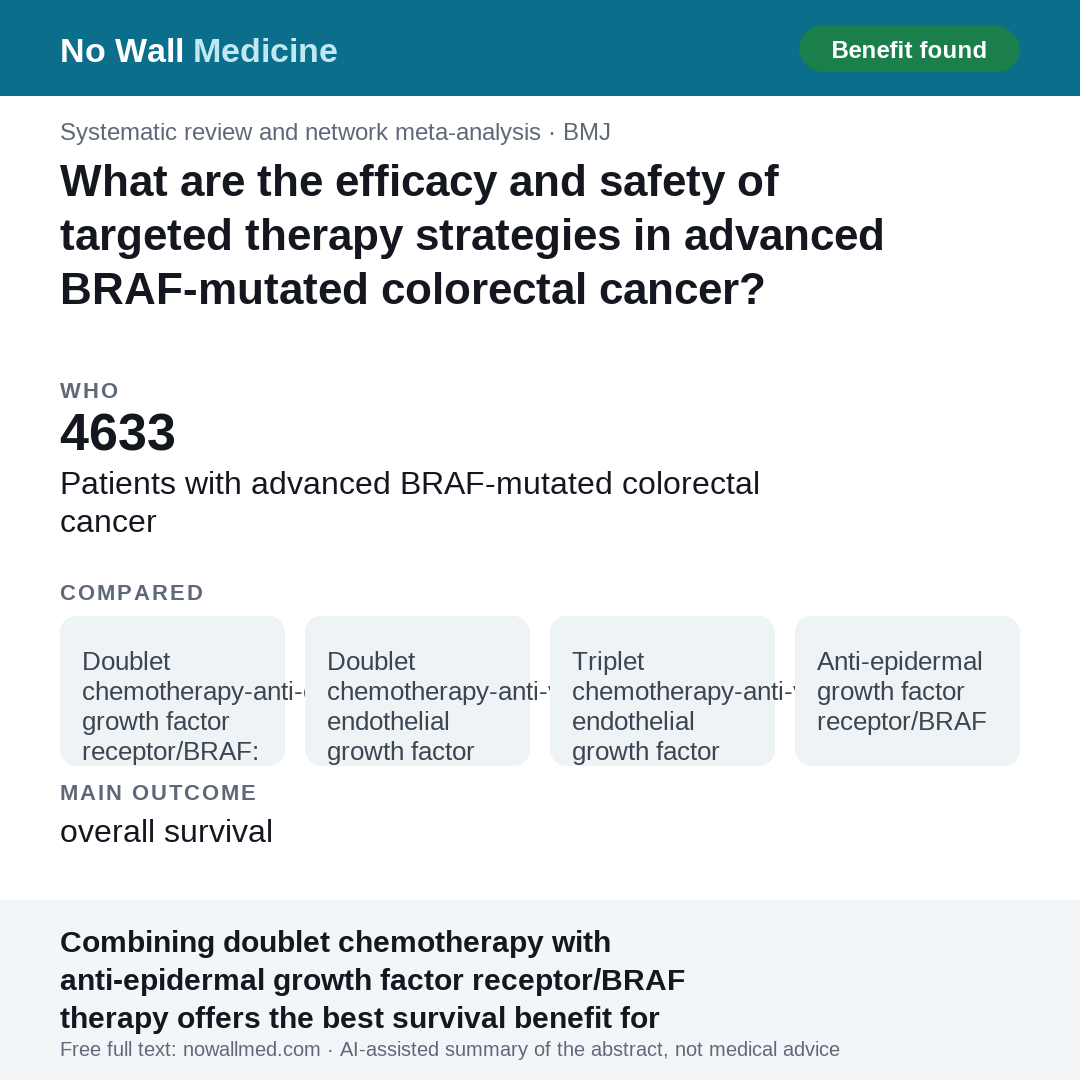
What are the efficacy and safety of targeted therapy strategies in advanced BRAF-mutated colorectal cancer?
Who
4633
Patients with advanced BRAF-mutated colorectal cancer
Compared
Doublet chemotherapy-anti-epidermal growth factor receptor/BRAF: best overall survival
Doublet chemotherapy-anti-vascular endothelial growth factor
Triplet chemotherapy-anti-vascular endothelial growth factor
Anti-epidermal growth factor receptor/BRAF
Main outcome
overall survival
Result: hazard ratio 0.49 (95% CrI 0.36 to 0.66)
Bottom line: Combining doublet chemotherapy with anti-epidermal growth factor receptor/BRAF therapy offers the best survival benefit for initial treatment.
BMJ · 2025-11-19Download image
Clinical question: What are the efficacy and safety of targeted therapy strategies in advanced BRAF-mutated colorectal cancer?
Why it matters: Clinicians need to know which targeted therapy strategies provide the best efficacy and safety for patients with advanced BRAF-mutated colorectal cancer.
Key points
- Researchers analyzed 60 studies involving 4633 patients with advanced BRAF-mutated colorectal cancer to compare different targeted therapy strategies.
- In the first line setting, doublet chemotherapy plus anti-EGFR/BRAF therapy was associated with the best overall survival compared to other regimens.
- For second or later line treatment, anti-EGFR/BRAF regimens with or without an additional inhibitor ranked highest for efficacy and tolerability.
Headline and key points written with AI from the paper’s abstract, with every number checked against it. Read the paper before relying on them.
Abstract
Objective
To investigate the individual and comparative efficacy and safety of targeted therapy based strategies in advanced BRAF-mutated colorectal cancer. Design
Systematic review and network meta-analysis. Data sources
PubMed, Embase, Cochrane Library, and ClinicalTrials.gov from inception to 31 May 2025, and international conference proceedings. Eligibility criteria for selecting studies
Clinical trials and multicentre, real world studies investigating the efficacy and safety of targeted therapies for advanced BRAF-mutated colorectal cancer with at least one of the clinical outcomes of interest. Data synthesis
The primary endpoint was overall survival in the first line and second or later line settings. Secondary endpoints included progression-free survival, objective response rate, disease control rate, and grade ≥3 adverse events. Single arm meta-analysis, pairwise meta-analysis, and network meta-analysis were performed to pool hazard ratios with 95% credible intervals (CrIs) for overall survival and progression-free survival, and odds ratios with 95% CrIs for objective response rate, disease control rate, and adverse events. The rankogram and surface under the cumulative ranking curve (SUCRA) evaluated the relative superiority of regimens in the network meta-analysis. Results
60 studies involving 4633 patients with advanced BRAF-mutated colorectal cancer were included. Pooled estimates indicated that patients could benefit from an anti-EGFR (epidermal growth factor receptor)/BRAF based regimen. Doublet chemotherapy (DCT)-anti-EGFR/BRAF was associated with the best overall survival, providing significant benefits compared with DCT-anti-VEGF (vascular endothelial growth factor) (hazard ratio 0.49, 95% CrI 0.36 to 0.66), triplet chemotherapy-anti-VEGF (0.51, 0.33 to 0.80), and anti-EGFR/BRAF (0.70, 0.51 to 0.96) regimens in the first line setting. Chemotherapy-anti-EGFR/BRAF showed significant superiority in overall survival (SUCRA=0.94 for DCT-anti-EGFR/BRAF, 0.90 for single agent chemotherapy (SCT)-anti-EGFR/BRAF) and progression-free survival (0.93 for DCT-anti-EGFR/BRAF and 0.92 for SCT-anti-EGFR/BRAF) among all first line targeted therapy strategies. In the second or later line setting, anti-EGFR/BRAF with or without an additional inhibitor (anti-MEK (mitogen-activated protein kinase kinase) or anti-PI3K (phosphoinositide 3-kinase)), exhibited better efficacy compared with other alternative strategies, ranking highest across study endpoints based on rank probability and SUCRA. Conclusions
For initial treatment of advanced BRAF-mutated colorectal cancer, combining doublet chemotherapy with anti-EGFR/BRAF therapy offers the best survival benefit. For patients who have had previous treatment, anti-EGFR/BRAF regimens (with or without a MEK inhibitor) are the most effective and tolerable options. Systematic review registration
PROSPERO CRD420250653959.
Abstract reproduced under the article’s CC BY licence.
Topics
Cite this article
Qin BD, Jiao XD, Wang Z, Liu K, Ling Y, Wu Y. Targeted therapy in advanced BRAF-mutated colorectal cancer: systematic review and network meta-analysis. BMJ. 2025. doi:10.1136/bmj-2025-086026
Spotted a mistake? Suggest a correction