Computed tomographic coronary angiography did not reduce heart attack or cardiac death risk in patients
Targeted Use of Computed Tomographic Coronary Angiography in Acute Chest Pain
Multicenter, randomized, controlled trialNo clear difference
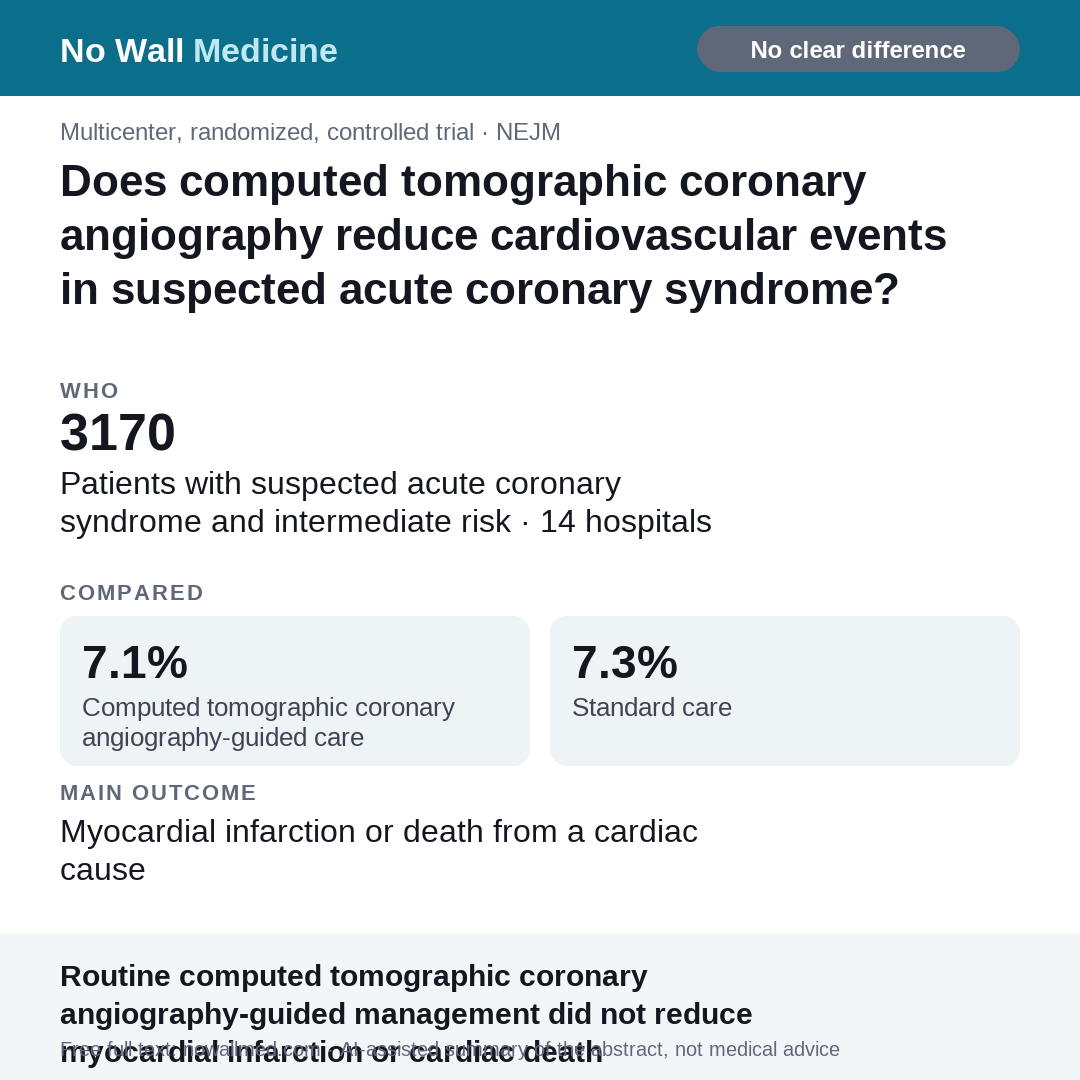
Does computed tomographic coronary angiography reduce cardiovascular events in suspected acute coronary syndrome?
Who
3170
Patients with suspected acute coronary syndrome and intermediate risk · 14 hospitals across the United Kingdom
Compared
7.1%Computed tomographic coronary angiography-guided care
7.3%Standard care
Main outcome
Myocardial infarction or death from a cardiac cause
Result: adjusted hazard ratio 0.95 (95% CI 0.73 to 1.23)
Bottom line: Routine computed tomographic coronary angiography-guided management did not reduce myocardial infarction or cardiac death compared to standard care.
Funded by: British Heart Foundation
NEJM · 2026-08-29Download image
Clinical question: Does computed tomographic coronary angiography reduce cardiovascular events in suspected acute coronary syndrome?
Why it matters: It was unknown if further investigation reduces cardiovascular risk for patients with suspected acute coronary syndrome after a heart attack has been ruled out.
Key points
- Researchers studied 3170 patients with intermediate risk of cardiovascular events who were assigned to either computed tomographic coronary angiography or standard care.
- After a median of 3.0 years, primary outcomes occurred in 7.1% of the angiography group and 7.3% of the standard-care group.
- Only 0.4% of all participants experienced an adverse event related to the computed tomographic coronary angiography.
Headline and key points written with AI from the paper’s abstract, with every number checked against it. Read the paper before relying on them.
Topics
Cite this article
Lee KK, Wereski R, Lowe D, O'Brien R, Ferry AV, Bularga A. Targeted Use of Computed Tomographic Coronary Angiography in Acute Chest Pain. NEJM. 2026. doi:10.1056/NEJMoa2608903
Spotted a mistake? Suggest a correction