Trained medical officers provided spinal anaesthesia with failure rates similar to specialist anaesthesiologists
Task-sharing spinal anaesthesia care in three rural Indian hospitals: a non-inferiority randomised controlled clinical trial
Randomised, non-inferiority trialBenefit found
Are spinal anaesthesia failure rates of medical officers non-inferior to consultant anaesthesiologists?
Who
422
Patients aged over 18 years with low perioperative risk · Three rural hospitals in Tamil Nadu and Chhattisgarh, India
Compared
3.0%Medical officers
2.6%Consultant anaesthesiologists
Main outcome
Spinal anaesthesia failure rate
Result: difference in success rate of 0.4% (95% CI=0.36-0.43%; p=0.80)
Bottom line: Trained medical officers provided spinal anaesthesia care with failure rates non-inferior to consultant anaesthesiologists in low-risk patients.
BMJ Glob Health · 2024-08-16Download image
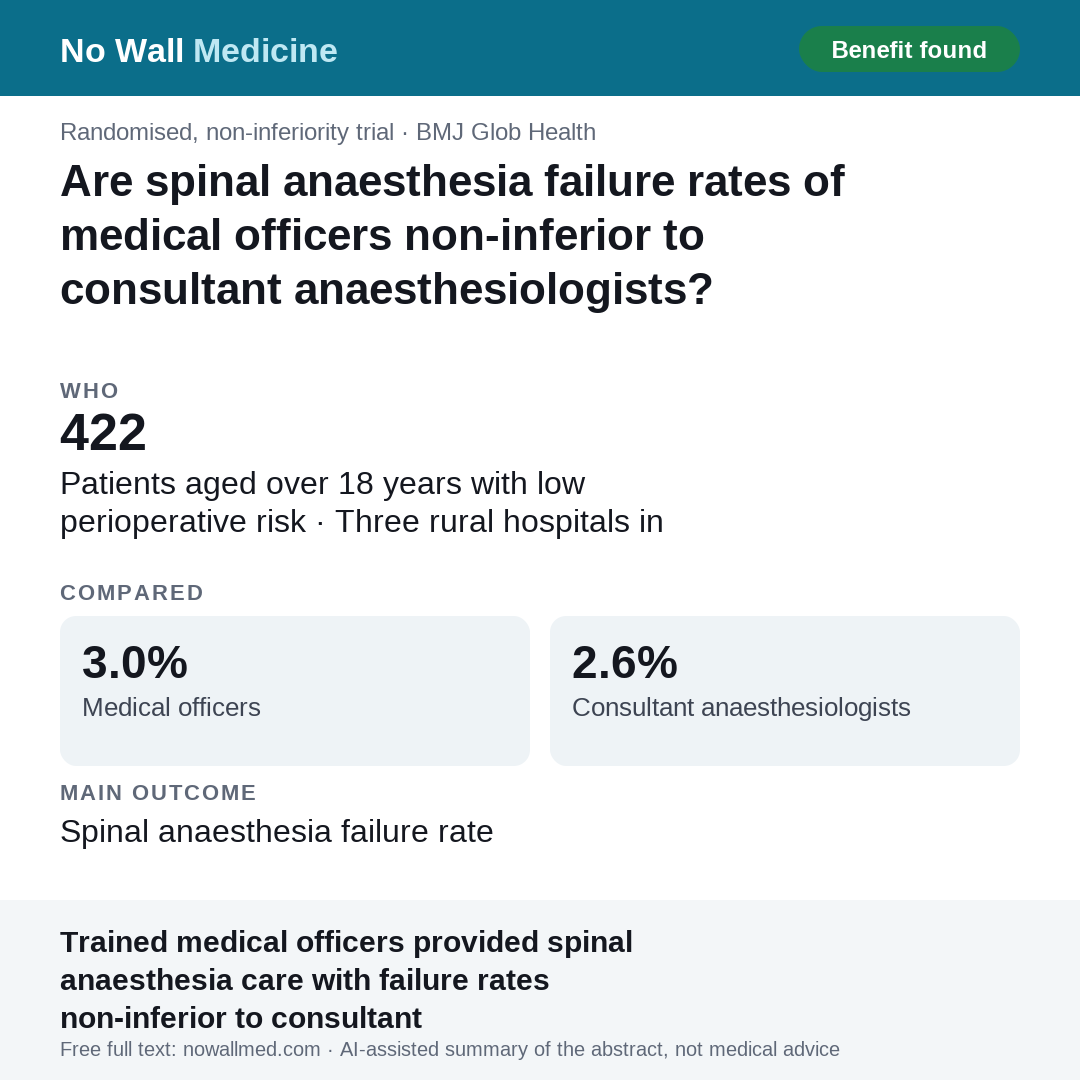
Clinical question: Are spinal anaesthesia failure rates of medical officers non-inferior to consultant anaesthesiologists?
Why it matters: It was unknown if spinal anaesthesia failure rates for non-specialist medical officers were non-inferior to those of consultant anaesthesiologists after receiving standardized training.
Key points
- Researchers studied 422 patients in three rural Indian hospitals who were randomized to receive care from either medical officers or consultant anaesthesiologists.
- The spinal anaesthesia failure rate for medical officers was 3.0% compared to 2.6% for consultant anaesthesiologists, which was within the 5% non-inferiority margin.
- There were no statistically significant differences between the two groups regarding intraoperative or postoperative complications or patient pain levels.
Headline and key points written with AI from the paper’s abstract, with every number checked against it. Read the paper before relying on them.
Abstract
Background
Task-sharing of spinal anaesthesia care by non-specialist graduate physicians, termed medical officers (MOs), is commonly practised in rural Indian healthcare facilities to mitigate workforce constraints. We sought to assess whether spinal anaesthesia failure rates of MOs were non-inferior to those of consultant anaesthesiologists (CA) following a standardised educational curriculum. Methods
We performed a randomised, non-inferiority trial in three rural hospitals in Tamil Nadu and Chhattisgarh, India. Patients aged over 18 years with low perioperative risk (ASA I & II) were randomised to receive MO or CA care. Prior to the trial, MOs underwent task-based anaesthesia training, inclusive of remotely accessed lectures, simulation-based training and directly observed anaesthetic procedures and intraoperative care. The primary outcome measure was spinal anaesthesia failure with a non-inferiority margin of 5%. Secondary outcome measures consisted of incidence of perioperative and postoperative complications. Findings
Between 12 July 2019 and 8 June 2020, a total of 422 patients undergoing surgical procedures amenable to spinal anaesthesia care were randomised to receive either MO (231, 54.7%) or CA care (191, 45.2%). Spinal anaesthesia failure rate for MOs (7, 3.0%) was non-inferior to those of CA (5, 2.6%); difference in success rate of 0.4% (95% CI=0.36-0.43%; p=0.80). Additionally, there were no statistically significant differences observed between the two groups for intraoperative or postoperative complications, or patients' experience of pain during the procedure. Interpretation
This study demonstrates that failure rates of spinal anaesthesia care provided by trained MOs are non-inferior to care provided by CAs in low-risk surgical patients. This may support policy measures that use task-sharing as a means of expanding anaesthesia care capacity in rural Indian hospitals. Trial registration number
NCT04438811.
Abstract reproduced under the article’s CC BY NC licence.
Topics
Cite this article
Menon N, George R, Kataria R, Manoharan R, Brooks MB, Pendleton A. Task-sharing spinal anaesthesia care in three rural Indian hospitals: a non-inferiority randomised controlled clinical trial. BMJ Glob Health. 2024. doi:10.1136/bmjgh-2023-014170
Spotted a mistake? Suggest a correction
Top studies every Monday
The week’s key trials and guidelines in your specialties, plus any topics you follow. By email, free.
Get the weekly digest