Systematic review suggests whole-eye transplantation is technically feasible in animal models
Technical Feasibility of Whole-eye Vascular Composite Allotransplantation: A Systematic Review
Systematic reviewBenefit found
Is whole-eye vascular composite allotransplantation surgically feasible?
Who
Mammalian and cold-blooded models · Not specified
Compared
Mammalian microvascular anastomosis: 96% of allografts survived after surgery
Nervous coaptation: 82.9% of retinas had positive electroretinogram signals
Main outcome
Surgical feasibility, allograft survival, and functional retinal survival
Bottom line: Whole-eye transplantation appears feasible with high allograft survival and potential functional retinal restoration in animal models.
Limitation: Results on optic nerve function were inconclusive and ocular-motor functionality was rarely addressed.
Plast Reconstr Surg Glob Open · 2023-04-25Download image
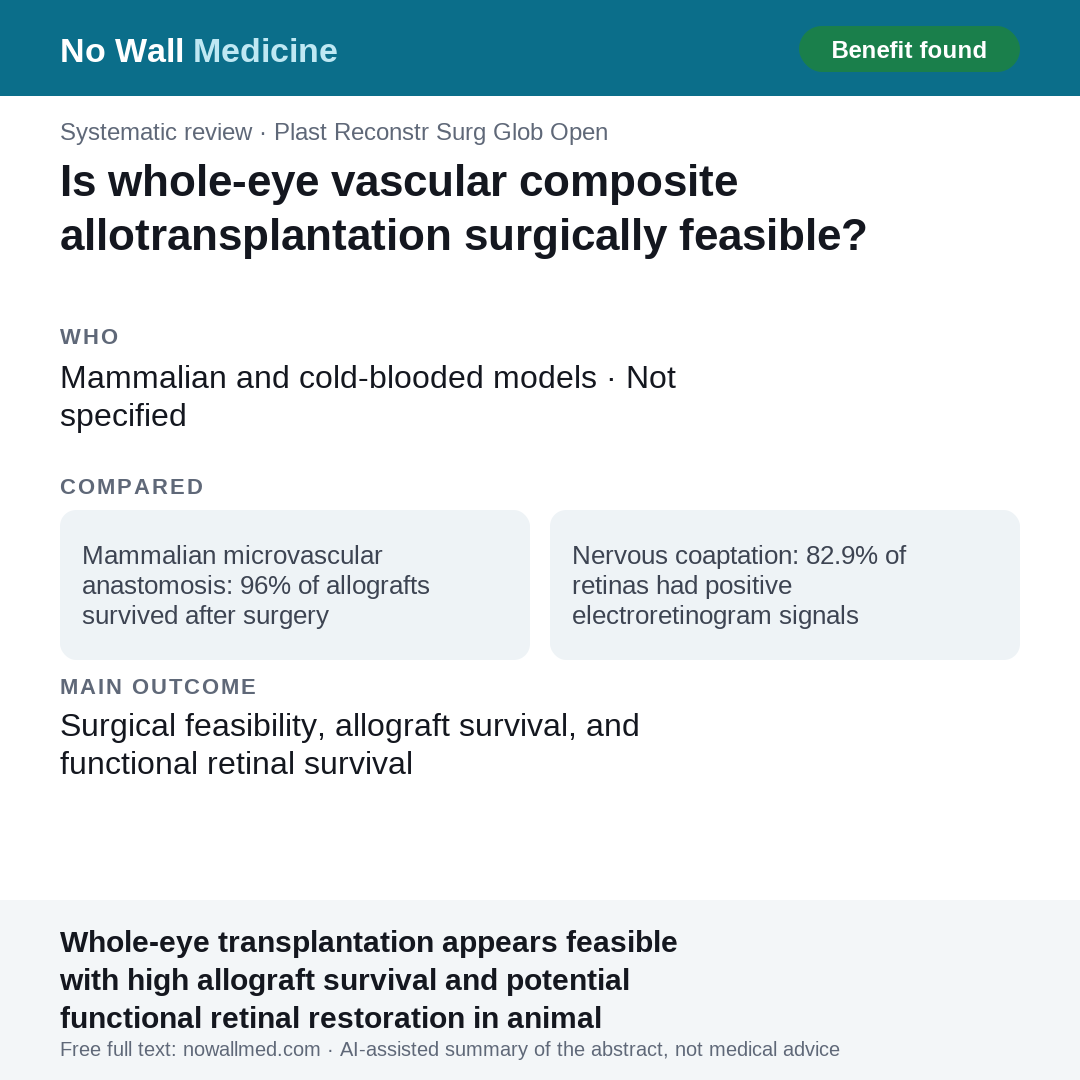
Clinical question: Is whole-eye vascular composite allotransplantation surgically feasible?
Why it matters: It is unknown if whole-eye transplantation is technically feasible or what the barriers and ethical concerns might be for future clinical use.
Key points
- Researchers reviewed 33 articles involving 14 mammalian and 19 cold-blooded animal models to assess surgical techniques for whole-eye transplantation.
- In mammalian studies using microvascular anastomosis (connecting small blood vessels), 96% of transplanted eyes survived after surgery.
- With nervous coaptation (joining nerve fibers), 82.9% of retinas showed positive electroretinogram signals, which indicates functional retinal cells.
Headline and key points written with AI from the paper’s abstract, with every number checked against it. Read the paper before relying on them.
Was this summary helpful?
Cite this article
Laspro M, Chaya BF, Brydges HT, Dave N, Thys E, Onuh OC. Technical Feasibility of Whole-eye Vascular Composite Allotransplantation: A Systematic Review. Plast Reconstr Surg Glob Open. 2023. doi:10.1097/GOX.0000000000004946
Spotted a mistake? Suggest a correction
Top studies every Monday
The week’s key trials and guidelines in your specialties, plus any topics you follow. By email, free.
Get the weekly digest