Team-based tele-instruction tool improved chest compression quality among multiple lay responders during simulations
Tele-Instruction Tool for Multiple Lay Responders Providing Cardiopulmonary Resuscitation in Telehealth Emergency Dispatch Services: Mixed Methods Study
Randomized controlled simulation trialBenefit found
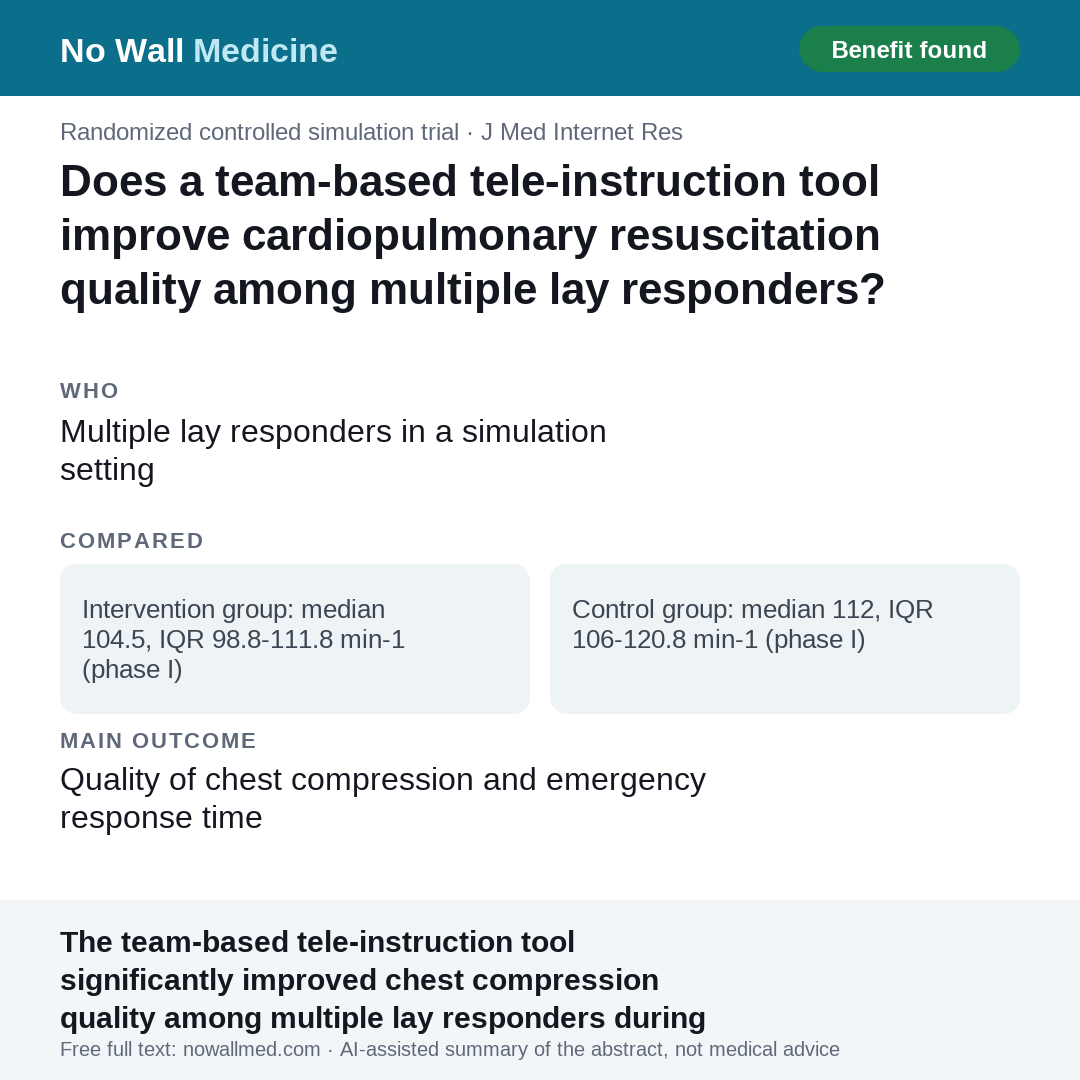
Does a team-based tele-instruction tool improve cardiopulmonary resuscitation quality among multiple lay responders?
Who
Multiple lay responders in a simulation setting
Compared
Intervention group: median 104.5, IQR 98.8-111.8 min-1 (phase I)
Control group: median 112, IQR 106-120.8 min-1 (phase I)
Main outcome
Quality of chest compression and emergency response time
Bottom line: The team-based tele-instruction tool significantly improved chest compression quality among multiple lay responders during resuscitation.
Limitation: Further assessment in real-life rescue scenarios is warranted.
J Med Internet Res · 2023-07-26Download image
Clinical question: Does a team-based tele-instruction tool improve cardiopulmonary resuscitation quality among multiple lay responders?
Why it matters: Existing telephone-assisted cardiopulmonary resuscitation protocols focus on individual rescuers rather than instructing and coordinating multiple lay responders to work together.
Key points
- Researchers conducted a randomized controlled simulation trial comparing a team-based tele-instruction tool to standard methods for guiding multiple lay responders in cardiopulmonary resuscitation.
- The tool was associated with more appropriate chest compression rates in phase I (median 104.5, IQR 98.8-111.8 min-1 vs median 112, IQR 106-120.8 min-1) and phase II (median 117.5, IQR 112.3-125 min-1 vs median 111, IQR 105.3-119 min-1).
- The intervention group showed a delay in time to first chest compression (median 20, IQR 15-24.8 seconds vs median 25, IQR 20.5-40.3 seconds) and time to open the airway (median 48, IQR 36.3-62 seconds vs median 73.5, IQR 54.5-227.8 seconds).
Headline and key points written with AI from the paper’s abstract, with every number checked against it. Read the paper before relying on them.
Was this summary helpful?
Subject terms
Cite this article
Xu J, Qu M, Dong X, Chen Y, Yin H, Qu F. Tele-Instruction Tool for Multiple Lay Responders Providing Cardiopulmonary Resuscitation in Telehealth Emergency Dispatch Services: Mixed Methods Study. J Med Internet Res. 2023. doi:10.2196/46092
Spotted a mistake? Suggest a correction
Top studies every Monday
The week’s key trials and guidelines in your specialties, plus any topics you follow. By email, free.
Get the weekly digest