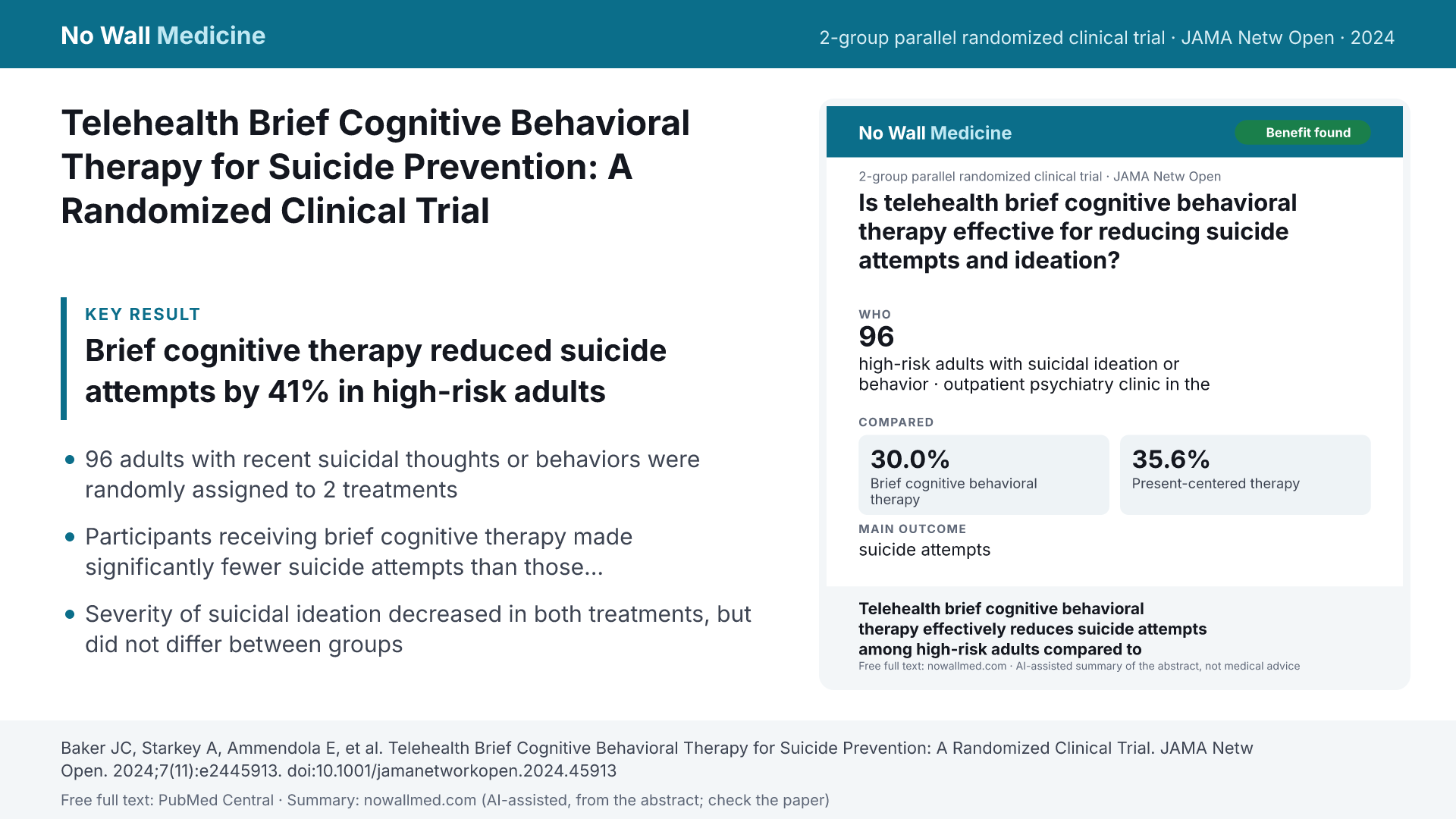
Brief cognitive therapy reduced suicide attempts by 41% in high-risk adults
Telehealth Brief Cognitive Behavioral Therapy for Suicide Prevention: A Randomized Clinical Trial
2-group parallel randomized clinical trialBenefit found
Is telehealth brief cognitive behavioral therapy effective for reducing suicide attempts and ideation?
Who
96
high-risk adults with suicidal ideation or behavior · outpatient psychiatry clinic in the midwestern US
Compared
30.0%Brief cognitive behavioral therapy
35.6%Present-centered therapy
Main outcome
suicide attempts
Result: hazard ratio 0.59 (95% CI 0.36-0.96)
Bottom line: Telehealth brief cognitive behavioral therapy effectively reduces suicide attempts among high-risk adults compared to present-centered therapy.
JAMA Netw Open · 2024-11-04 · Save PNG
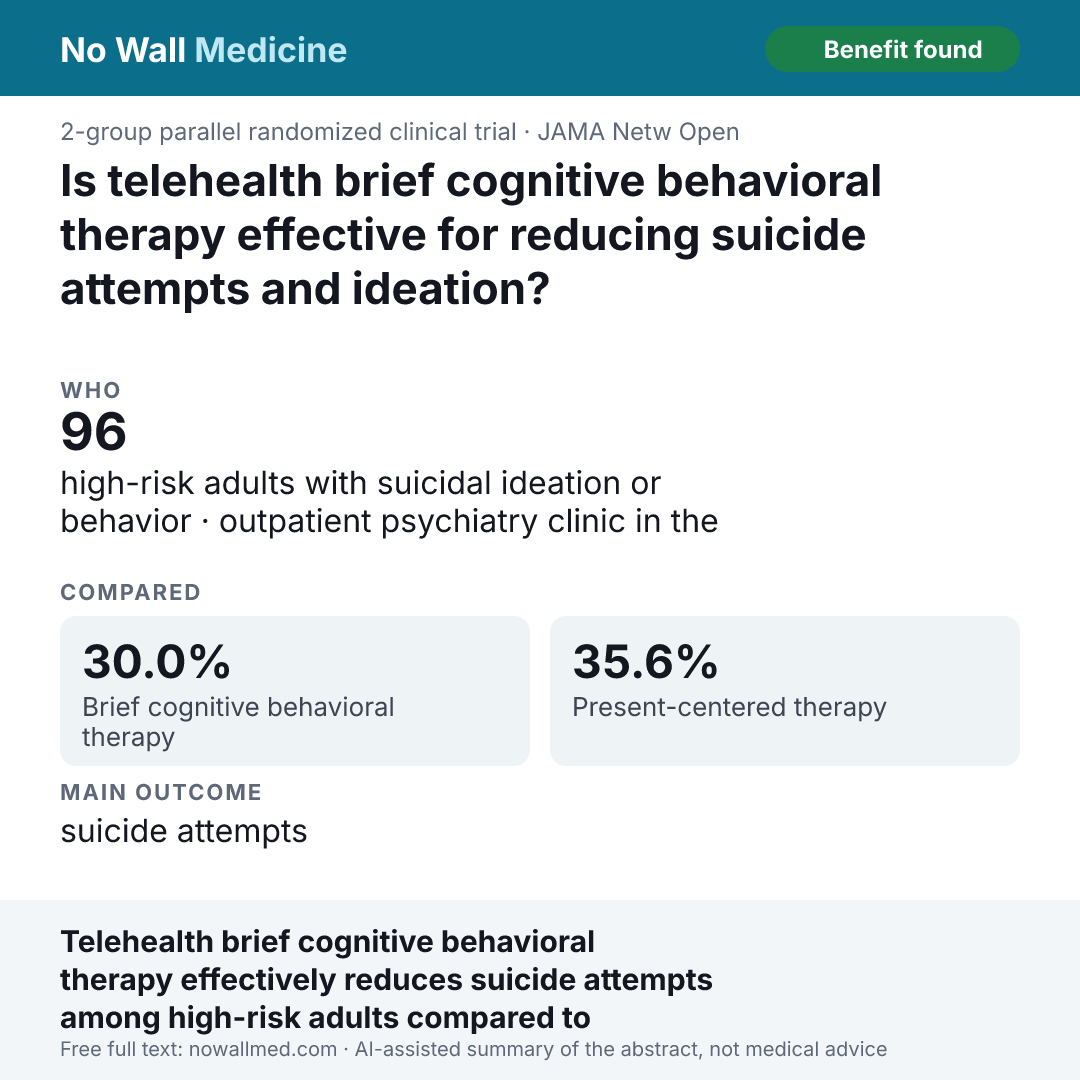
Clinical question: Is telehealth brief cognitive behavioral therapy effective for reducing suicide attempts and ideation?
Key points
- 96 adults with recent suicidal thoughts or behaviors were randomly assigned to 2 treatments.
- Participants receiving brief cognitive therapy made significantly fewer suicide attempts than those receiving present-centered therapy.
- Severity of suicidal ideation decreased in both treatments, but did not differ between groups.
Headline and key points written with AI from the paper’s abstract, with every number checked against it. Read the paper before relying on them.
Was this summary helpful?
Subject terms
Headline, design, result, key points, caveat and citation as plain text.
Cite this article
Baker JC, Starkey A, Ammendola E, et al. Telehealth Brief Cognitive Behavioral Therapy for Suicide Prevention: A Randomized Clinical Trial. JAMA Netw Open. 2024;7(11):e2445913. doi:10.1001/jamanetworkopen.2024.45913
Spotted a mistake? Suggest a correction