Telehealth parenting intervention improved behavior problems in young children with developmental delay
Telehealth Treatment of Behavior Problems in Young Children With Developmental Delay: A Randomized Clinical Trial
Randomized clinical trialBenefit found
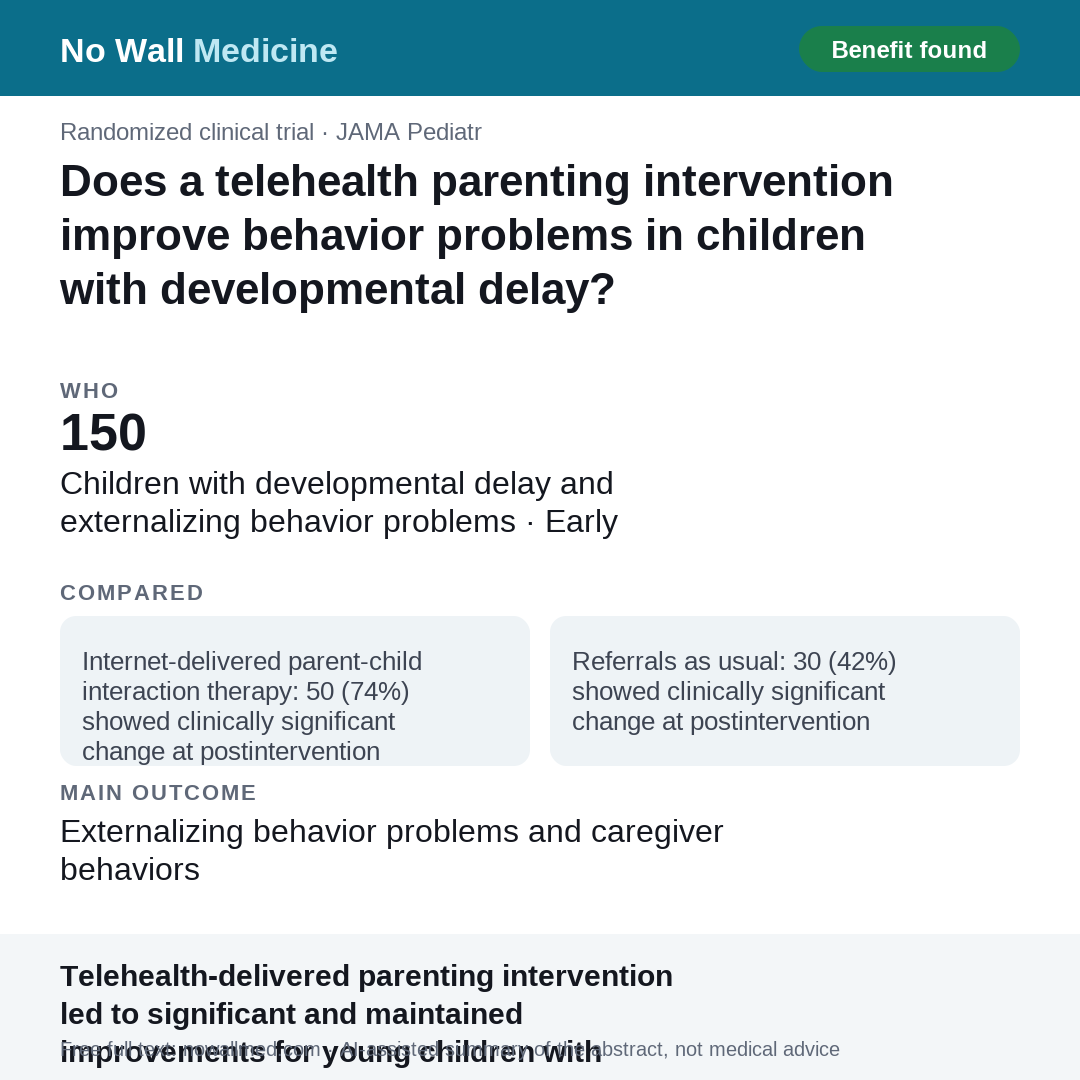
Does a telehealth parenting intervention improve behavior problems in children with developmental delay?
Who
150
Children with developmental delay and externalizing behavior problems · Early intervention sites
Compared
Internet-delivered parent-child interaction therapy: 50 (74%) showed clinically significant change at postintervention
Referrals as usual: 30 (42%) showed clinically significant change at postintervention
Main outcome
Externalizing behavior problems and caregiver behaviors
Result: postintervention Cohen d = 0.48
Bottom line: Telehealth-delivered parenting intervention led to significant and maintained improvements for young children with developmental delay and their caregivers.
JAMA Pediatr · 2023-01-10Download image
Clinical question: Does a telehealth parenting intervention improve behavior problems in children with developmental delay?
Why it matters: Controlled studies examining telehealth approaches for children with developmental delay are limited.
Key points
- Researchers studied 150 children with developmental delay and their caregivers, comparing internet-delivered parent-child interaction therapy to usual referrals.
- Children receiving the telehealth intervention showed lower levels of externalizing behavior problems at postintervention (Cohen d = 0.48), 6 months (Cohen d = 0.49), and 12 months (Cohen d = 0.50).
- The telehealth group had a higher rate of clinically significant change at postintervention (74%) compared to the referral group (42%).
Headline and key points written with AI from the paper’s abstract, with every number checked against it. Read the paper before relying on them.
Was this summary helpful?
Subject terms
Cite this article
Bagner DM, Berkovits MD, Coxe S, et al. Telehealth Treatment of Behavior Problems in Young Children With Developmental Delay: A Randomized Clinical Trial. JAMA Pediatr. 2023. doi:10.1001/jamapediatrics.2022.5204
Spotted a mistake? Suggest a correction