Telitacicept showed higher response rates than placebo in patients with active systemic lupus erythematosus
Telitacicept in patients with active systemic lupus erythematosus: results of a phase 2b, randomised, double-blind, placebo-controlled trial
Randomized, double-blind, placebo-controlled trialBenefit found
Is telitacicept effective and safe in patients with active systemic lupus erythematosus?
Who
249
Adult patients with active systemic lupus erythematosus · 29 hospitals in China
Compared
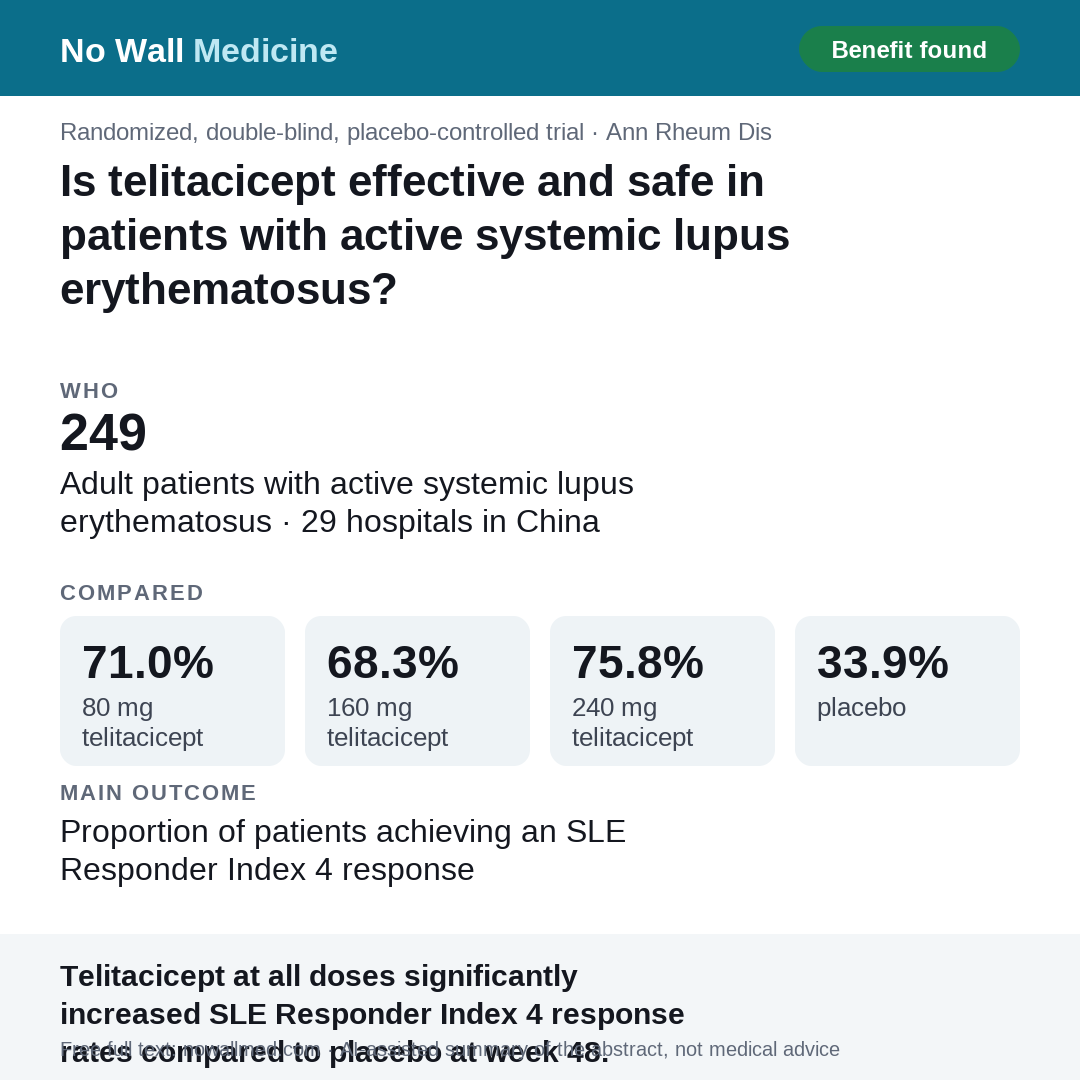
71.0%80 mg telitacicept
68.3%160 mg telitacicept
75.8%240 mg telitacicept
33.9%placebo
Main outcome
Proportion of patients achieving an SLE Responder Index 4 response
Bottom line: Telitacicept at all doses significantly increased SLE Responder Index 4 response rates compared to placebo at week 48.
Ann Rheum Dis · 2024-03-12Download image
Clinical question: Is telitacicept effective and safe in patients with active systemic lupus erythematosus?
Why it matters: The efficacy and safety of telitacicept, a protein that neutralizes B lymphocyte stimulator and proliferation-inducing ligand signals, were unknown in patients with active systemic lupus erythematosus.
Key points
- Researchers studied 249 adult patients with active systemic lupus erythematosus, comparing weekly subcutaneous doses of 80 mg, 160 mg, or 240 mg of telitacicept against a placebo.
- At week 48, the proportion of patients achieving the primary response measure was 75.8% for the 240 mg group, 68.3% for the 160 mg group, 71.0% for the 80 mg group, and 33.9% for the placebo group.
- The incidence of adverse events and serious adverse events was similar between the telitacicept and placebo groups.
Headline and key points written with AI from the paper’s abstract, with every number checked against it. Read the paper before relying on them.
Was this summary helpful?
Abstract
Objectives
This phase 2b, randomised, double-blind, placebo-controlled trial evaluated the efficacy and safety of telitacicept, a novel fusion protein that neutralises signals of B lymphocyte stimulator and a proliferation-inducing ligand, in active systemic lupus erythematosus (SLE). Methods
Adult patients with active SLE (n=249) were recruited from 29 hospitals in China and randomised 1:1:1:1 to receive subcutaneous telitacicept at 80 mg (n=62), 160 mg (n=63), 240 mg (n=62) or placebo (n=62) once weekly in addition to standard therapy. The primary endpoint was the proportion of patients achieving an SLE Responder Index 4 (SRI-4) response at week 48. Missing data were imputed using the last observation carried forward method. Results
At week 48, the proportion of patients achieving an SRI-4 response was 75.8% in the 240 mg telitacicept group, 68.3% in the 160 mg group, 71.0% in the 80 mg group and 33.9% in the placebo group (all p<0.001). Significant treatment responses were observed in secondary endpoints, including a ≥4-point reduction on the Systemic Lupus Erythematosus Disease Activity Index, a lack of Physician's Global Assessment score worsening and a glucocorticoid dose reduction in the 240 mg group. Telitacicept was well tolerated, and the incidence of adverse events and serious adverse events was similar between the telitacicept and placebo groups. Conclusions
This phase 2b clinical trial met the primary endpoint. All telitacicept groups showed a significantly higher proportion of patients achieving an SRI-4 response than the placebo group at week 48, and all doses were well tolerated. These results support further investigations of telitacicept in clinical trials involving more diverse populations and larger sample sizes. Trial registration number
ClinicalTrials.gov Registry (NCT02885610).
Abstract reproduced under the article’s CC BY NC licence.
Subject terms
Cite this article
Wu D, Li J, Xu D, Merrill JT, van Vollenhoven RF, Liu Y. Telitacicept in patients with active systemic lupus erythematosus: results of a phase 2b, randomised, double-blind, placebo-controlled trial. Ann Rheum Dis. 2024. doi:10.1136/ard-2023-224854
Spotted a mistake? Suggest a correction
Top studies every Monday
The week’s key trials and guidelines in your specialties, plus any topics you follow. By email, free.
Get the weekly digest