High-dose influenza vaccine was not superior to standard-dose for reducing cardiopulmonary events
Temporal Association Among Influenza-Like Illness, Cardiovascular Events, and Vaccine Dose in Patients With High-Risk Cardiovascular Disease: Secondary Analysis of a Randomized Clinical Trial
Double-blind, active comparator randomized clinical trialNo clear difference
Does high-dose trivalent influenza vaccine reduce cardiopulmonary events compared to standard-dose quadrivalent vaccine?
Who
3094
Patients with high-risk cardiovascular disease · Multicenter, United States
Compared
High-dose trivalent vaccine
Standard-dose quadrivalent vaccine
Main outcome
Time to composite of all-cause death or cardiopulmonary hospitalization
Result: odds ratio 0.88 (95% CI 0.65 to 1.20)
Bottom line: High-dose influenza vaccine did not significantly reduce cardiopulmonary events compared to standard-dose vaccine in high-risk cardiovascular patients.
JAMA Netw Open · 2023-09-05Download image
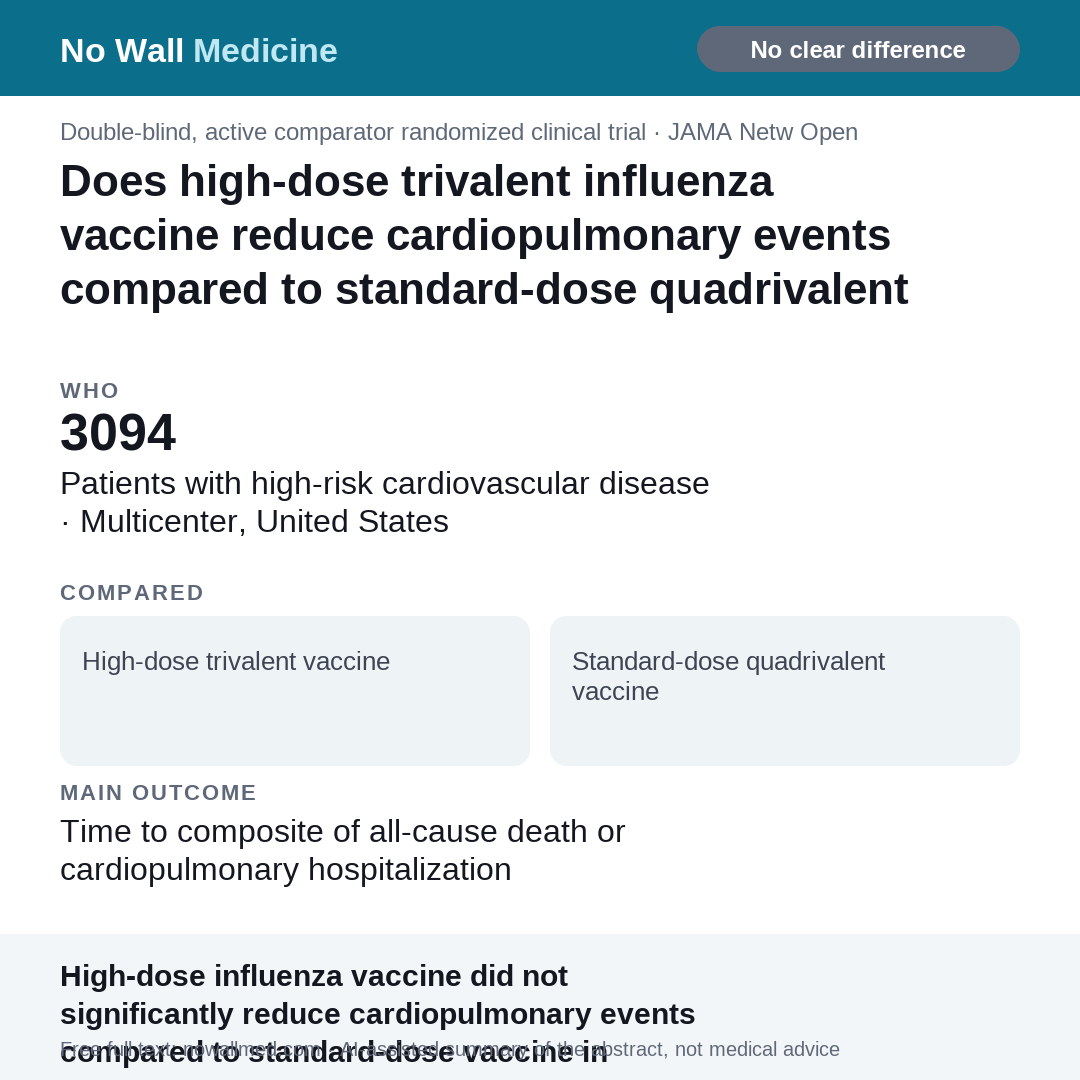
Clinical question: Does high-dose trivalent influenza vaccine reduce cardiopulmonary events compared to standard-dose quadrivalent vaccine?
Why it matters: It was unknown if a high-dose trivalent influenza vaccine provides more benefit than a standard-dose quadrivalent vaccine for reducing cardiopulmonary events in patients with high-risk cardiovascular disease.
Key points
- The study analyzed 3094 patients with high-risk cardiovascular disease who were randomized to receive either a high-dose trivalent or a standard-dose quadrivalent influenza vaccine.
- High-dose vaccine compared to standard-dose did not significantly reduce the primary outcome of all-cause death or cardiopulmonary hospitalization, even during weeks of high influenza-like illness activity.
- A 1% increase in influenza-like illness activity in the prior week was associated with an increased risk of cardiopulmonary hospitalization (OR, 1.13) and cardiovascular hospitalization (OR, 1.12).
Headline and key points written with AI from the paper’s abstract, with every number checked against it. Read the paper before relying on them.
Was this summary helpful?
Subject terms
Cite this article
Hegde SM, Claggett BL, Udell JA, Kim K, Joseph J, Farkouh ME. Temporal Association Among Influenza-Like Illness, Cardiovascular Events, and Vaccine Dose in Patients With High-Risk Cardiovascular Disease: Secondary Analysis of a Randomized Clinical Trial. JAMA Netw Open. 2023. doi:10.1001/jamanetworkopen.2023.31284
Spotted a mistake? Suggest a correction
Top studies every Monday
The week’s key trials and guidelines in your specialties, plus any topics you follow. By email, free.
Get the weekly digest