Temporal satisfaction patterns in body image after aesthetic surgery: A systematic review and meta-analysis
Systematic review and meta-analysisBenefit found
How does body image satisfaction evolve over time after aesthetic surgery?
Who
4823
Patients undergoing aesthetic surgery
Compared
71.4%1 month
82.6%3 months
87.2%6 months
91.5%12 months
Main outcome
Body image satisfaction rates over time
Bottom line: Body image satisfaction increases rapidly after aesthetic surgery before plateauing over time.
Limitation: Heterogeneous measurement tools, publication bias, and limited long-term follow-up beyond 24 months.
J Plast Reconstr Aesthet Surg · 2025-08-21Download image
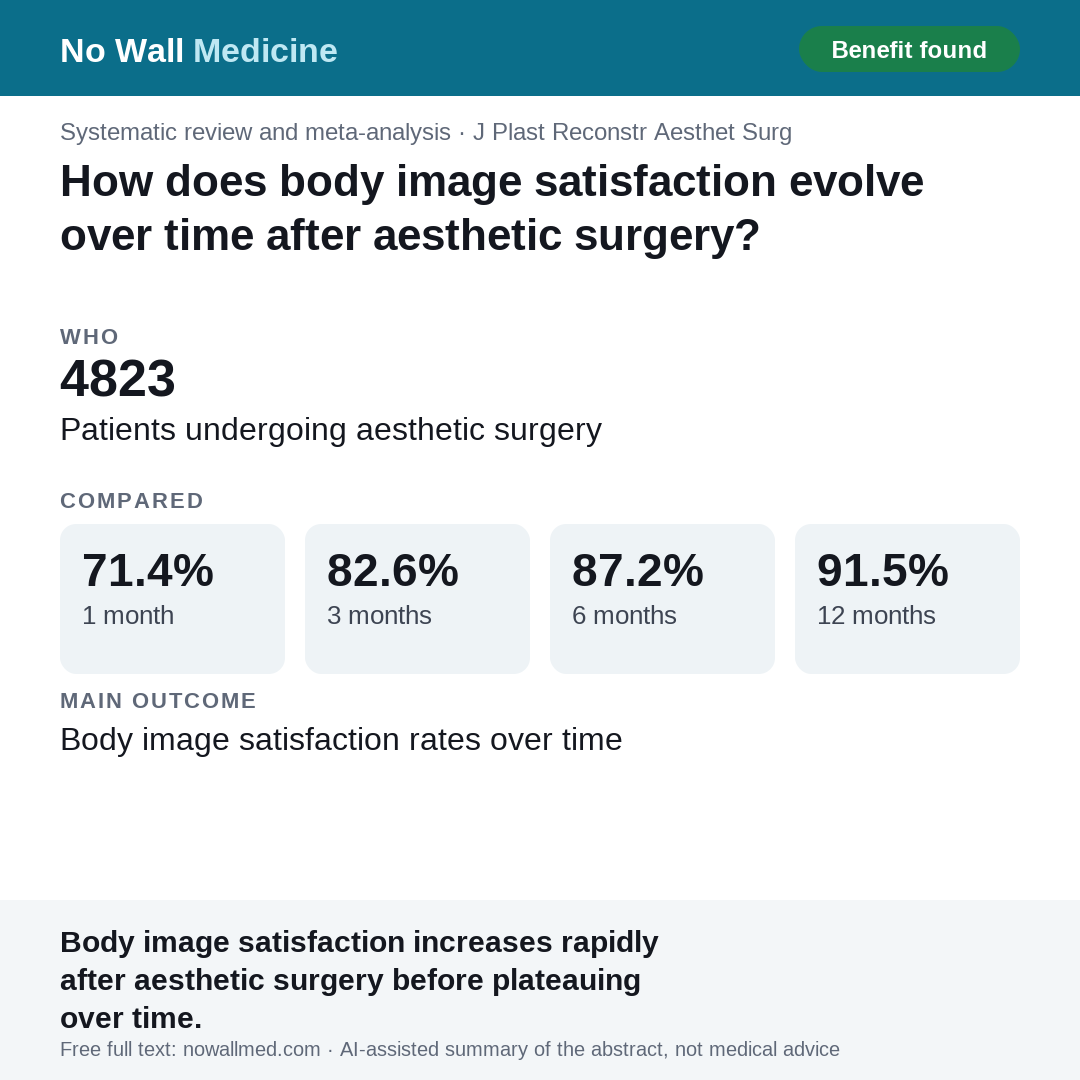
Clinical question: How does body image satisfaction evolve over time after aesthetic surgery?
Abstract
Background
Understanding how body image satisfaction evolves following aesthetic surgery is crucial for psychological adaptation and clinical practice. We systematically reviewed and meta-analyzed satisfaction trends over time following aesthetic surgery to elucidate the psychological adaptation process. Methods
We searched PubMed, Web of Science, and PsycINFO (2010-2024) for studies reporting satisfaction at multiple post-operative time points. This review was registered on PROSPERO CRD420251054218. Random-effects meta-analysis synthesized satisfaction rates, with subgroup analyses by procedure type. Meta-regression explored psychological and demographic predictors. Results
Twenty-seven studies (N=4823 patients) demonstrated satisfaction that increased rapidly then plateaued over time: 71.4% at 1 month, 82.6% at 3 months, 87.2% at 6 months, 91.5% at 12 months, and 93.8% at 24 months. Psychological screening (β=0.134, p<0.001) and age (β=0.012/year, p<0.001) positively predicted satisfaction, while body mass index (β=-0.024/unit, p=0.001) and revision surgery (β=-0.187, p<0.001) negatively predicted outcomes. Breast procedures showed the highest satisfaction (93.2% at 12 months), while rhinoplasty showed the lowest (86.3% at 12 months). Conclusions
Body image satisfaction following aesthetic surgery follows predictable adaptation patterns consistent with hedonic adaptation theory. The initial rapid increase reflects immediate post-operative relief, while subsequent stabilization represents integration into self-concept. Results support psychological screening and realistic expectation-setting for optimal outcomes. Limitations include heterogeneous measurement tools, publication bias, and limited long-term follow-up beyond 24 months.
Topics
Cite this article
Friedman O, Tal D. Temporal satisfaction patterns in body image after aesthetic surgery: A systematic review and meta-analysis. J Plast Reconstr Aesthet Surg. 2025. doi:10.1016/j.bjps.2025.07.044
Spotted a mistake? Suggest a correction