Transvenous diaphragm neurostimulation was associated with higher successful weaning rates in patients on mechanical ventilation
Temporary Transvenous Diaphragm Neurostimulation for Weaning from Mechanical Ventilation (RESCUE-3): A Randomized Clinical Trial
International, multicenter, open-label, randomized clinical trialMixed results
Does transvenous diaphragm neurostimulation increase successful weaning in patients with difficulty weaning?
Who
216
Adult patients requiring mechanical ventilation for 96 hours or more · International, multicenter
Compared
71transvenous diaphragm neurostimulation (70%)
69standard of care (61%)
Main outcome
successful weaning at Day 30
Result: adjusted hazard ratio 1.34 (95% credible interval 1.01-1.78)
Bottom line: Transvenous diaphragm neurostimulation showed potential benefit for weaning success but a possible increase in serious adverse events.
AJRCCM · 2025-06-11Download image
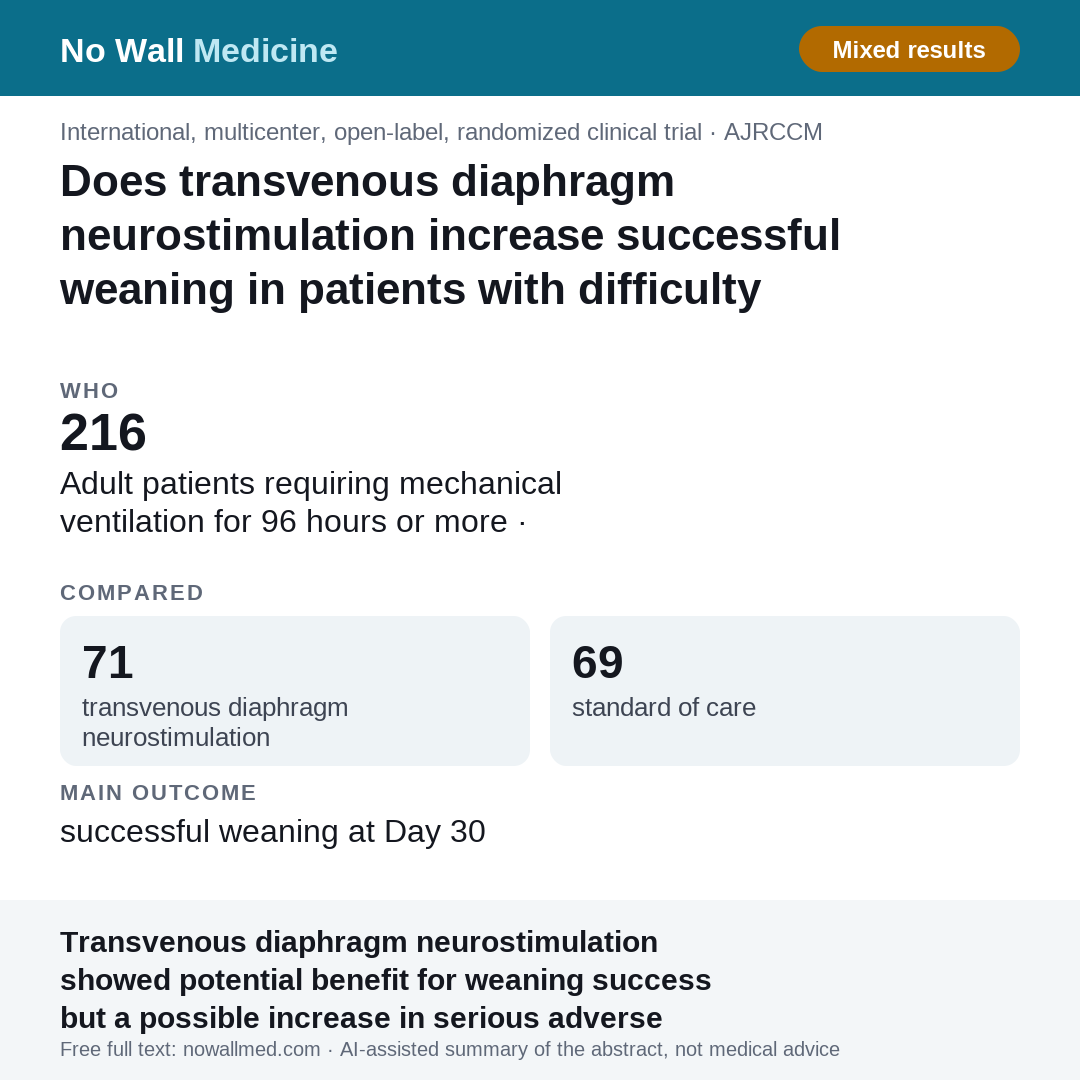
Clinical question: Does transvenous diaphragm neurostimulation increase successful weaning in patients with difficulty weaning?
Why it matters: It is uncertain how transvenous diaphragm neurostimulation, which aims to increase diaphragm strength, impacts patient outcomes for those struggling to breathe without a ventilator.
Key points
- The study randomized 216 adult patients who failed two or more weaning attempts to receive either twice-daily diaphragm neurostimulation or standard care.
- At Day 30, 70% of the treatment group successfully weaned compared to 61% in the control group.
- Serious adverse events were reported in 36% of the treatment group and 24% of the control group.
Headline and key points written with AI from the paper’s abstract, with every number checked against it. Read the paper before relying on them.
Topics
Cite this article
Dres M, Ewert R, Conrad SA, Ataya A, Shrager J, Mortaza S. Temporary Transvenous Diaphragm Neurostimulation for Weaning from Mechanical Ventilation (RESCUE-3): A Randomized Clinical Trial. AJRCCM. 2025. doi:10.1164/rccm.202505-1056OC
Spotted a mistake? Suggest a correction
Top studies every Monday
The week’s key trials and guidelines in your specialties, plus any topics you follow. By email, free.
Get the weekly digest