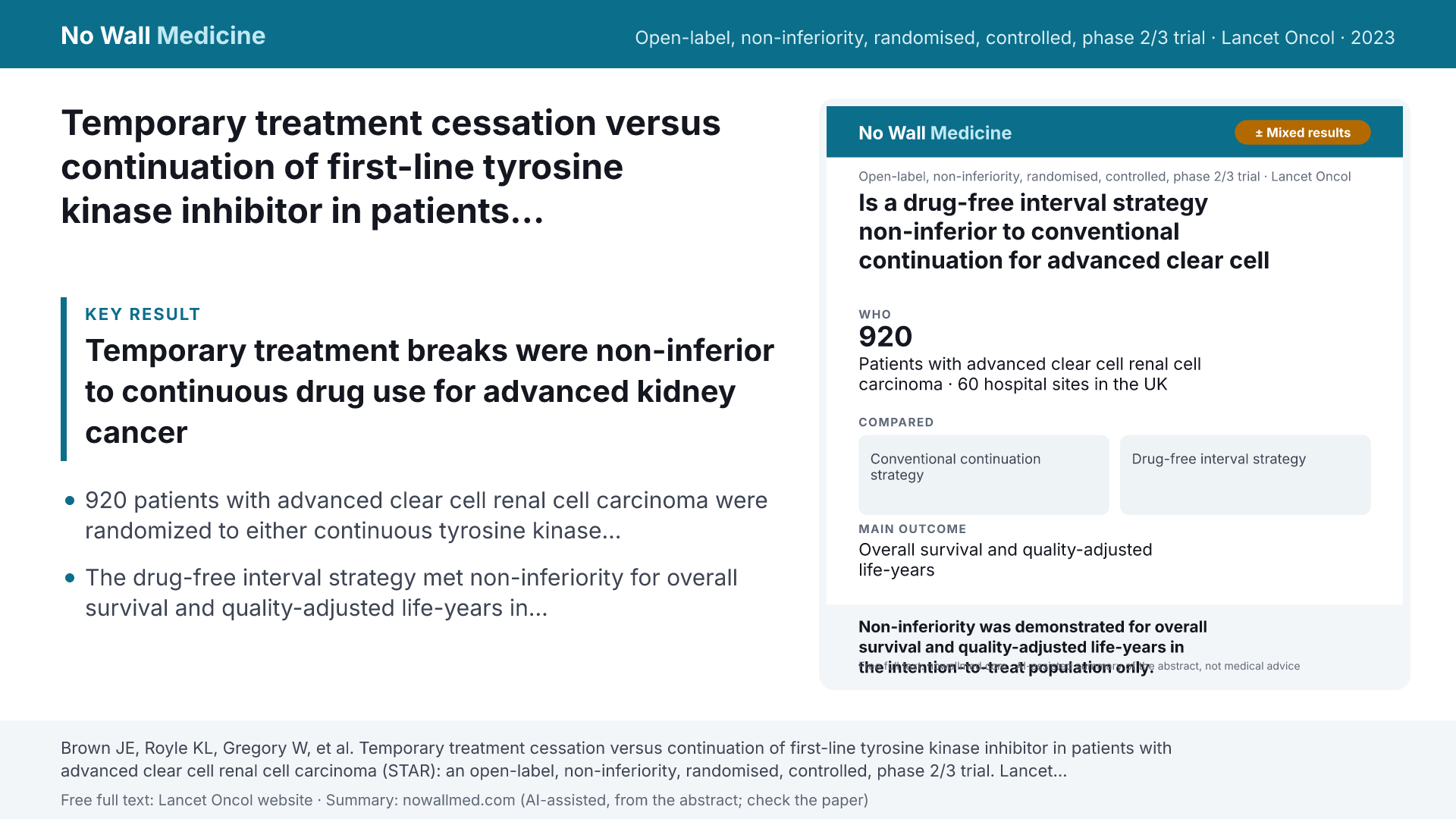
Temporary treatment breaks were non-inferior to continuous drug use for advanced kidney cancer
Temporary treatment cessation versus continuation of first-line tyrosine kinase inhibitor in patients with advanced clear cell renal cell carcinoma (STAR): an open-label, non-inferiority, randomised, controlled, phase 2/3 trial
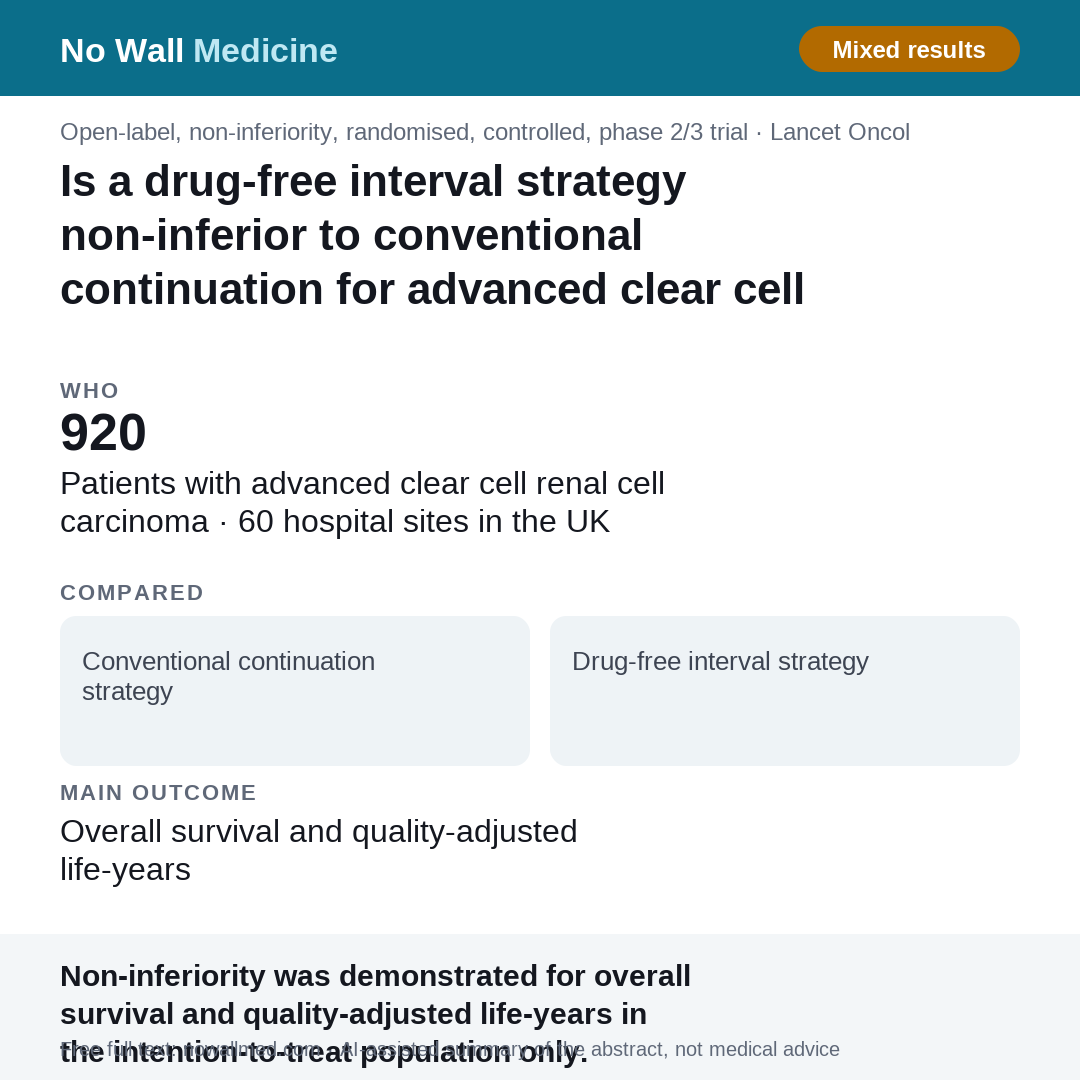
Open-label, non-inferiority, randomised, controlled, phase 2/3 trialMixed results
Is a drug-free interval strategy non-inferior to conventional continuation for advanced clear cell renal cell carcinoma?
Who
920
Patients with advanced clear cell renal cell carcinoma · 60 hospital sites in the UK
Compared
Conventional continuation strategy
Drug-free interval strategy
Main outcome
Overall survival and quality-adjusted life-years
Result: adjusted hazard ratio 0·97 (95% CI 0·83 to 1·12)
Bottom line: Non-inferiority was demonstrated for overall survival and quality-adjusted life-years in the intention-to-treat population only.
Limitation: Non-inferiority was not met for both endpoints in both analysis populations.
Lancet Oncol · 2023-02-13Download image
Clinical question: Is a drug-free interval strategy non-inferior to conventional continuation for advanced clear cell renal cell carcinoma?
Why it matters: It was unknown if pausing tyrosine kinase inhibitor treatment could reduce toxicity without compromising survival or quality of life in patients with advanced clear cell renal cell carcinoma.
Key points
- 920 patients with advanced clear cell renal cell carcinoma were randomized to either continuous tyrosine kinase inhibitor treatment or a strategy involving drug-free intervals.
- The drug-free interval strategy met non-inferiority for overall survival and quality-adjusted life-years in the intention-to-treat population, but not in the per-protocol population.
- Grade 3 or worse adverse events included hypertension, liver toxicity, and fatigue, with 21% of participants experiencing a serious adverse reaction.
Headline and key points written with AI from the paper’s abstract, with every number checked against it. Read the paper before relying on them.
Was this summary helpful?
Abstract
Background
Temporary drug treatment cessation might alleviate toxicity without substantially compromising efficacy in patients with cancer. We aimed to determine if a tyrosine kinase inhibitor drug-free interval strategy was non-inferior to a conventional continuation strategy for first-line treatment of advanced clear cell renal cell carcinoma. Methods
This open-label, non-inferiority, randomised, controlled, phase 2/3 trial was done at 60 hospital sites in the UK. Eligible patients (aged ≥18 years) had histologically confirmed clear cell renal cell carcinoma, inoperable loco-regional or metastatic disease, no previous systemic therapy for advanced disease, uni-dimensionally assessed Response Evaluation Criteria in Solid Tumours-defined measurable disease, and an Eastern Cooperative Oncology Group performance status of 0-1. Patients were randomly assigned (1:1) at baseline to a conventional continuation strategy or drug-free interval strategy using a central computer-generated minimisation programme incorporating a random element. Stratification factors were Memorial Sloan Kettering Cancer Center prognostic group risk factor, sex, trial site, age, disease status, tyrosine kinase inhibitor, and previous nephrectomy. All patients received standard dosing schedules of oral sunitinib (50 mg per day) or oral pazopanib (800 mg per day) for 24 weeks before moving into their randomly allocated group. Patients allocated to the drug-free interval strategy group then had a treatment break until disease progression, when treatment was re-instated. Patients in the conventional continuation strategy group continued treatment. Patients, treating clinicians, and the study team were aware of treatment allocation. The co-primary endpoints were overall survival and quality-adjusted life-years (QALYs); non-inferiority was shown if the lower limit of the two-sided 95% CI for the overall survival hazard ratio (HR) was 0·812 or higher and if the lower limit of the two-sided 95% CI of the marginal difference in mean QALYs was -0·156 or higher. The co-primary endpoints were assessed in the intention-to-treat (ITT) population, which included all randomly assigned patients, and the per-protocol population, which excluded patients in the ITT population with major protocol violations and who did not begin their randomisation allocation as per the protocol. Non-inferiority was to be concluded if it was met for both endpoints in both analysis populations. Safety was assessed in all participants who received a tyrosine kinase inhibitor. The trial was registered with ISRCTN, 06473203, and EudraCT, 2011-001098-16. Findings
Between Jan 13, 2012, and Sept 12, 2017, 2197 patients were screened for eligibility, of whom 920 were randomly assigned to the conventional continuation strategy (n=461) or the drug-free interval strategy (n=459; 668 [73%] male and 251 [27%] female; 885 [96%] White and 23 [3%] non-White). The median follow-up time was 58 months (IQR 46-73 months) in the ITT population and 58 months (46-72) in the per-protocol population. 488 patients continued on the trial after week 24. For overall survival, non-inferiority was demonstrated in the ITT population only (adjusted HR 0·97 [95% CI 0·83 to 1·12] in the ITT population; 0·94 [0·80 to 1·09] in the per-protocol population). Non-inferiority was demonstrated for QALYs in the ITT population (n=919) and per-protocol (n=871) population (marginal effect difference 0·06 [95% CI -0·11 to 0·23] for the ITT population; 0·04 [-0·14 to 0·21] for the per-protocol population). The most common grade 3 or worse adverse events were hypertension (124 [26%] of 485 patients in the conventional continuation strategy group vs 127 [29%] of 431 patients in the drug-free interval strategy group); hepatotoxicity (55 [11%] vs 48 [11%]); and fatigue (39 [8%] vs 63 [15%]). 192 (21%) of 920 participants had a serious adverse reaction. 12 treatment-related deaths were reported (three patients in the conventional continuation strategy group; nine patients in the drug-free interval strategy group) due to vascular (n=3), cardiac (n=3), hepatobiliary (n=3), gastrointestinal (n=1), or nervous system (n=1) disorders, and from infections and infestations (n=1). Interpretation
Overall, non-inferiority between groups could not be concluded. However, there seemed to be no clinically meaningful reduction in life expectancy between the drug-free interval strategy and conventional continuation strategy groups and treatment breaks might be a feasible and cost-effective option with lifestyle benefits for patients during tyrosine kinase inhibitor therapy in patients with renal cell carcinoma. Funding
UK National Institute for Health and Care Research.
Abstract reproduced under the article’s CC BY licence.
Subject terms
Cite this article
Brown JE, Royle KL, Gregory W, et al. Temporary treatment cessation versus continuation of first-line tyrosine kinase inhibitor in patients with advanced clear cell renal cell carcinoma (STAR): an open-label, non-inferiority, randomised, controlled, phase 2/3 trial. Lancet Oncol. 2023. doi:10.1016/S1470-2045(22)00793-8
Spotted a mistake? Suggest a correction