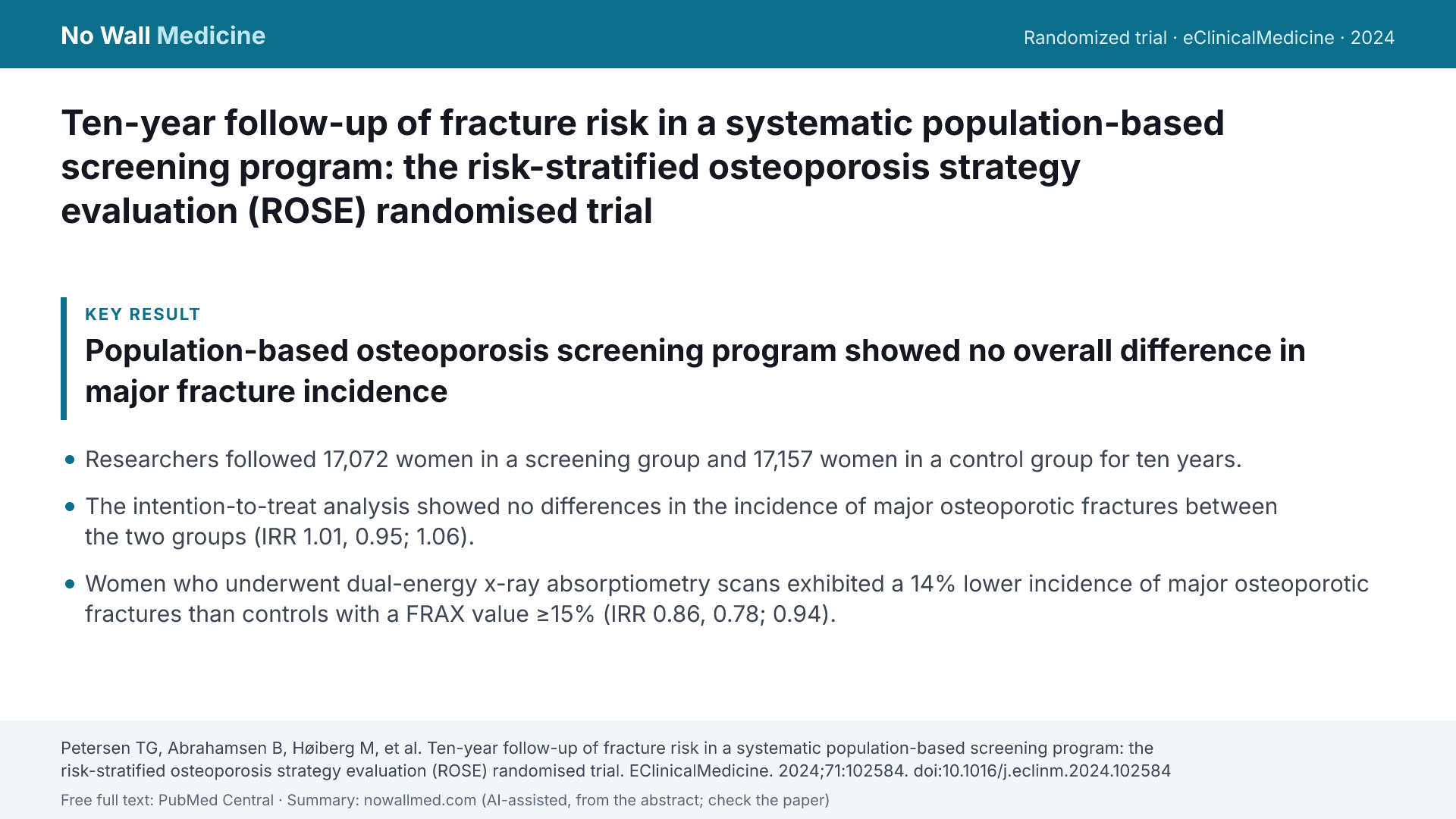
Population-based osteoporosis screening program showed no overall difference in major fracture incidence
Ten-year follow-up of fracture risk in a systematic population-based screening program: the risk-stratified osteoporosis strategy evaluation (ROSE) randomised trial
Key points
- Researchers followed 17,072 women in a screening group and 17,157 women in a control group for ten years.
- The intention-to-treat analysis showed no differences in the incidence of major osteoporotic fractures between the two groups (IRR 1.01, 0.95; 1.06).
- Women who underwent dual-energy x-ray absorptiometry scans exhibited a 14% lower incidence of major osteoporotic fractures than controls with a FRAX value ≥15% (IRR 0.86, 0.78; 0.94).
Headline and key points written with AI from the paper’s abstract, with every number checked against it. Read the paper before relying on them.
Was this summary helpful?
Cite this article
Petersen TG, Abrahamsen B, Høiberg M, et al. Ten-year follow-up of fracture risk in a systematic population-based screening program: the risk-stratified osteoporosis strategy evaluation (ROSE) randomised trial. EClinicalMedicine. 2024;71:102584. doi:10.1016/j.eclinm.2024.102584
Spotted a mistake? Suggest a correction