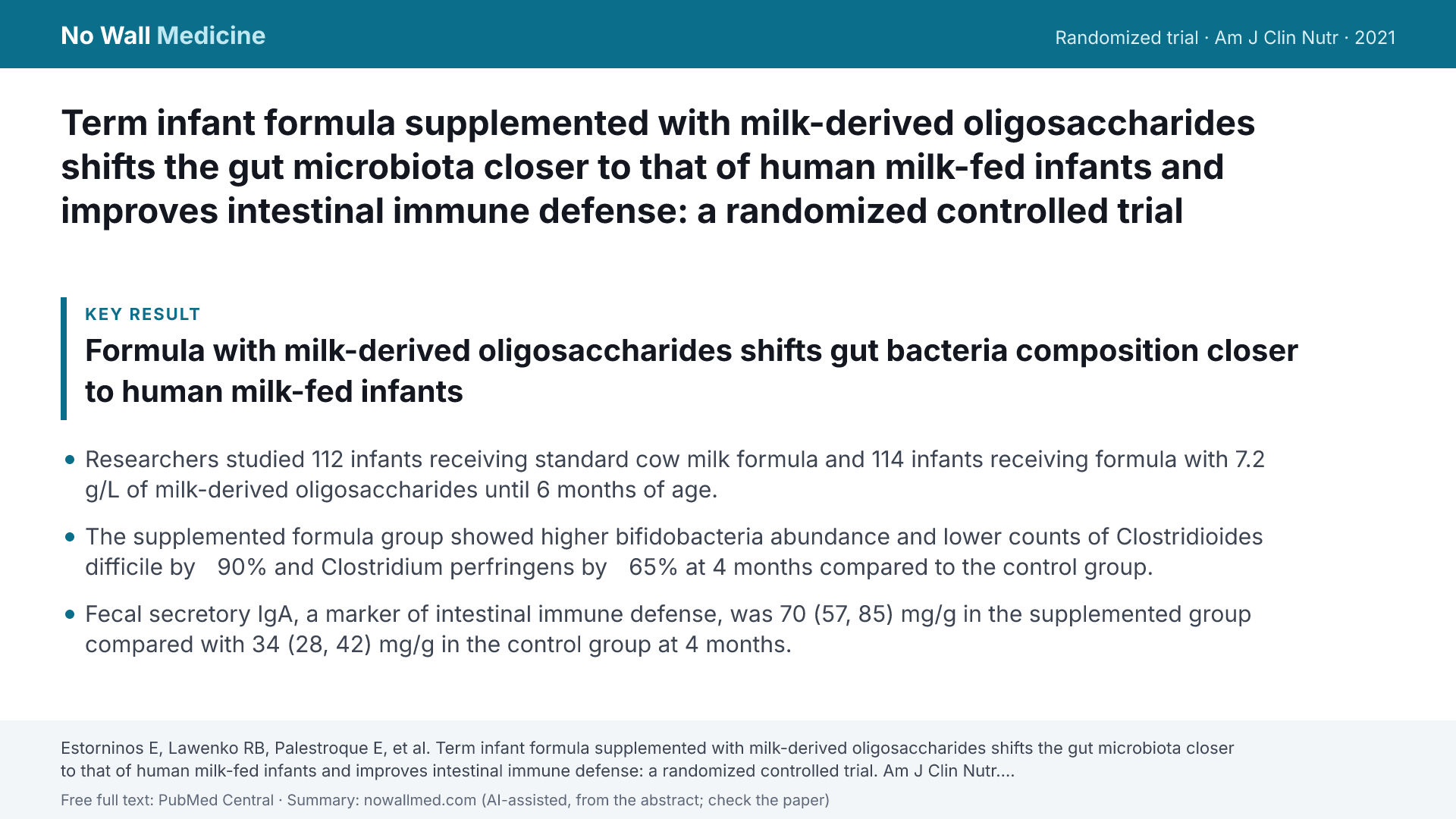
Term infant formula supplemented with milk-derived oligosaccharides shifts the gut microbiota closer to that of human milk-fed infants and improves intestinal immune defense: a randomized controlled trial
Key result: Formula with milk-derived oligosaccharides shifts gut bacteria composition closer to human milk-fed infants
Key points
- Researchers studied 112 infants receiving standard cow milk formula and 114 infants receiving formula with 7.2 g/L of milk-derived oligosaccharides until 6 months of age.
- The supplemented formula group showed higher bifidobacteria abundance and lower counts of Clostridioides difficile by ∼90% and Clostridium perfringens by ∼65% at 4 months compared to the control group.
- Fecal secretory IgA, a marker of intestinal immune defense, was 70 (57, 85) mg/g in the supplemented group compared with 34 (28, 42) mg/g in the control group at 4 months.
Why it matters: It is unknown how adding milk-derived oligosaccharides to infant formula affects the gut microbiota and intestinal immune response compared to human milk.
Discussion prompts
- Would these patients look like yours? Who was left out?
- Is the main outcome one that matters to patients?
- Is the difference large enough to change what you do?
Cite: Estorninos E, Lawenko RB, Palestroque E, et al. Term infant formula supplemented with milk-derived oligosaccharides shifts the gut microbiota closer to that of human milk-fed infants and improves intestinal immune defense: a randomized controlled trial. Am J Clin Nutr. 2021. doi:10.1093/ajcn/nqab336
Free full text: PubMed Central · Summary and visual abstract: nowallmed.com/a/term-infant-formula-supplemented-with-milk-derived-oligosaccharides-11tonyr/ (AI-assisted from the abstract; check the paper before relying on it).