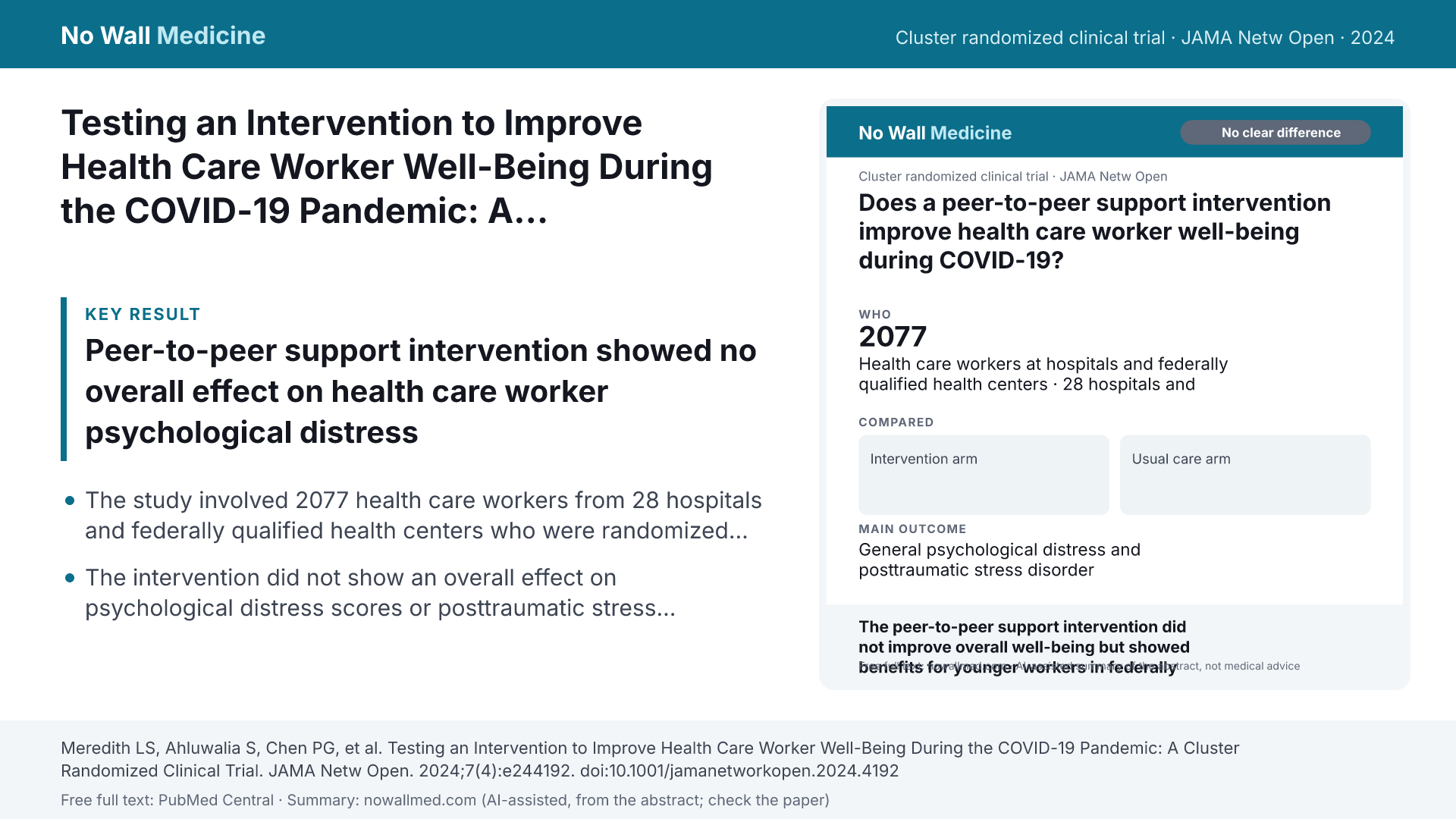
Peer-to-peer support intervention showed no overall effect on health care worker psychological distress
Testing an Intervention to Improve Health Care Worker Well-Being During the COVID-19 Pandemic: A Cluster Randomized Clinical Trial
Cluster randomized clinical trialNo clear difference
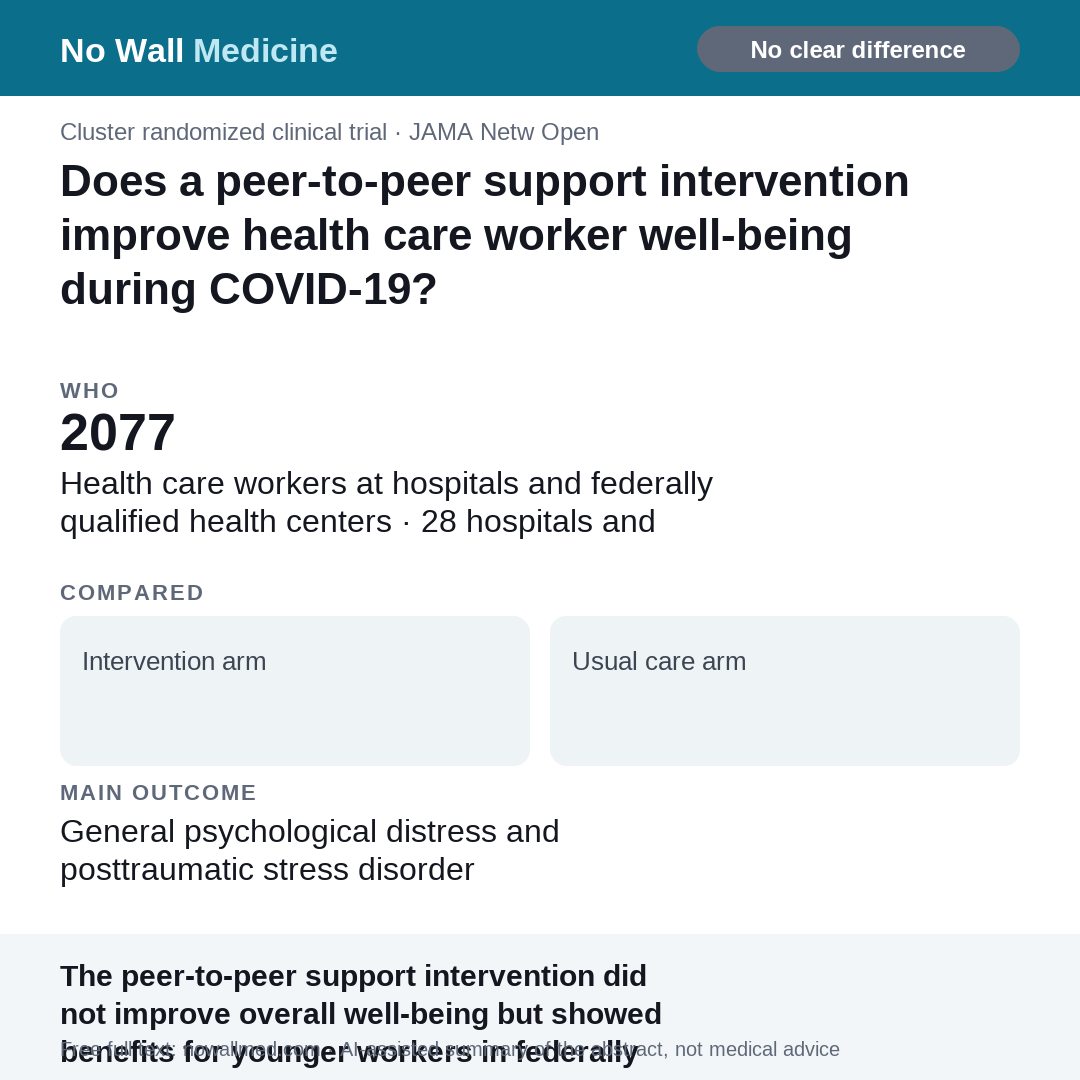
Does a peer-to-peer support intervention improve health care worker well-being during COVID-19?
Who
2077
Health care workers at hospitals and federally qualified health centers · 28 hospitals and federally qualified health centers in the US
Compared
Intervention arm
Usual care arm
Main outcome
General psychological distress and posttraumatic stress disorder
Result: psychological distress score 0.238 (95% CI, -0.310 to 0.785); PTSD symptom score 0.189 (95% CI, -1.068 to 1.446)
Bottom line: The peer-to-peer support intervention did not improve overall well-being but showed benefits for younger workers in federally qualified health centers.
JAMA Netw Open · 2024-04-01Download image
Clinical question: Does a peer-to-peer support intervention improve health care worker well-being during COVID-19?
Why it matters: It was unknown if a tailored peer-to-peer support intervention could effectively support the well-being of health care workers during the COVID-19 pandemic.
Key points
- The study involved 2077 health care workers from 28 hospitals and federally qualified health centers who were randomized to receive either peer-to-peer support or usual care.
- The intervention did not show an overall effect on psychological distress scores or posttraumatic stress disorder symptoms.
- In federally qualified health centers, workers aged 30 years or younger showed a reduction of more than 4 points in psychological distress and nearly 7 points in posttraumatic stress disorder scores.
Headline and key points written with AI from the paper’s abstract, with every number checked against it. Read the paper before relying on them.
Was this summary helpful?
Subject terms
Cite this article
Meredith LS, Ahluwalia S, Chen PG, et al. Testing an Intervention to Improve Health Care Worker Well-Being During the COVID-19 Pandemic: A Cluster Randomized Clinical Trial. JAMA Netw Open. 2024. doi:10.1001/jamanetworkopen.2024.4192
Spotted a mistake? Suggest a correction