Genetic analysis links physical activity and sedentary behavior to mental health and substance use
Testing the causal relationships of physical activity and sedentary behaviour with mental health and substance use disorders: a Mendelian randomisation study
Two-sample Mendelian randomisation studyMixed results
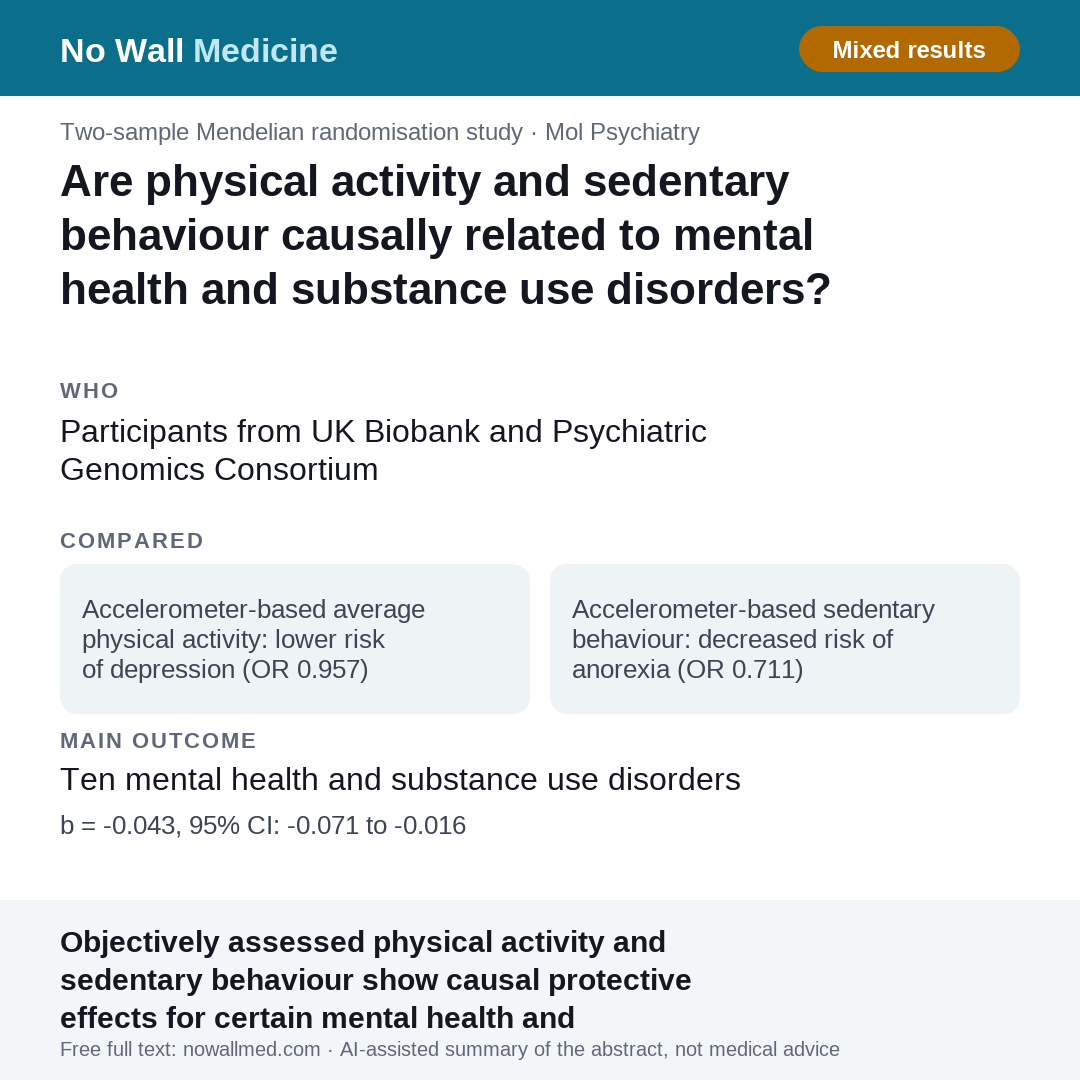
Are physical activity and sedentary behaviour causally related to mental health and substance use disorders?
Who
Participants from UK Biobank and Psychiatric Genomics Consortium
Compared
Accelerometer-based average physical activity: lower risk of depression (OR 0.957)
Accelerometer-based sedentary behaviour: decreased risk of anorexia (OR 0.711)
Main outcome
Ten mental health and substance use disorders
Result: b = -0.043, 95% CI: -0.071 to -0.016
Bottom line: Objectively assessed physical activity and sedentary behaviour show causal protective effects for certain mental health and substance use disorders.
Mol Psychiatry · 2023-07-21Download image
Clinical question: Are physical activity and sedentary behaviour causally related to mental health and substance use disorders?
Why it matters: It is unclear whether the link between physical activity and mental health disorders is causal or explained by confounding bias or reverse causality.
Key points
- Researchers used Mendelian randomization to examine the bidirectional causal relationships between physical activity, sedentary behavior, and ten mental health or substance use disorders.
- Objectively measured average physical activity was associated with a lower risk of depression (OR = 0.957) and cigarette smoking (β = -0.022).
- Sedentary behavior was associated with a lower risk of anorexia (OR = 0.711) and schizophrenia (OR = 0.795), though reverse causality was found for schizophrenia.
Headline and key points written with AI from the paper’s abstract, with every number checked against it. Read the paper before relying on them.
Was this summary helpful?
Subject terms
Cite this article
Iob E, Pingault JB, Munafò MR, Stubbs B, Gilthorpe MS, Maihofer AX. Testing the causal relationships of physical activity and sedentary behaviour with mental health and substance use disorders: a Mendelian randomisation study. Mol Psychiatry. 2023. doi:10.1038/s41380-023-02133-9
Spotted a mistake? Suggest a correction
Top studies every Monday
The week’s key trials and guidelines in your specialties, plus any topics you follow. By email, free.
Get the weekly digest