Testosterone injections in infants with Klinefelter syndrome changed body composition but not neurodevelopmental outcomes
Testosterone Effects on Short-term Physical, Hormonal, and Neurodevelopmental Outcomes (TESTO) in Infants With 47,XXY
Double-blind randomized controlled trialMixed results
Does exogenous testosterone treatment positively affect short-term outcomes in infants with 47,XXY?
Who
71
Infants 30 to 90 days of age with prenatally identified, nonmosaic 47,XXY · United States tertiary care pediatric hospital
Compared
Testosterone cypionate: change in percent fat mass z-scores -0.57 (95% CI, -1.1 to -0.06)
Control
Main outcome
change in percent fat mass z-scores and Alberta Infant Motor Scales
Result: difference in change in percent fat mass z-scores -0.57 (95% CI, -1.1 to -0.06)
Bottom line: Testosterone improved fat mass and lean mass but suppressed the hypothalamic-pituitary-gonadal axis without impacting neurodevelopmental outcomes.
Limitation: long-term follow-up on physical health, neurodevelopment, and testicular function is needed
J Clin Endocrinol Metab · 2025-04-03Download image
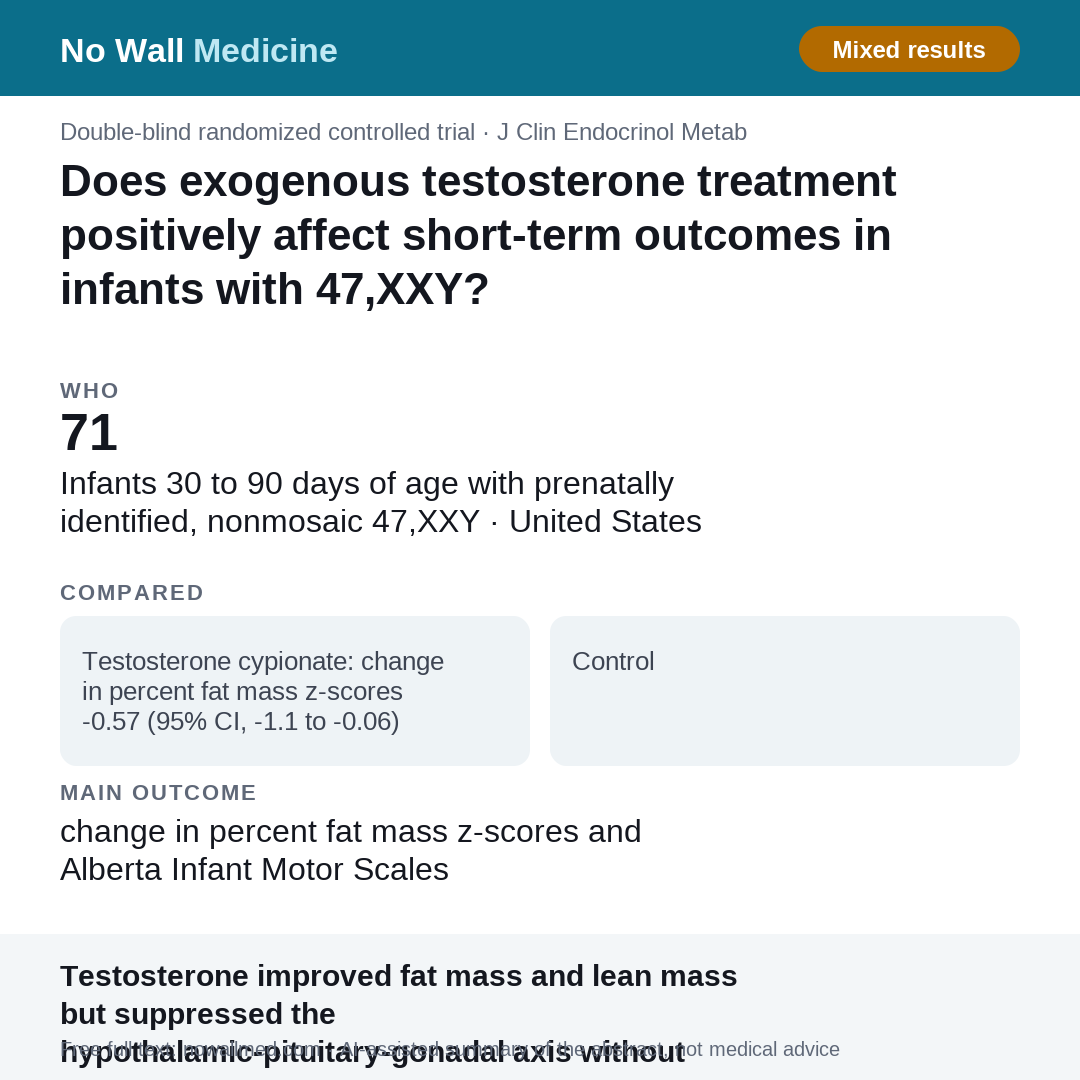
Clinical question: Does exogenous testosterone treatment positively affect short-term outcomes in infants with 47,XXY?
Why it matters: It is unknown if providing testosterone during the minipuberty period of infancy affects physical, hormonal, or neurodevelopmental outcomes in infants with Klinefelter syndrome.
Key points
- Researchers conducted a double-blind randomized controlled trial with 71 infants aged 30 to 90 days with nonmosaic 47,XXY/Klinefelter syndrome.
- Testosterone treatment was associated with a between-group difference in percent fat mass z-scores of -0.57 and greater increases in lean mass (1.5 ± 0.4 kg vs 1.2 ± 0.4 kg).
- The treatment was associated with suppressed gonadotropins and inhibin B, but there were no significant differences in motor, cognitive, or language outcomes.
Headline and key points written with AI from the paper’s abstract, with every number checked against it. Read the paper before relying on them.
Was this summary helpful?
Subject terms
Cite this article
Davis SM, Howell S, Janusz J, Lahlou N, Reynolds R, Thompson T. Testosterone Effects on Short-term Physical, Hormonal, and Neurodevelopmental Outcomes (TESTO) in Infants With 47,XXY. J Clin Endocrinol Metab. 2025. doi:10.1210/clinem/dgaf217
Spotted a mistake? Suggest a correction
Top studies every Monday
The week’s key trials and guidelines in your specialties, plus any topics you follow. By email, free.
Get the weekly digest