Text messaging with or without financial incentives is cost-effective for weight loss in men
Text messaging with or without financial incentives versus a waitlist control for weight loss in men: cost-effectiveness analysis of the Game of Stones randomised controlled trial
3-arm randomised controlled trialBenefit found
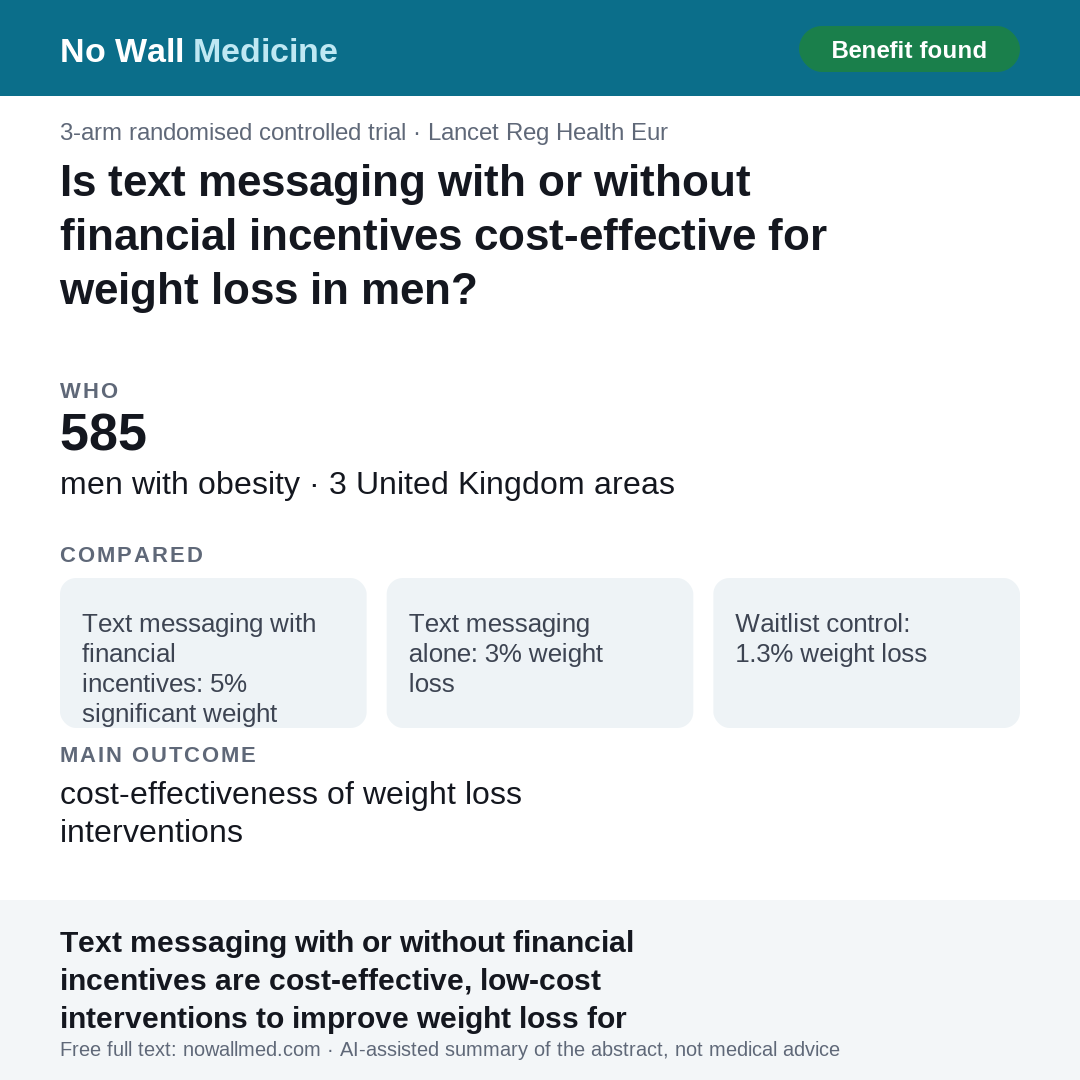
Is text messaging with or without financial incentives cost-effective for weight loss in men?
Who
585
men with obesity · 3 United Kingdom areas
Compared
Text messaging with financial incentives: 5% significant weight loss
Text messaging alone: 3% weight loss
Waitlist control: 1.3% weight loss
Main outcome
cost-effectiveness of weight loss interventions
Result: ICER £9748 (£7,705, £11,791) for incentives versus control
Bottom line: Text messaging with or without financial incentives are cost-effective, low-cost interventions to improve weight loss for men.
Funded by: National Institute for Health and Care Research
Lancet Reg Health Eur · 2025-05-21Download image
Clinical question: Is text messaging with or without financial incentives cost-effective for weight loss in men?
Why it matters: Men with obesity are less likely to engage with weight loss programs, creating a need for cost-effective interventions.
Key points
- Researchers studied 585 men with obesity in a randomized controlled trial comparing text messaging alone, text messaging with financial incentives, and a waitlist control group.
- At 12 months, text messaging with financial incentives resulted in 5% weight loss, text messaging alone resulted in 3% weight loss, and the control group saw 1.3% weight loss.
- Lifetime modeling showed text messaging with financial incentives had a mean discounted cost of £15,277 and 12.48 quality-adjusted life years per person.
Headline and key points written with AI from the paper’s abstract, with every number checked against it. Read the paper before relying on them.
Cite this article
Getaneh AM, van der Pol M, Boyers D, Avenell A, Cotton S, Dombrowski SU. Text messaging with or without financial incentives versus a waitlist control for weight loss in men: cost-effectiveness analysis of the Game of Stones randomised controlled trial. Lancet Reg Health Eur. 2025. doi:10.1016/j.lanepe.2025.101328
Spotted a mistake? Suggest a correction