Artificial intelligence shows high accuracy in diagnosing early gastric cancer from endoscopic images
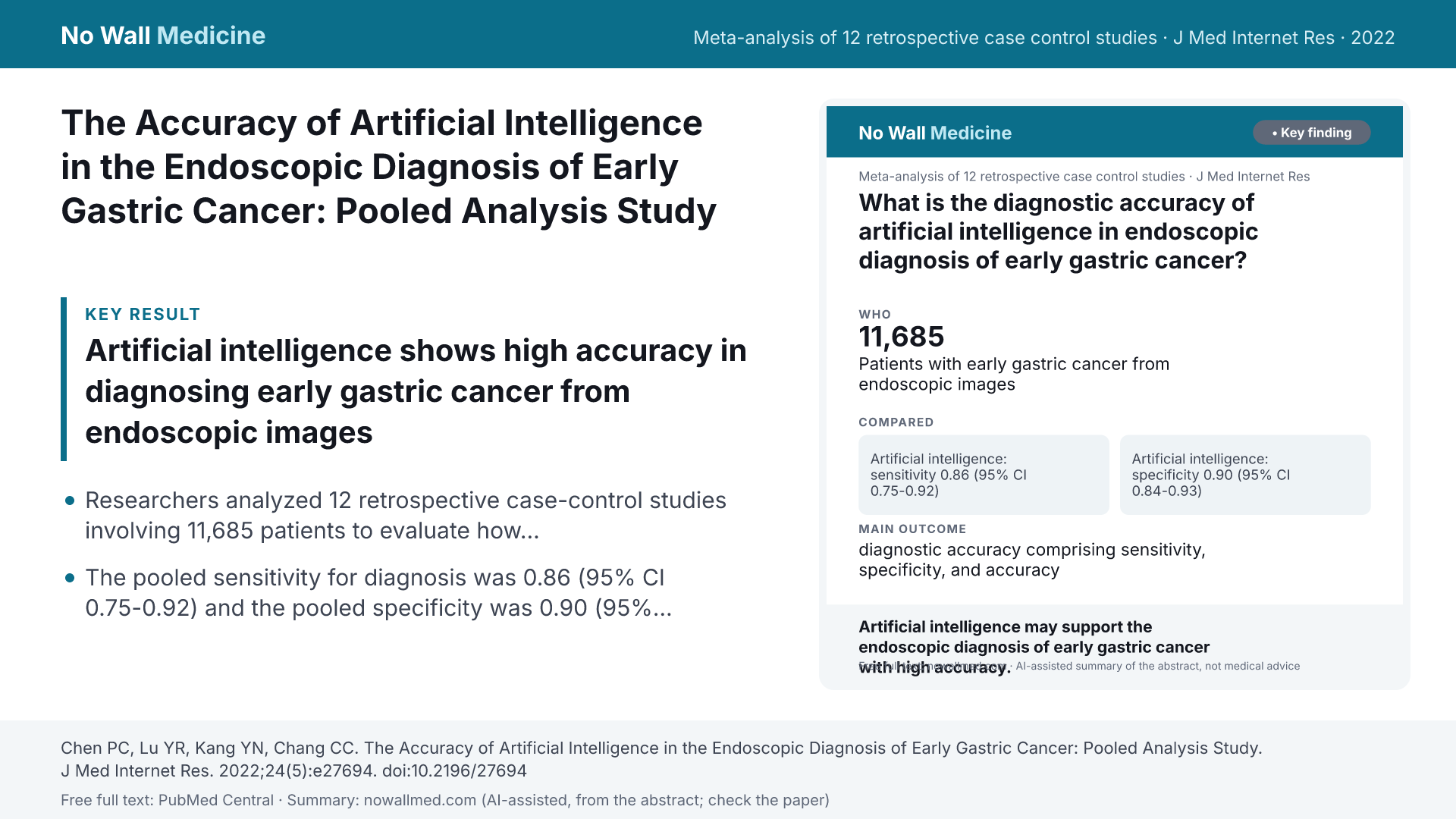
The Accuracy of Artificial Intelligence in the Endoscopic Diagnosis of Early Gastric Cancer: Pooled Analysis Study
Meta-analysis of 12 retrospective case control studiesBenefit found
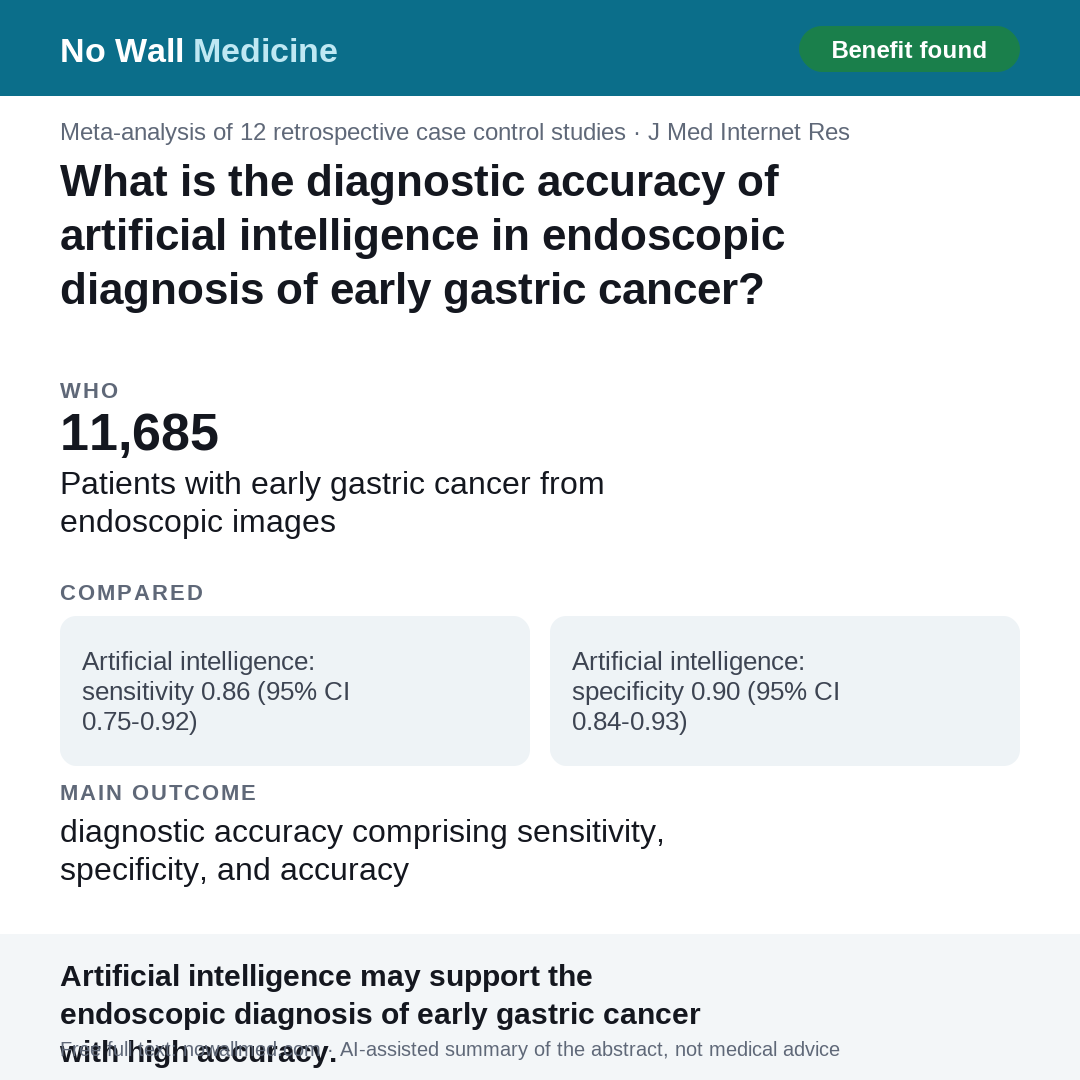
What is the diagnostic accuracy of artificial intelligence in endoscopic diagnosis of early gastric cancer?
Who
11,685
Patients with early gastric cancer from endoscopic images
Compared
Artificial intelligence: sensitivity 0.86 (95% CI 0.75-0.92)
Artificial intelligence: specificity 0.90 (95% CI 0.84-0.93)
Main outcome
diagnostic accuracy comprising sensitivity, specificity, and accuracy
Result: area under the curve 0.94
Bottom line: Artificial intelligence may support the endoscopic diagnosis of early gastric cancer with high accuracy.
Limitation: the collocation of imaging techniques and optimal algorithms remain unclear
J Med Internet Res · 2022-05-16Download image
Clinical question: What is the diagnostic accuracy of artificial intelligence in endoscopic diagnosis of early gastric cancer?
Why it matters: Previous research syntheses have had a limited focus on populations specifically with early gastric cancer, which is difficult to identify in clinical practice.
Key points
- Researchers analyzed 12 retrospective case-control studies involving 11,685 patients to evaluate how artificial intelligence performs in identifying early stomach cancer.
- The pooled sensitivity for diagnosis was 0.86 (95% CI 0.75-0.92) and the pooled specificity was 0.90 (95% CI 0.84-0.93).
- The area under the curve, a measure of diagnostic performance, was 0.94.
Limitation the authors note: The included studies were retrospective case-control studies.
Headline and key points written with AI from the paper’s abstract, with every number checked against it. Read the paper before relying on them.
Was this summary helpful?
Subject terms
Cite this article
Chen PC, Lu YR, Kang YN, Chang CC. The Accuracy of Artificial Intelligence in the Endoscopic Diagnosis of Early Gastric Cancer: Pooled Analysis Study. J Med Internet Res. 2022. doi:10.2196/27694
Spotted a mistake? Suggest a correction