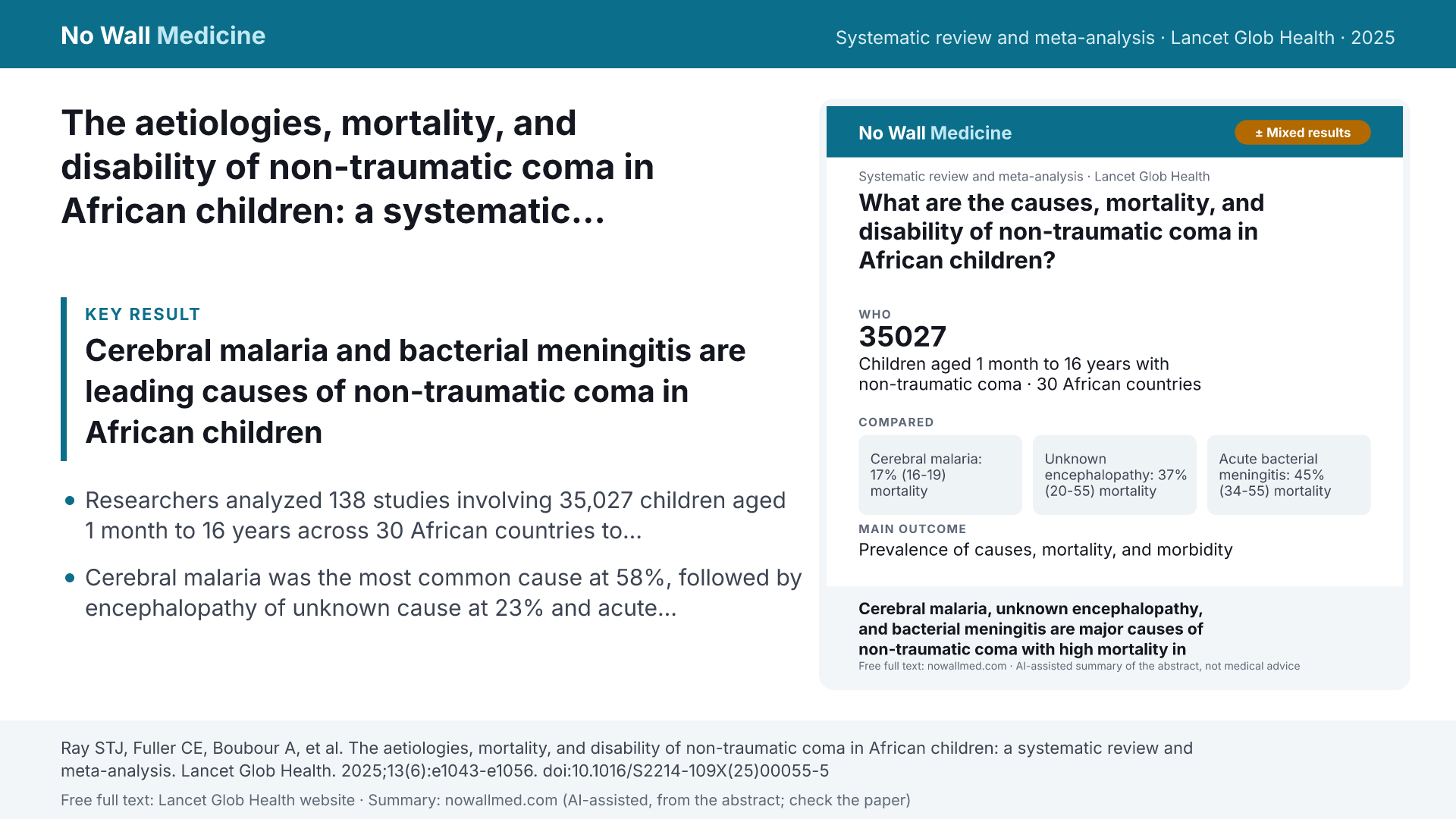
Cerebral malaria and bacterial meningitis are leading causes of non-traumatic coma in African children
The aetiologies, mortality, and disability of non-traumatic coma in African children: a systematic review and meta-analysis
Systematic review and meta-analysisMixed results
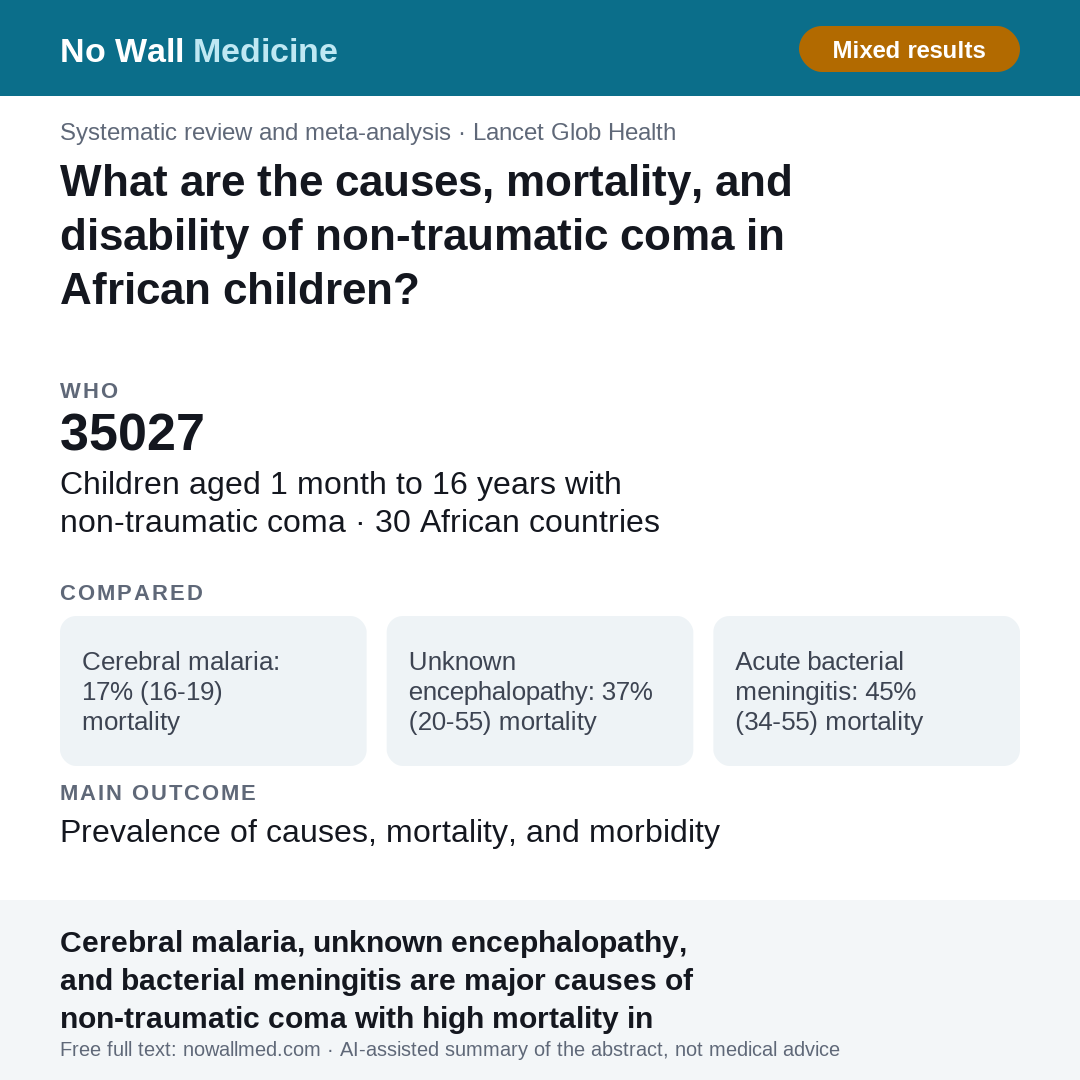
What are the causes, mortality, and disability of non-traumatic coma in African children?
Who
35027
Children aged 1 month to 16 years with non-traumatic coma · 30 African countries
Compared
Cerebral malaria: 17% (16-19) mortality
Unknown encephalopathy: 37% (20-55) mortality
Acute bacterial meningitis: 45% (34-55) mortality
Main outcome
Prevalence of causes, mortality, and morbidity
Bottom line: Cerebral malaria, unknown encephalopathy, and bacterial meningitis are major causes of non-traumatic coma with high mortality in African children.
Funded by: Wellcome Trust
Lancet Glob Health · 2025-04-22Download image
Clinical question: What are the causes, mortality, and disability of non-traumatic coma in African children?
Why it matters: Evidence is scarce regarding the specific causes, mortality rates, and disability outcomes for children presenting with non-traumatic coma in Africa.
Key points
- Researchers analyzed 138 studies involving 35,027 children aged 1 month to 16 years across 30 African countries to assess causes and outcomes of non-traumatic coma.
- Cerebral malaria was the most common cause at 58%, followed by encephalopathy of unknown cause at 23% and acute bacterial meningitis at 10%.
- Case-fatality rates were 17% for cerebral malaria, 37% for unknown encephalopathy, and 45% for acute bacterial meningitis.
Headline and key points written with AI from the paper’s abstract, with every number checked against it. Read the paper before relying on them.
Was this summary helpful?
Abstract
Background
Non-traumatic coma in African children is a common life-threatening presentation often leading to hospital attendance. We aimed to estimate the distribution of non-traumatic coma causes and outcomes, including disease-specific outcomes, for which evidence is scarce. Methods
We systematically reviewed MEDLINE, Embase, and Scopus databases from inception to Feb 6, 2024. We included studies recruiting children (aged 1 month to 16 years) with non-traumatic coma (Blantyre Coma Scale score ≤2, ie deep coma or comparable alternative) from any African country. Disease-specific studies were included if outcomes were reported. Primary data were requested where required. We used a DerSimonian-Laird random effects model to calculate pooled estimates for prevalence of causes, mortality, and morbidity (in-hospital and post-discharge), including analysis of mortality by temporality. This study was registered with PROSPERO (CRD4202014193). Findings
We screened 16 666 articles. 138 studies were eligible for analysis, reporting causes, outcome data, or both from 35 027 children with non-traumatic coma in 30 African countries. 114 (89%) of 128 studies were determined to be high quality. Among the causes, cerebral malaria had highest pooled prevalence at 58% (95% CI 48-69), encephalopathy of unknown cause was associated with 23% (9-36) of cases, and acute bacterial meningitis was the cause of 10% (8-12) of cases, with all other causes representing lower proportions of cases. Pooled overall case-fatality rates were 17% (16-19) for cerebral malaria, 37% (20-55) for unknown encephalopathy, and 45% (34-55) for acute bacterial meningitis. By meta-regression, there was no significant difference in cerebral malaria (p=0·98), acute bacterial meningitis (p=0·99), or all-cause coma (p=0·081) mortality by year of study. There was no substantial difference in deaths associated with cerebral malaria in-hospital compared with post-discharge (17% [16-19] vs (18% [16-20]). Mortality was higher post-discharge than in-hospital in most non-malarial comas, including acute bacterial meningitis (39% [26-52]) vs 53% [38-69]). Disability associated with cerebral malaria was 11% (9-12). Pooled disability outcomes associated with other non-malarial diseases were largely absent. Interpretation
The prevalence and outcomes of cerebral malaria and meningitis associated with non-traumatic coma were strikingly static across five decades. Enhanced molecular and radiological diagnostics, investment, policy making, community awareness, and health service provision are all required to facilitate earlier referral to specialist centres, to drive a step-change in diagnostic yield and treatment options to improve these outcomes. Funding
Wellcome Trust. Translations
For the Chichewa, French and Portuguese translations of the abstract see Supplementary Materials section.
Abstract reproduced under the article’s CC BY licence.
Subject terms
Cite this article
Ray STJ, Fuller CE, Boubour A, Tshimangani T, Kafoteka E, Muiruri-Liomba A. The aetiologies, mortality, and disability of non-traumatic coma in African children: a systematic review and meta-analysis. Lancet Glob Health. 2025. doi:10.1016/S2214-109X(25)00055-5
Spotted a mistake? Suggest a correction
Top studies every Monday
The week’s key trials and guidelines in your specialties, plus any topics you follow. By email, free.
Get the weekly digest