Artificial intelligence applied to real-time self-reports shows potential for predicting suicidal ideation
The Application of AI to Ecological Momentary Assessment Data in Suicide Research: Systematic Review
Why it matters: Variations in data collection and reporting procedures currently hamper the application of artificial intelligence to real-time self-report data in suicide research.
Key points
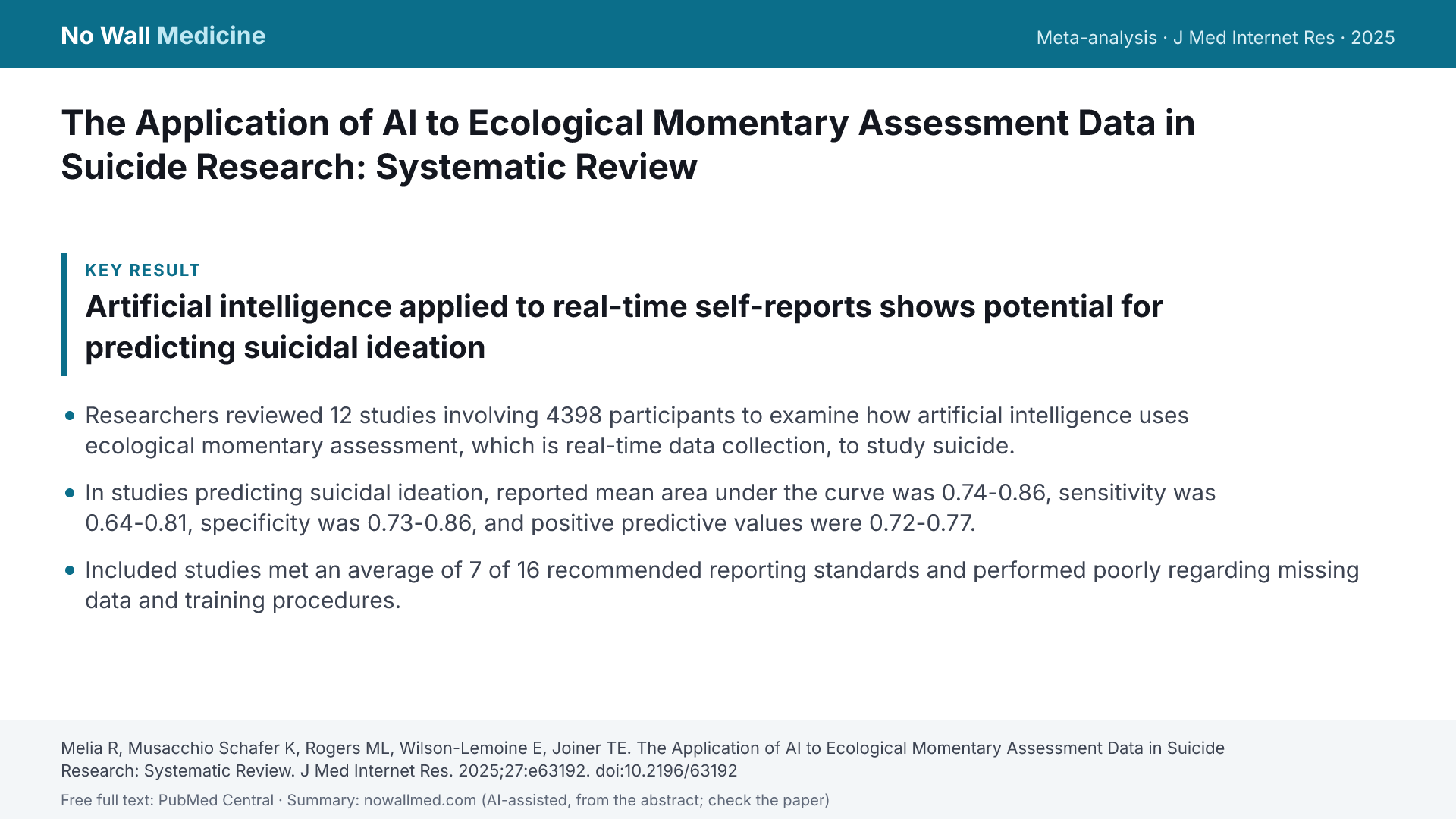
- Researchers reviewed 12 studies involving 4398 participants to examine how artificial intelligence uses ecological momentary assessment, which is real-time data collection, to study suicide.
- In studies predicting suicidal ideation, reported mean area under the curve was 0.74-0.86, sensitivity was 0.64-0.81, specificity was 0.73-0.86, and positive predictive values were 0.72-0.77.
- Included studies met an average of 7 of 16 recommended reporting standards and performed poorly regarding missing data and training procedures.
Limitation the authors note: The included studies performed poorly in reporting training procedures and the treatment of missing data.
Headline and key points written with AI from the paper’s abstract, with every number checked against it. Read the paper before relying on them.
Was this summary helpful?
Subject terms
Headline, design, result, key points, caveat and citation as plain text.
Cite this article
Melia R, Musacchio Schafer K, Rogers ML, Wilson-Lemoine E, Joiner TE. The Application of AI to Ecological Momentary Assessment Data in Suicide Research: Systematic Review. J Med Internet Res. 2025;27:e63192. doi:10.2196/63192
Spotted a mistake? Suggest a correction