Machine learning algorithms achieved 0.89 accuracy in identifying posttraumatic stress disorder
The application of machine learning techniques in posttraumatic stress disorder: a systematic review and meta-analysis
Systematic review and meta-analysisBenefit found
How effective are machine learning techniques in classifying posttraumatic stress disorder?
Who
210,001
Individuals in studies involving posttraumatic stress disorder
Compared
0.96multi-dimensional data
single data types: 0.86 to 0.90
Main outcome
classification accuracy
Result: overall accuracy of 0.89
Bottom line: Machine learning effectively classifies posttraumatic stress disorder, with multi-dimensional data providing higher accuracy than single data types.
Limitation: Selecting optimal combinations of data types and algorithms for clinical application remains a challenge.
NPJ Digit Med · 2024-05-09Download image
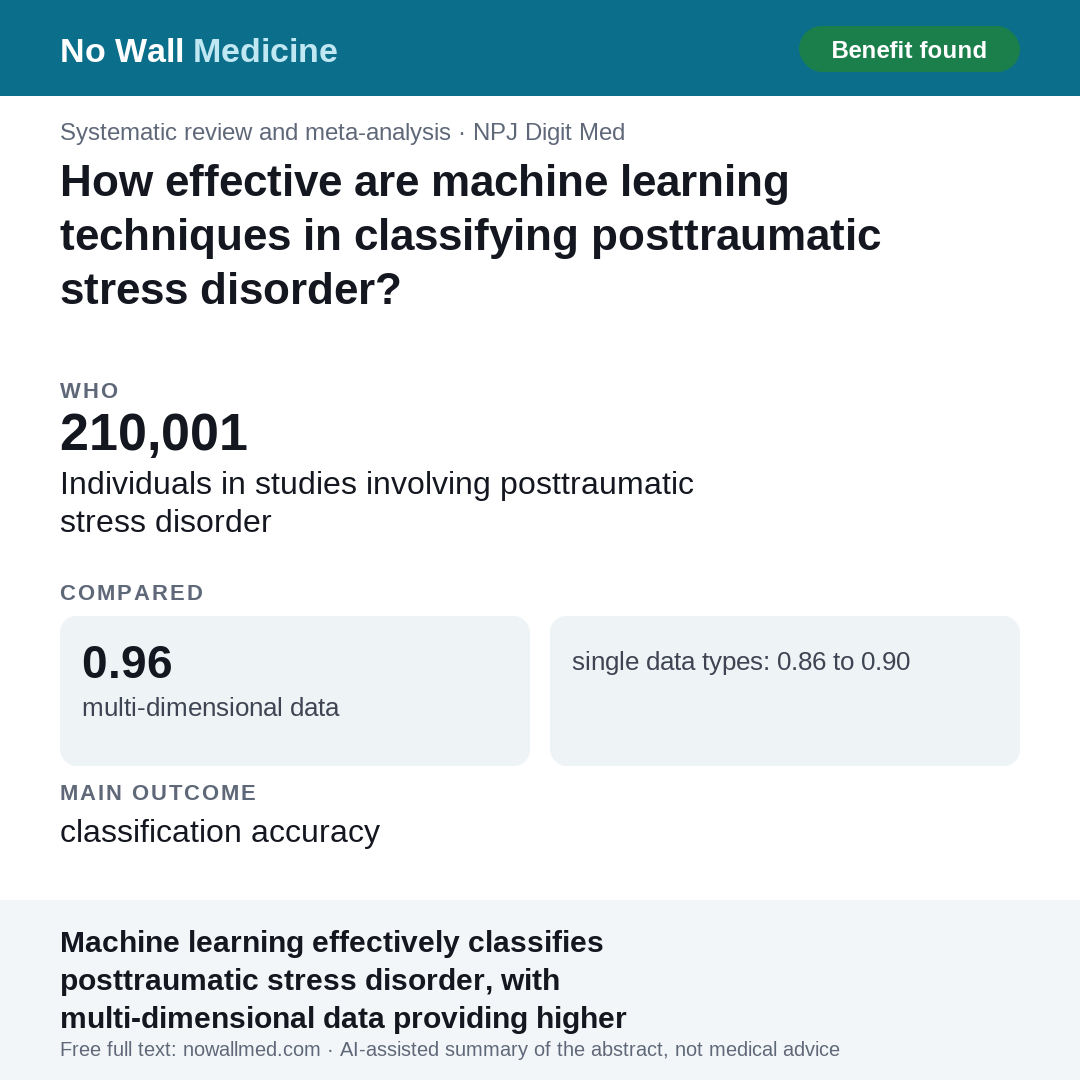
Clinical question: How effective are machine learning techniques in classifying posttraumatic stress disorder?
Why it matters: It was unknown how big data and machine learning techniques could be comprehensively applied to posttraumatic stress disorder.
Key points
- Researchers conducted a systematic review and meta-analysis of 873 studies involving a total of 210,001 participants.
- Machine learning algorithms achieved an overall accuracy of 0.89 for discriminating posttraumatic stress disorder.
- Classification accuracy was 0.96 when using multi-dimensional data compared to 0.86 to 0.90 for single data types.
Headline and key points written with AI from the paper’s abstract, with every number checked against it. Read the paper before relying on them.
Was this summary helpful?
Cite this article
Wang J, Ouyang H, Jiao R, Cheng S, Zhang H, Shang Z. The application of machine learning techniques in posttraumatic stress disorder: a systematic review and meta-analysis. NPJ Digit Med. 2024. doi:10.1038/s41746-024-01117-5
Spotted a mistake? Suggest a correction
Top studies every Monday
The week’s key trials and guidelines in your specialties, plus any topics you follow. By email, free.
Get the weekly digest