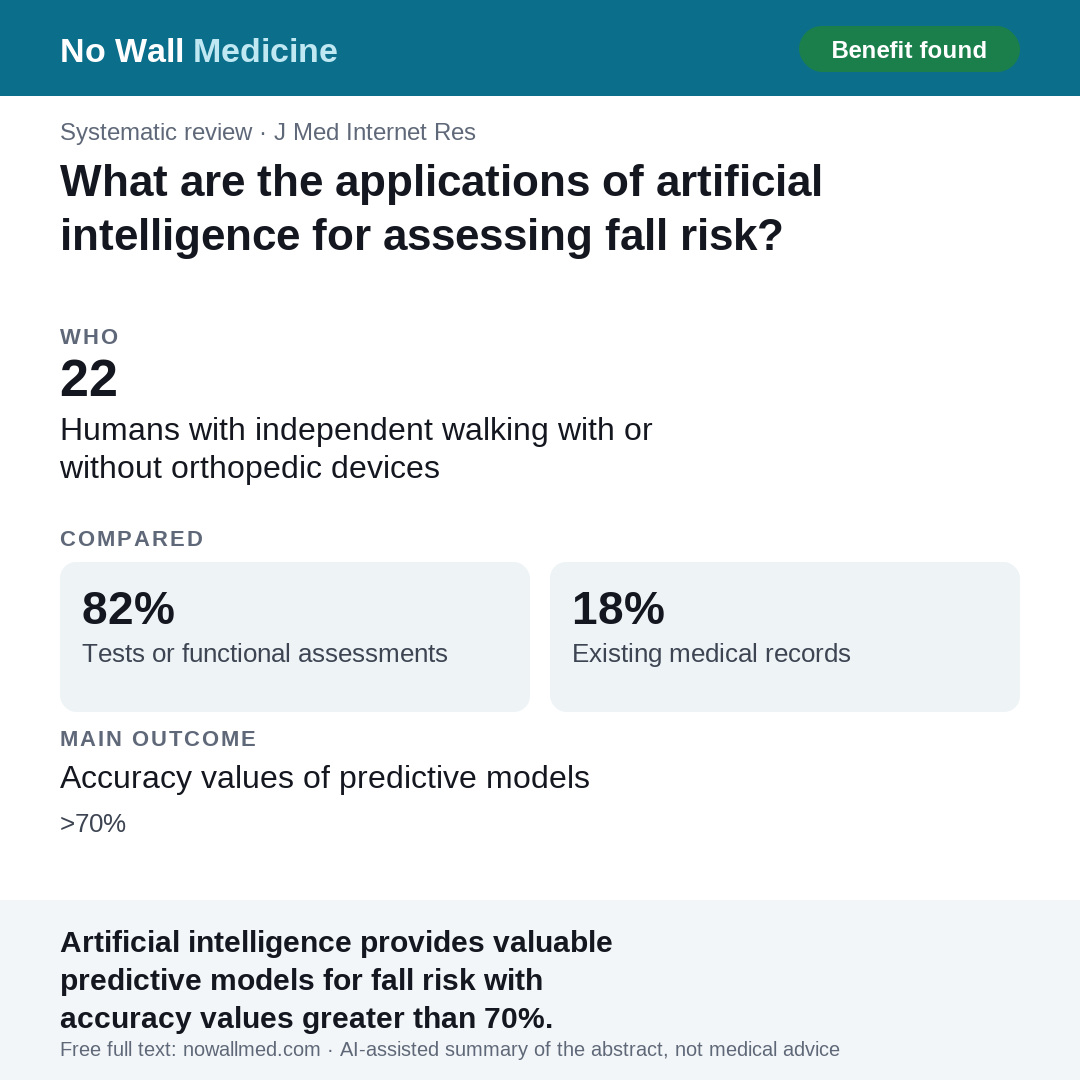
Artificial intelligence models achieved over 70% accuracy in predicting fall risk across reviewed studies
The Applications of Artificial Intelligence for Assessing Fall Risk: Systematic Review
Systematic reviewBenefit found
What are the applications of artificial intelligence for assessing fall risk?
Who
22
Humans with independent walking with or without orthopedic devices
Compared
82%Tests or functional assessments (18/22)
18%Existing medical records (4/22)
Main outcome
Accuracy values of predictive models
Result: >70%
Bottom line: Artificial intelligence provides valuable predictive models for fall risk with accuracy values greater than 70%.
J Med Internet Res · 2024-04-29Download image
Clinical question: What are the applications of artificial intelligence for assessing fall risk?
Why it matters: The potential for artificial intelligence to create low-cost, accurate predictive models for the 37.3 million annual falls requiring medical attention remains to be synthesized.
Key points
- Researchers reviewed 22 studies published between 2018 and 2024 that used artificial intelligence to analyze postural control and fall risk in humans.
- All included studies reported accuracy values of >70% for the predictive models created using artificial intelligence techniques.
- Data for these models was extracted from functional assessments or tests in 82% (18/22) of studies and from medical records in 18% (4/22) of studies.
Headline and key points written with AI from the paper’s abstract, with every number checked against it. Read the paper before relying on them.
Was this summary helpful?
Subject terms
Cite this article
González-Castro A, Leirós-Rodríguez R, Prada-García C, Benítez-Andrades JA. The Applications of Artificial Intelligence for Assessing Fall Risk: Systematic Review. J Med Internet Res. 2024. doi:10.2196/54934
Spotted a mistake? Suggest a correction
Top studies every Monday
The week’s key trials and guidelines in your specialties, plus any topics you follow. By email, free.
Get the weekly digest