Educational intervention for dialysis facilities was associated with smaller racial disparities in kidney transplant waitlisting
The ASCENT Intervention to Improve Access and Reduce Racial Inequalities in Kidney Waitlisting: A Randomized, Effectiveness-Implementation Trial
Cluster-randomized, pragmatic, multilevel, effectiveness-implementation trialBenefit found
Does the ASCENT intervention increase kidney waitlisting and reduce racial disparities?
Who
56332
Patients in United States dialysis facilities with low waitlisting · United States
Compared
ASCENT intervention: 2.68%-2.75%
Educational brochure control: 2.72%-2.56%
Main outcome
1-year waitlisting and racial differences in waitlisting
Result: adjusted odds ratio 0.84 (95% CI 0.49 to 1.42)
Bottom line: The ASCENT intervention may attenuate racial disparities in kidney waitlisting among dialysis facilities with low waitlisting.
CJASN · 2023-02-08Download image
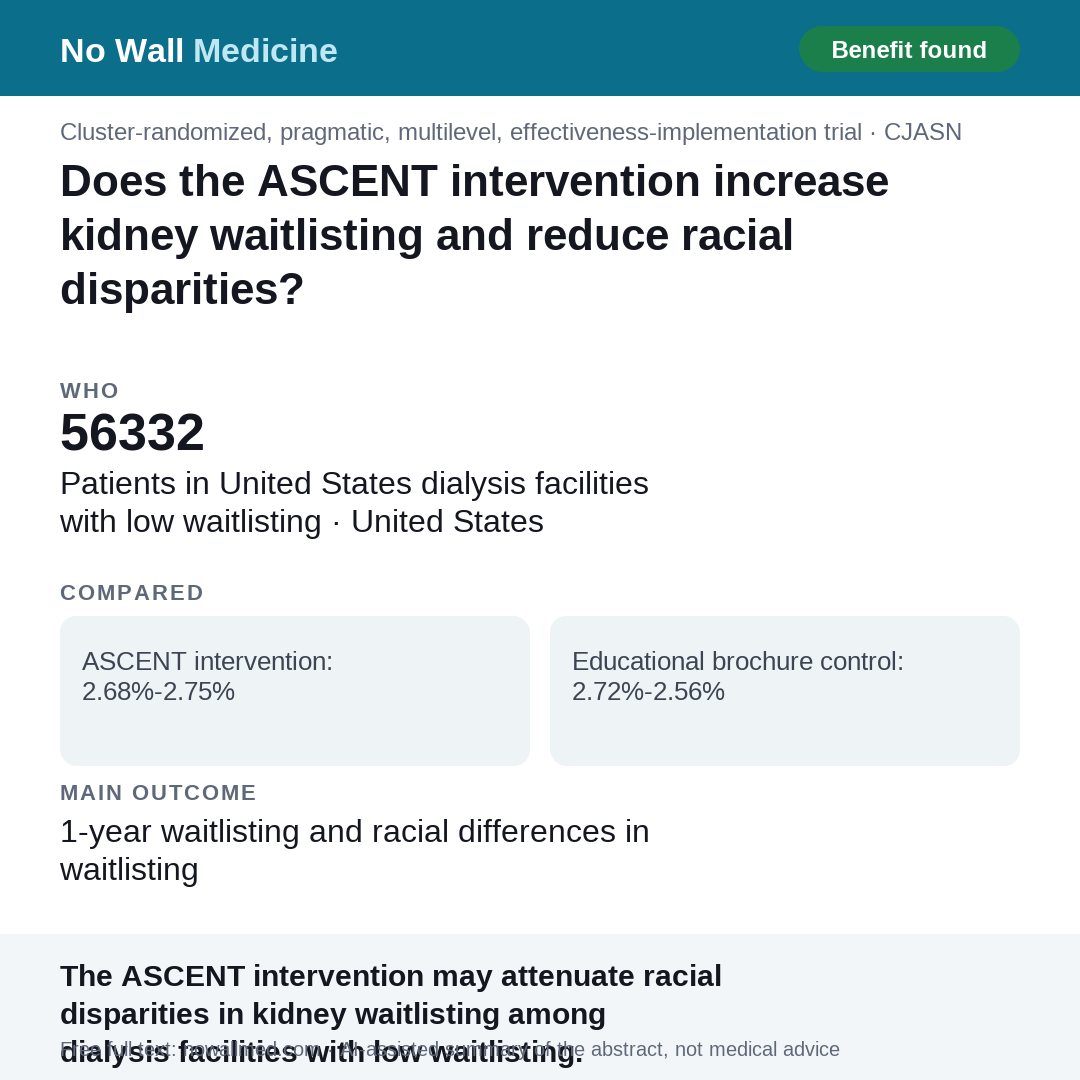
Clinical question: Does the ASCENT intervention increase kidney waitlisting and reduce racial disparities?
Why it matters: Dialysis facility staff had low awareness of how kidney allocation system changes could affect patient access to transplant and racial disparities in waitlisting.
Key points
- Researchers studied 655 US dialysis facilities and 56,332 prevalent patients to compare a multi-component educational intervention against an educational brochure.
- Among prevalent patients in the intervention group, Black patient waitlisting increased from 2.52% to 2.78% while White patient waitlisting remained at 2.66% to 2.69%.
- The racial disparity for incident patients in the intervention group was attenuated from an adjusted odds ratio of 0.56 at baseline to 0.84 after 1 year.
Headline and key points written with AI from the paper’s abstract, with every number checked against it. Read the paper before relying on them.
Was this summary helpful?
Subject terms
Cite this article
Patzer RE, Zhang R, Buford J, McPherson L, Lee YH, Urbanski M. The ASCENT Intervention to Improve Access and Reduce Racial Inequalities in Kidney Waitlisting: A Randomized, Effectiveness-Implementation Trial. CJASN. 2023. doi:10.2215/CJN.0000000000000071
Spotted a mistake? Suggest a correction
Top studies every Monday
The week’s key trials and guidelines in your specialties, plus any topics you follow. By email, free.
Get the weekly digest