Greater target level lordosis was associated with better neck disability scores after single-level neck surgery
The association between cervical sagittal balance parameters and clinical outcomes after single-level surgery for cervical radiculopathy and/or stenosis: A systematic review and meta-analysis
Systematic review and meta-analysisBenefit found
How do cervical sagittal balance parameters associate with clinical outcomes after single-level surgery?
Who
723
Patients undergoing single-level anterior cervical discectomy and fusion
Compared
Greater target level lordosis: lower postoperative Neck Disability Index (pooled Pearson's r = -0.13, 95% CI: 0.23 to -0.02)
Other sagittal balance parameters: not significant
Main outcome
Clinical outcomes including Neck Disability Index and Visual Analogue Scale
Result: pooled Pearson's r = -0.13, 95% CI: 0.23 to -0.02
Bottom line: A greater postoperative Cobb angle at the target level may improve outcomes after anterior cervical discectomy and fusion.
Limitation: Further studies in larger, diverse populations are needed to confirm and generalize the results.
Brain Spine · 2026-03-24Download image
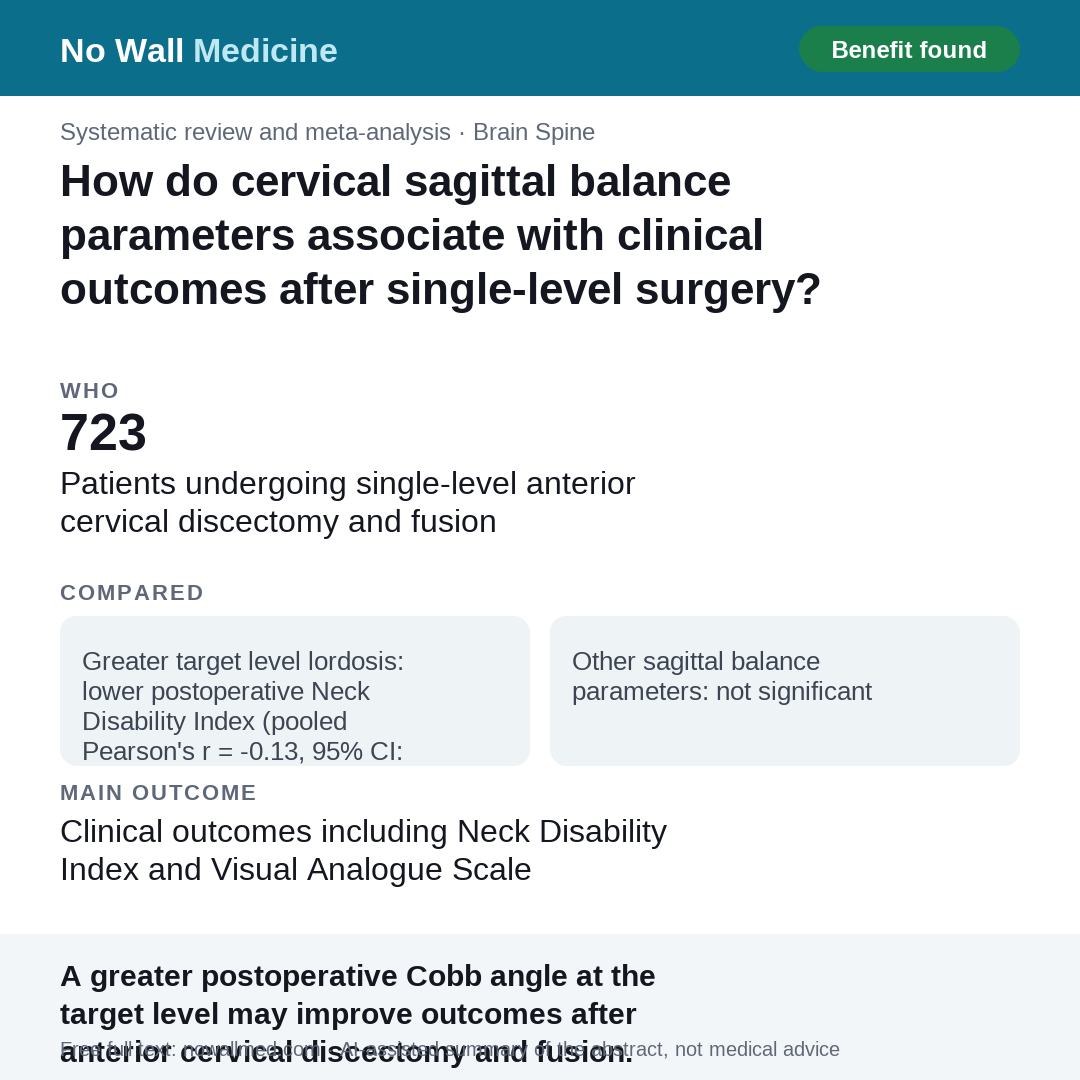
Clinical question: How do cervical sagittal balance parameters associate with clinical outcomes after single-level surgery?
Why it matters: The relationship between cervical sagittal balance parameters and clinical outcomes after single-level anterior cervical discectomy and fusion remains controversial.
Key points
- Researchers analyzed seven longitudinal studies involving 723 patients to examine how cervical sagittal balance parameters relate to clinical outcomes after anterior cervical discectomy and fusion.
- A greater Cobb angle of the target level (lordosis) was associated with a lower Neck Disability Index score (pooled Pearson's r = -0.13, 95% CI: 0.23 to -0.02).
- Correlations between the C2-C7 angle, cervical sagittal vertical axis, T1 slope, and T1 slope minus C2-C7 lordosis with the Neck Disability Index were not significant.
Limitation the authors note: Further studies in larger, diverse populations are needed to confirm and generalize the results.
Headline and key points written with AI from the paper’s abstract, with every number checked against it. Read the paper before relying on them.
Cite this article
Gül A, Gomez Farias J, Goedmakers CM, Mekary RA, Vleggeert-Lankamp C. The association between cervical sagittal balance parameters and clinical outcomes after single-level surgery for cervical radiculopathy and/or stenosis: A systematic review and meta-analysis. Brain Spine. 2026. doi:10.1016/j.bas.2026.106009
Spotted a mistake? Suggest a correction