Low-grade proteinuria is linked to higher kidney risk and faster decline in IgA nephropathy
The Association between Low-Grade Proteinuria and Adverse Kidney Outcomes in IgA Nephropathy: A Systematic Review and Meta-Analysis
Systematic review and meta-analysis of 23 studiesHarm found
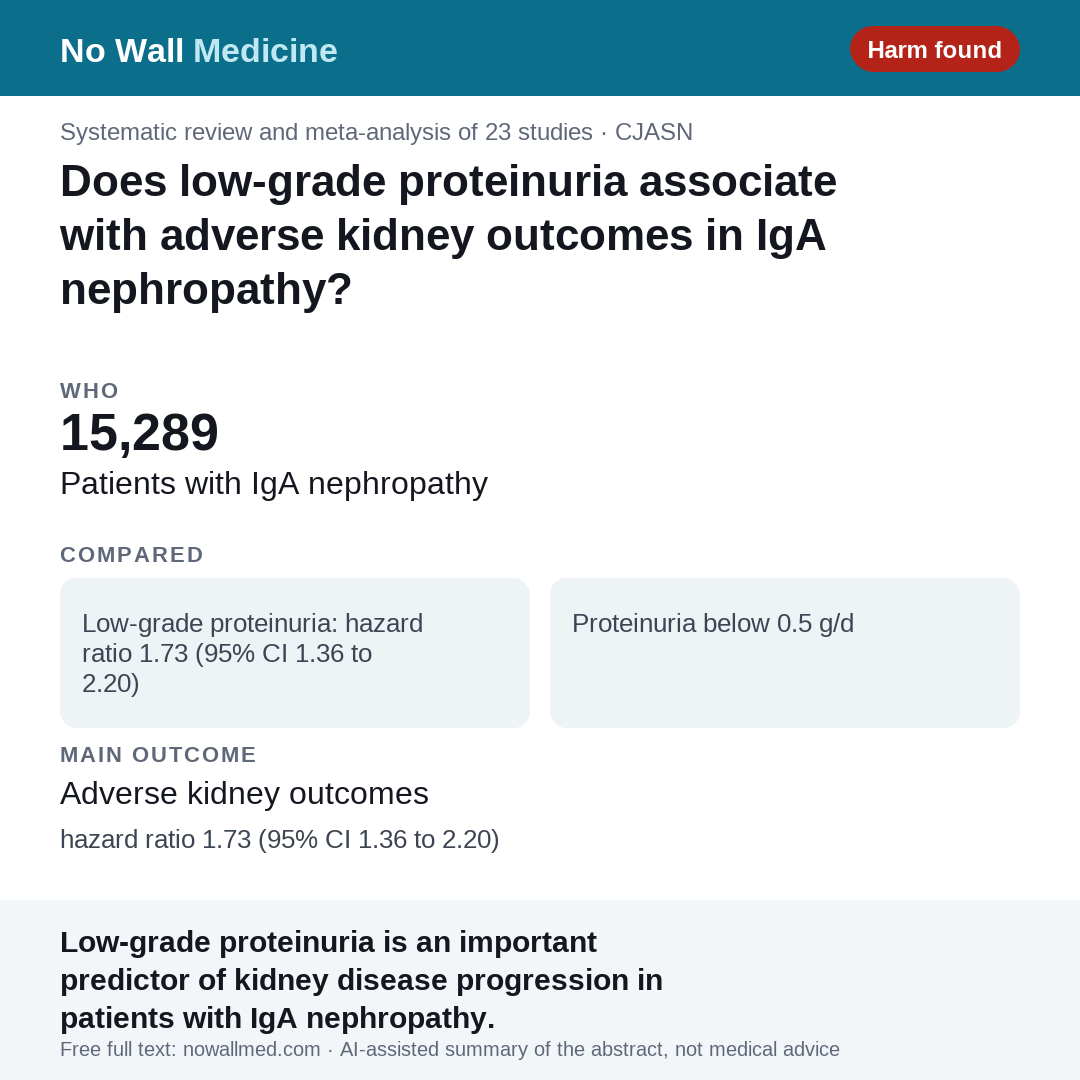
Does low-grade proteinuria associate with adverse kidney outcomes in IgA nephropathy?
Who
15,289
Patients with IgA nephropathy
Compared
Low-grade proteinuria: hazard ratio 1.73 (95% CI 1.36 to 2.20)
Proteinuria below 0.5 g/d
Main outcome
Adverse kidney outcomes
Result: hazard ratio 1.73 (95% CI 1.36 to 2.20)
Bottom line: Low-grade proteinuria is an important predictor of kidney disease progression in patients with IgA nephropathy.
CJASN · 2025-12-12Download image
Clinical question: Does low-grade proteinuria associate with adverse kidney outcomes in IgA nephropathy?
Why it matters: The prognostic effect of low-grade proteinuria, defined as 0.5-1.0 g/d, has not been systematically evaluated in patients with IgA nephropathy.
Key points
- Researchers analyzed 23 studies involving 15,289 patients to evaluate how low-grade proteinuria affects kidney outcomes in IgA nephropathy.
- Low-grade proteinuria was associated with a pooled hazard ratio of 1.73 at baseline and 2.87 for time-averaged levels.
- Patients with low-grade proteinuria showed a faster annual decline in estimated glomerular filtration rate of -1.02 ml/min per 1.73 m2 per year.
Headline and key points written with AI from the paper’s abstract, with every number checked against it. Read the paper before relying on them.
Topics
Cite this article
Yamaguchi Y, Kosugi T, Sasaki T, Haruhara K, Okabayashi Y, Okabe M. The Association between Low-Grade Proteinuria and Adverse Kidney Outcomes in IgA Nephropathy: A Systematic Review and Meta-Analysis. CJASN. 2025. doi:10.2215/CJN.0000000952
Spotted a mistake? Suggest a correction