Low folate levels are linked to higher treatment complications in children with cancer
The association between micronutrient status and clinical outcomes in children with cancer undergoing treatment: A systematic review and meta-analysis
Systematic review and meta-analysisMixed results
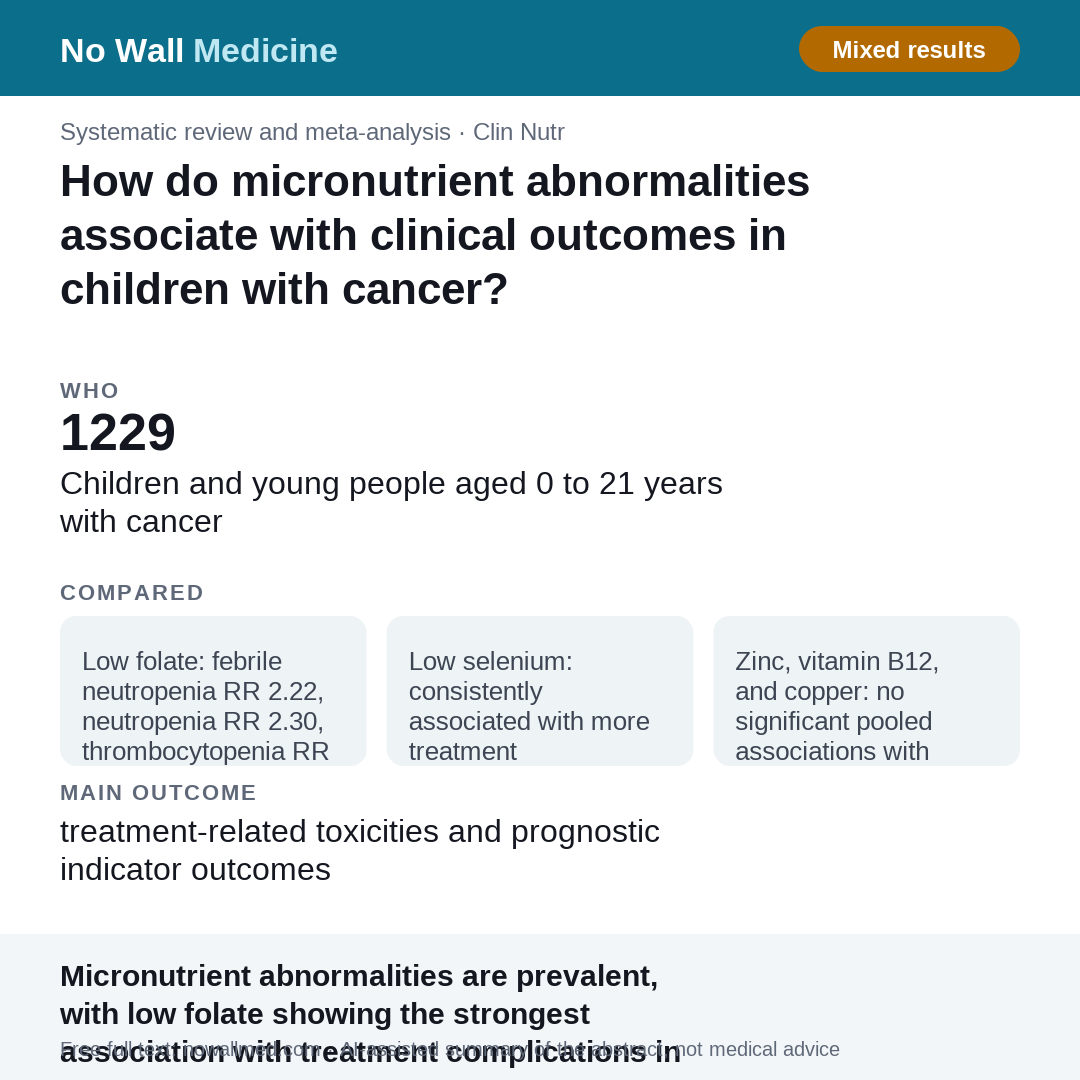
How do micronutrient abnormalities associate with clinical outcomes in children with cancer?
Who
1229
Children and young people aged 0 to 21 years with cancer
Compared
Low folate: febrile neutropenia RR 2.22, neutropenia RR 2.30, thrombocytopenia RR 2.80
Low selenium: consistently associated with more treatment complications
Zinc, vitamin B12, and copper: no significant pooled associations with event free survival
Main outcome
treatment-related toxicities and prognostic indicator outcomes
Bottom line: Micronutrient abnormalities are prevalent, with low folate showing the strongest association with treatment complications in children with cancer.
Limitation: Large international multicentre population-based and international mechanistic studies are warranted.
Clin Nutr · 2026-04-02Download image
Clinical question: How do micronutrient abnormalities associate with clinical outcomes in children with cancer?
Why it matters: The clinical implications of micronutrient abnormalities in children and young people undergoing cancer treatment remain unclear.
Key points
- Researchers analyzed ten studies involving 1,229 children and young people aged 0 to 21 years undergoing cancer therapy.
- Low folate was associated with increased risks of febrile neutropenia (RR 2.22), neutropenia (RR 2.30), and thrombocytopenia (RR 2.80).
- Micronutrient deficiencies were common, with folate deficiency at 10 to 56%, selenium at 20-58%, and zinc at 30-70%.
Limitation the authors note: The authors state that large international multicentre population-based and international mechanistic studies are warranted.
Headline and key points written with AI from the paper’s abstract, with every number checked against it. Read the paper before relying on them.
Topics
Cite this article
AbuSalameh H, Li R, Maria de Oliveira N, Schoeman J, Huibers M, van den Brink M. The association between micronutrient status and clinical outcomes in children with cancer undergoing treatment: A systematic review and meta-analysis. Clin Nutr. 2026. doi:10.1016/j.clnu.2026.106653
Spotted a mistake? Suggest a correction