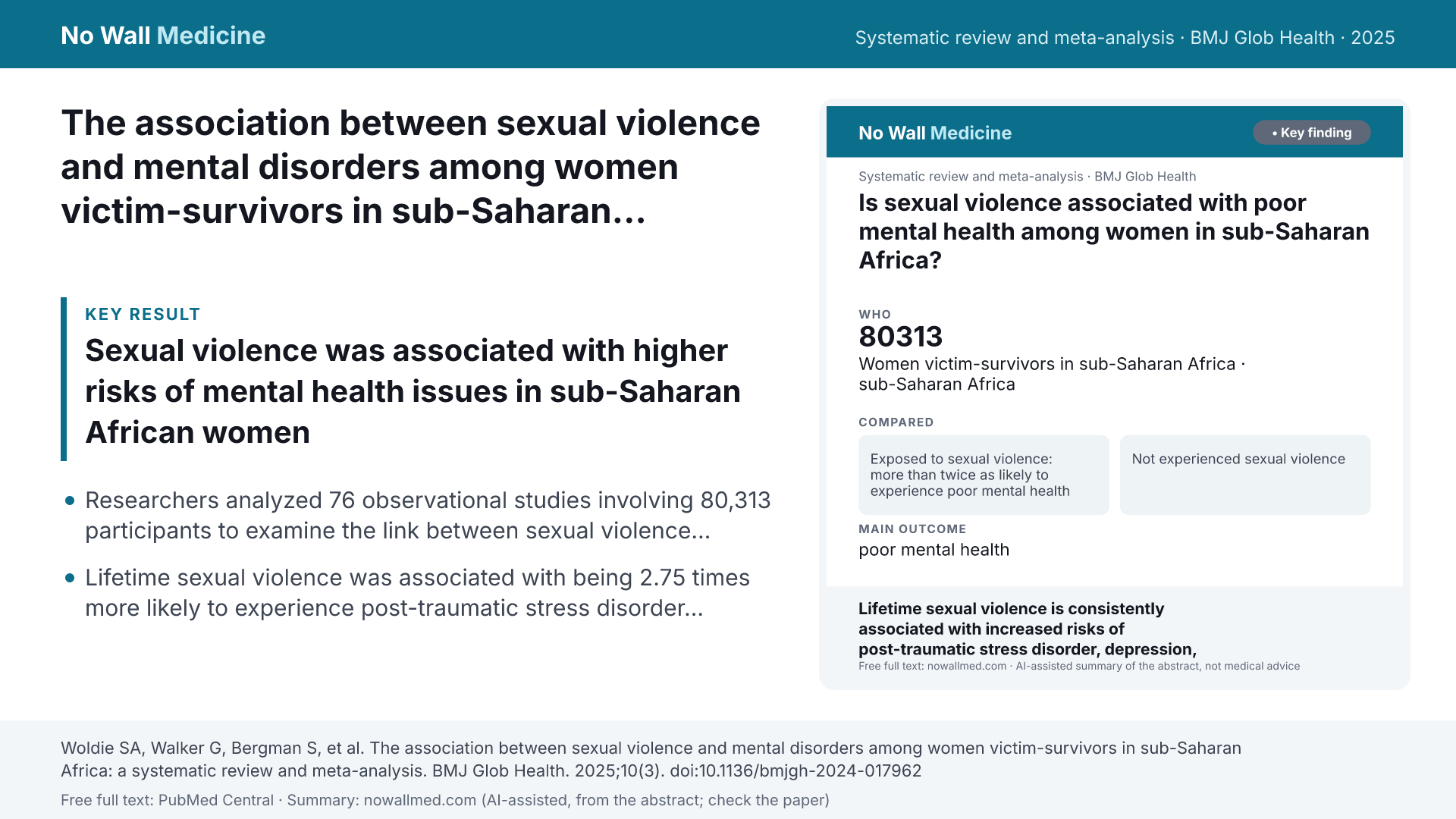
Sexual violence was associated with higher risks of mental health issues in sub-Saharan African women
The association between sexual violence and mental disorders among women victim-survivors in sub-Saharan Africa: a systematic review and meta-analysis
Systematic review and meta-analysisHarm found
Is sexual violence associated with poor mental health among women in sub-Saharan Africa?
Who
80313
Women victim-survivors in sub-Saharan Africa · sub-Saharan Africa
Compared
Exposed to sexual violence: more than twice as likely to experience poor mental health
Not experienced sexual violence
Main outcome
poor mental health
Result: OR 2.12 (95% CI 1.70 to 2.64) for common mental disorders
Bottom line: Lifetime sexual violence is consistently associated with increased risks of post-traumatic stress disorder, depression, anxiety, and other mental health issues.
BMJ Glob Health · 2025-03-22Download image
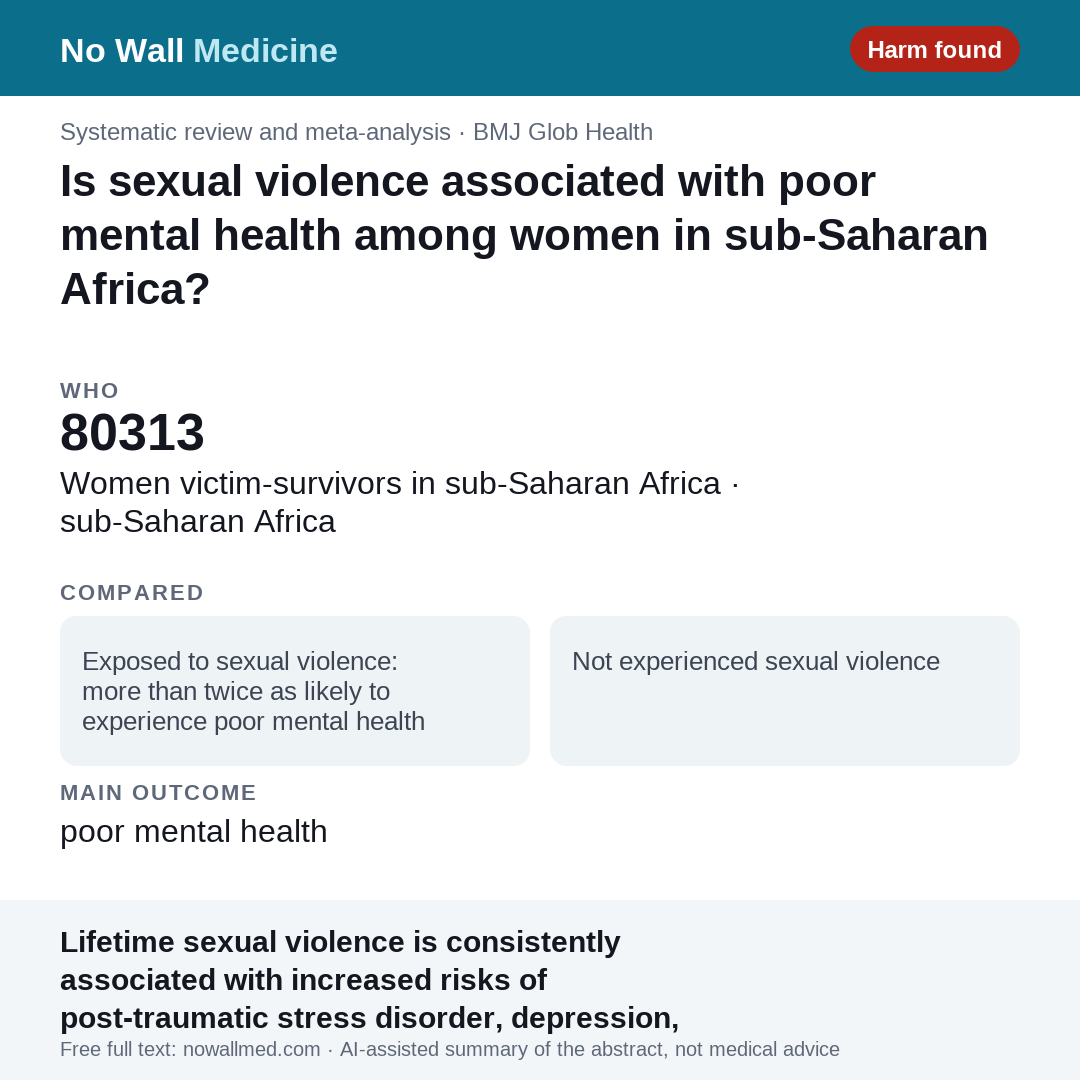
Clinical question: Is sexual violence associated with poor mental health among women in sub-Saharan Africa?
Why it matters: The specific strength and consistency of the link between sexual violence and poor mental health among women in sub-Saharan Africa were not previously synthesized.
Key points
- Researchers analyzed 76 observational studies involving 80,313 participants to examine the link between sexual violence and mental health in sub-Saharan Africa.
- Lifetime sexual violence was associated with being 2.75 times more likely to experience post-traumatic stress disorder and 2.38 times more likely to experience depression.
- The association was also linked to higher odds of anxiety (OR 2.81), common mental disorders (OR 2.12), suicidal behavior (OR 2.44), and emotional distress (OR 3.14).
Headline and key points written with AI from the paper’s abstract, with every number checked against it. Read the paper before relying on them.
Was this summary helpful?
Abstract
Background
Sexual violence is a serious public health and human rights problem with both short-term and long-term consequences. This review aims to systematically assess the link between sexual violence and poor mental health among sub-Saharan African women. Methods
Systematic review and meta-analyses of observational studies were performed. MEDLINE, CINAHL, EMBASE, PsycINFO, Cochrane, Global Health and the University of Melbourne library electronic databases were used to find relevant published literature over 12 years from 2012 to 2024 in sub-Saharan Africa with stringent eligibility criteria. Random effects meta-analyses were used to pool estimates of ORs and 95% CIs. The I2 statistic was used to assess heterogeneity. Results
This systematic review and meta-analysis of 76 observational studies included a total of 80 313 participants and found a consistent small-to-medium association between lifetime sexual violence and experiences of poor mental health. The pooled ORs suggest that women who were exposed to sexual violence were more than twice as likely to experience post-traumatic stress disorder (OR 2.75; 95% CI 1.96 to 3.86; I2=73.4%), depression (OR 2.38; 95% CI 2.04 to 2.77; I2=56.6%), anxiety (OR 2.81; 95% CI 1.67 to 4.72; I2=77.2%), common mental disorders (OR 2.12; 95% CI 1.70 to 2.64; I2=0.0%), suicidal behaviour (OR 2.44; 95% CI 1.92 to 3.10; I2=68.0%) and emotional distress (OR 3.14; 95% CI 1.73 to 5.69; I2=79.6%) compared with women who have not experienced sexual violence. Conclusions
Exposure to lifetime sexual violence was consistently associated with small to medium effects on poor mental health among women in sub-Saharan Africa. Thus, policy-makers should develop response strategies as well as mental health screening tools for all violence response service delivery points. In addition, health practitioners must prioritise screening for mental health conditions in patients who present with a history of sexual violence.
Abstract reproduced under the article’s CC BY NC licence.
Subject terms
Cite this article
Woldie SA, Walker G, Bergman S, Diemer K, Block K, Armstrong G. The association between sexual violence and mental disorders among women victim-survivors in sub-Saharan Africa: a systematic review and meta-analysis. BMJ Glob Health. 2025. doi:10.1136/bmjgh-2024-017962
Spotted a mistake? Suggest a correction